
Day 46 Tuesday April 21st (74 days to go) — We arrived at Komodo Island today and had to take a tender to the island. Our excursion today was to see Komodo Dragons. It was HOT and we could only last one hour before heading back to the ship. We did get to see two adult Komodo Dragons and a small one up in a tree.


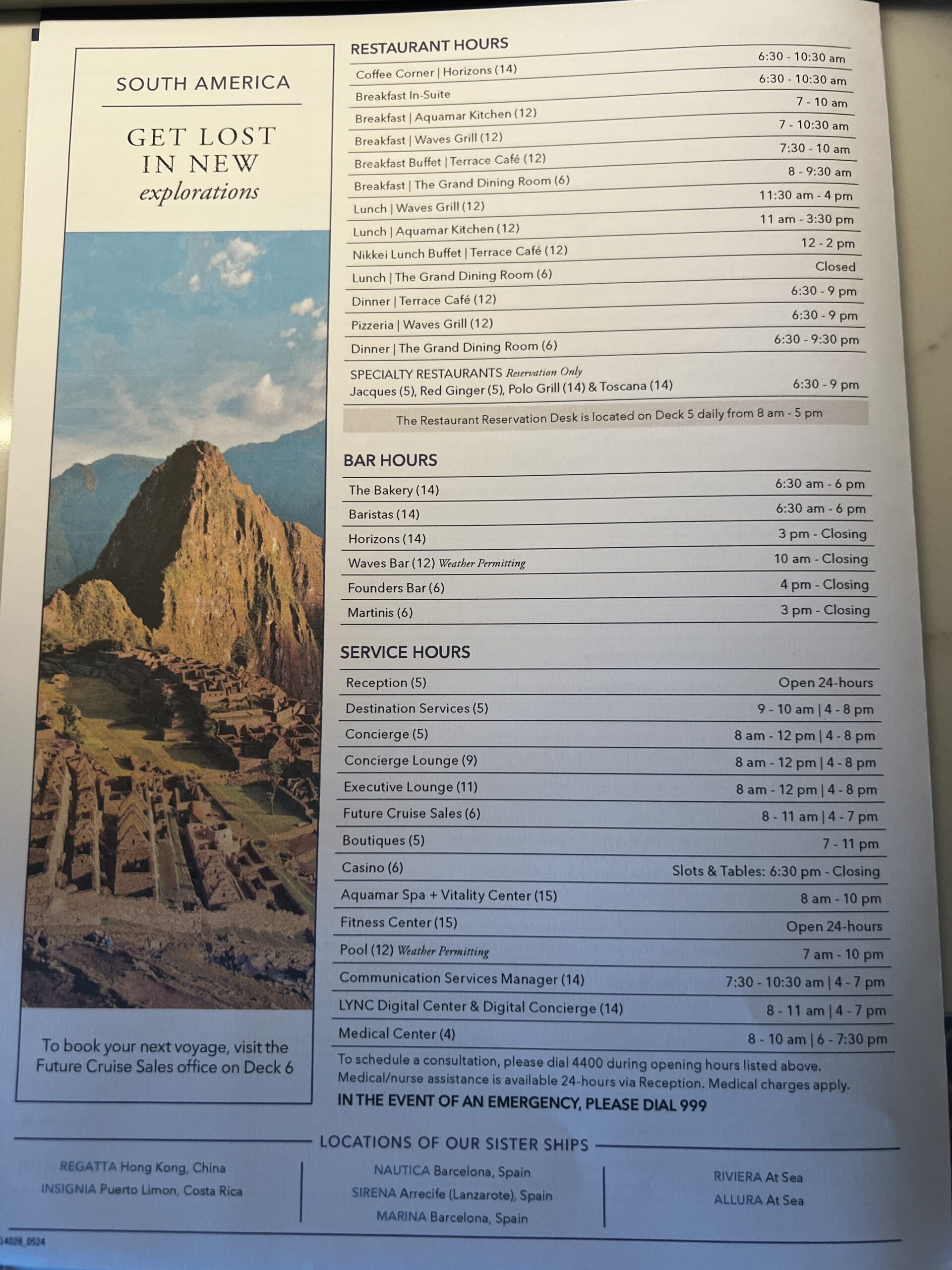
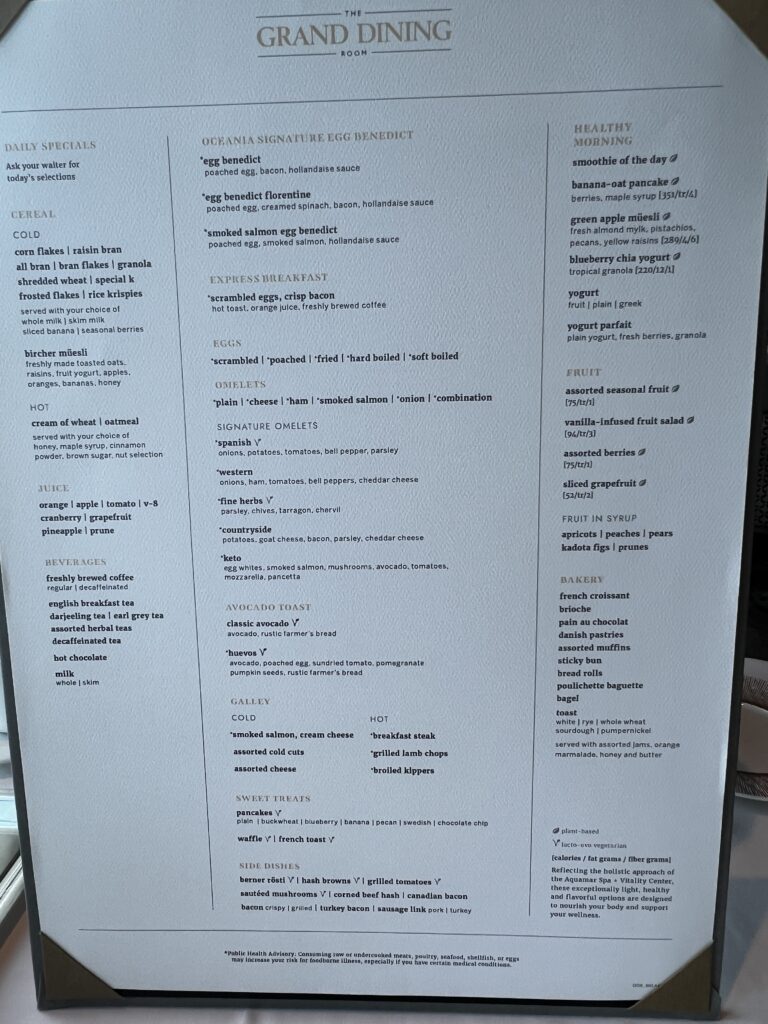
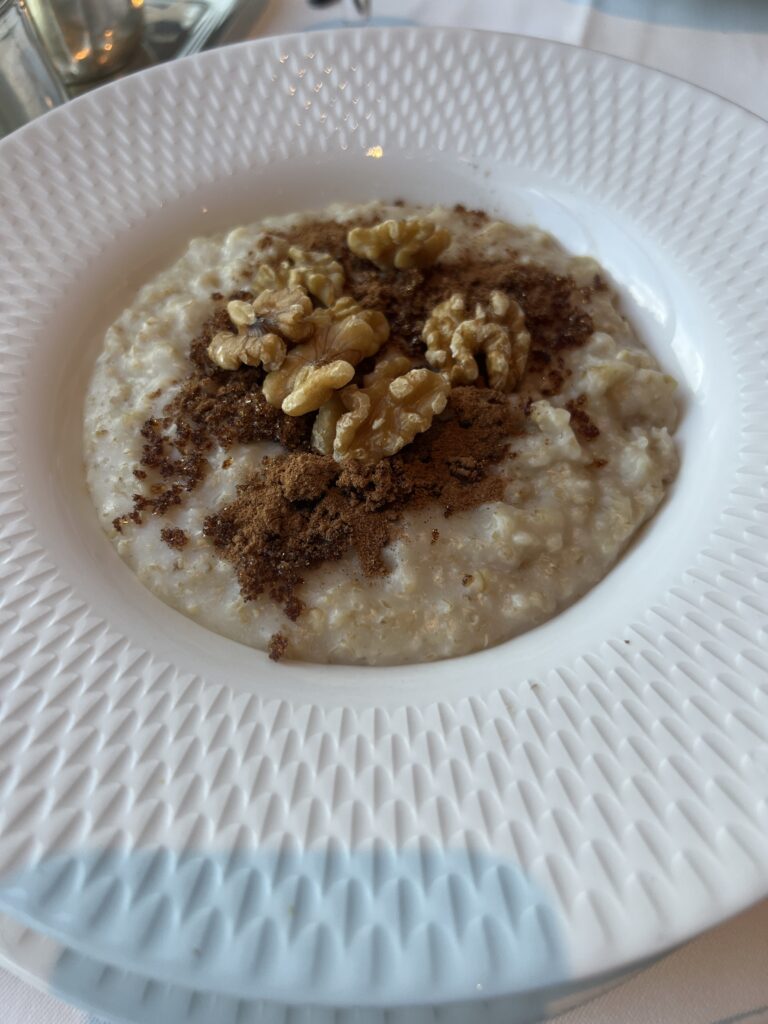
We ate in The Grand Dining Room for breakfast


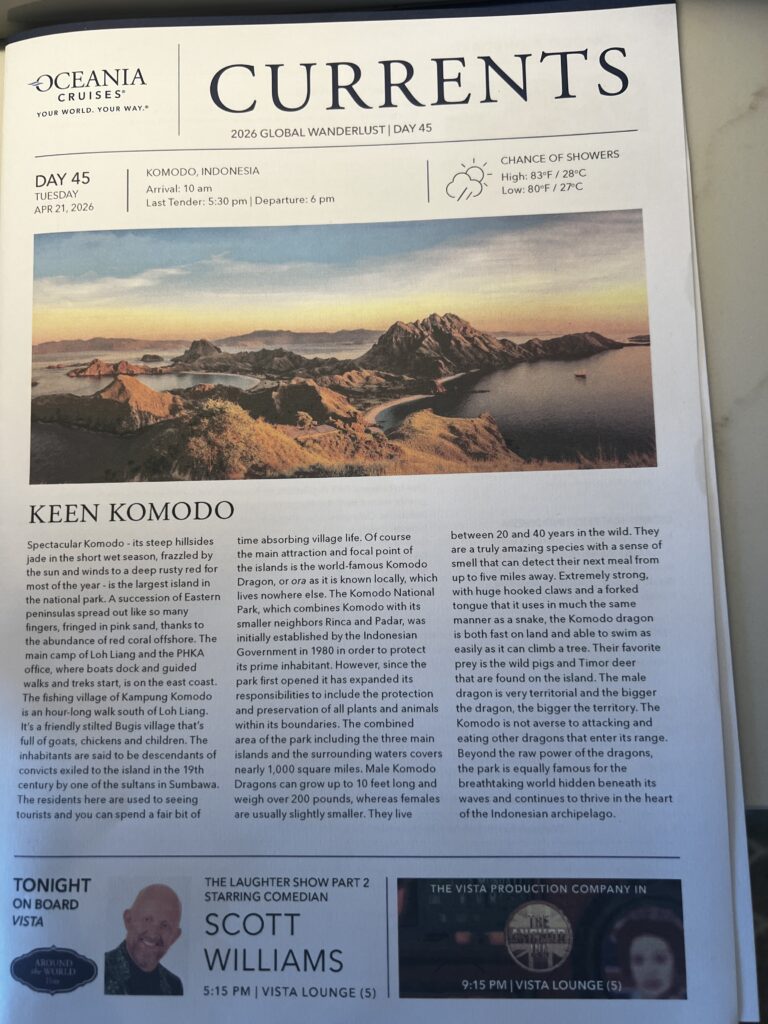
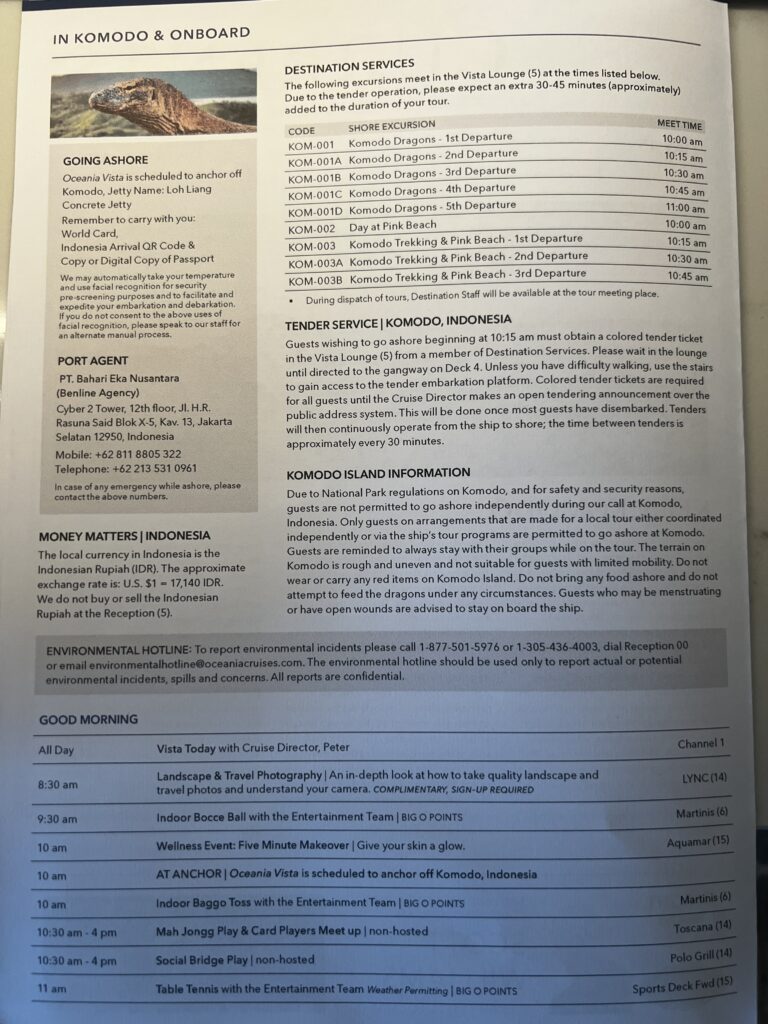
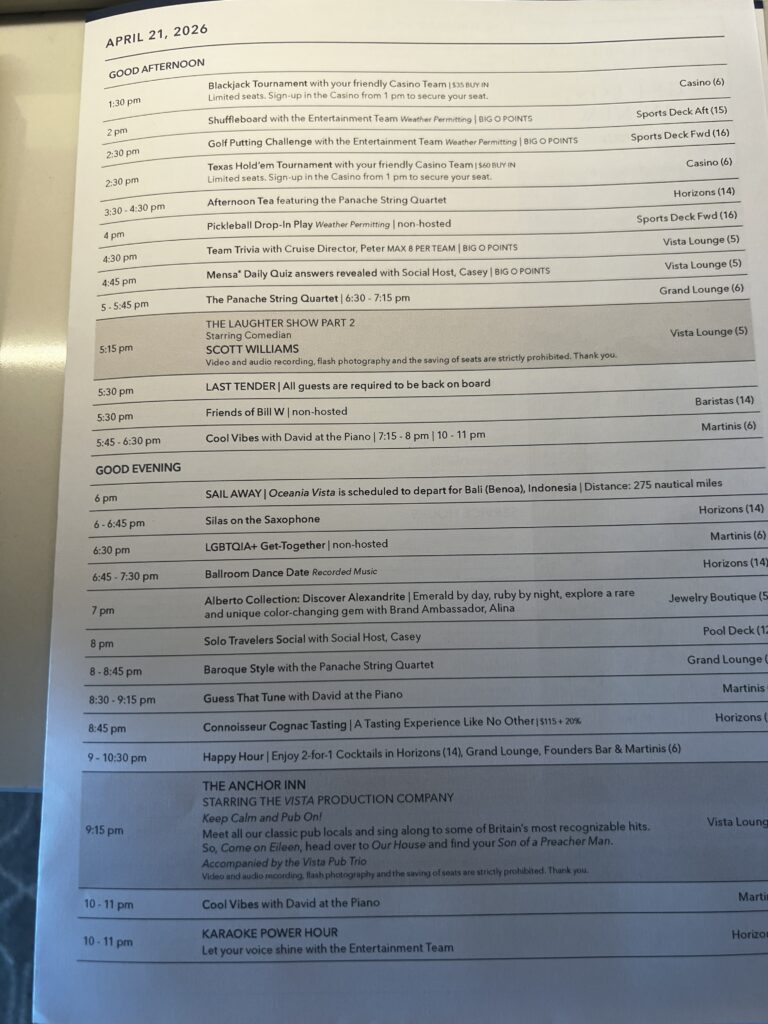
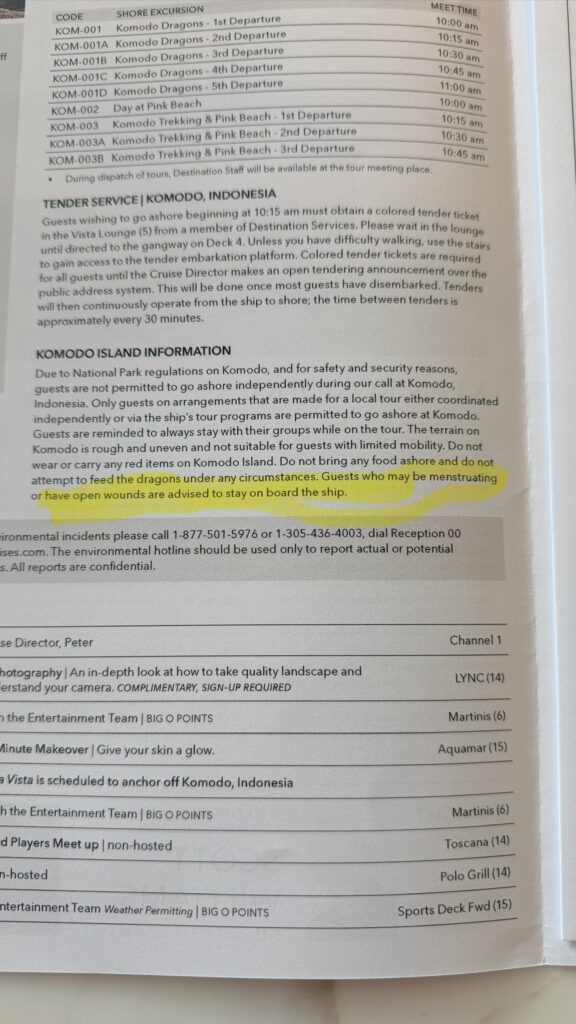
Copy of the day’s Currents with a warning about visiting the island and seeing the Komodo Dragons
Preparing the tender boat to use today to transport passengers to the island of Komodo
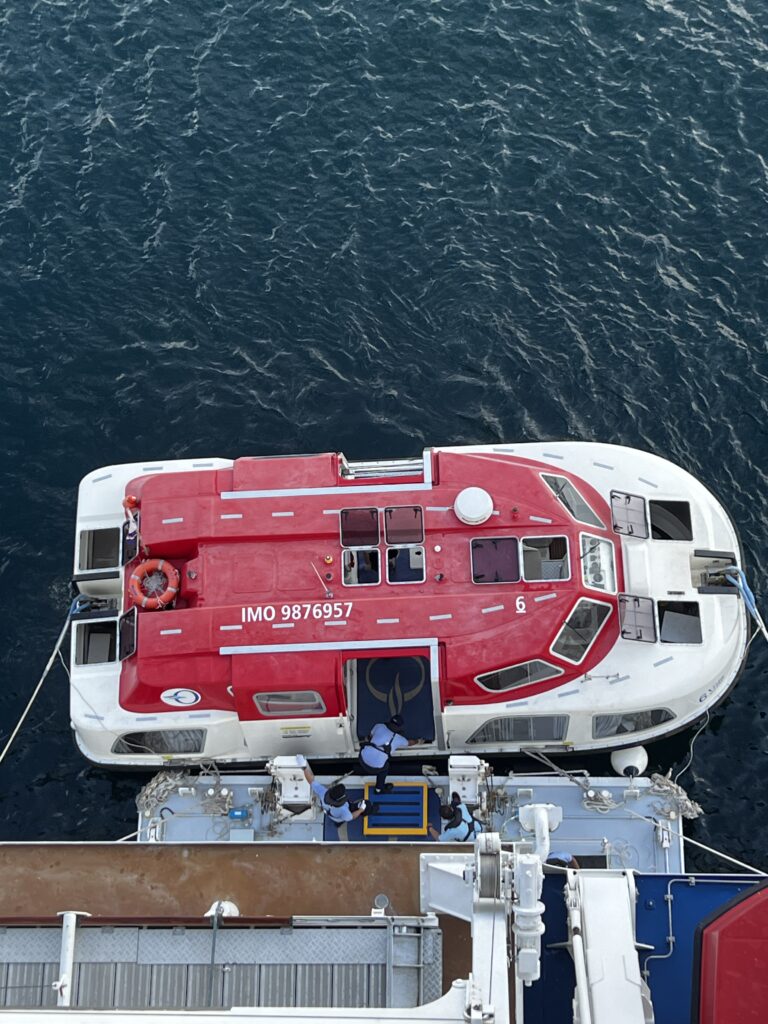
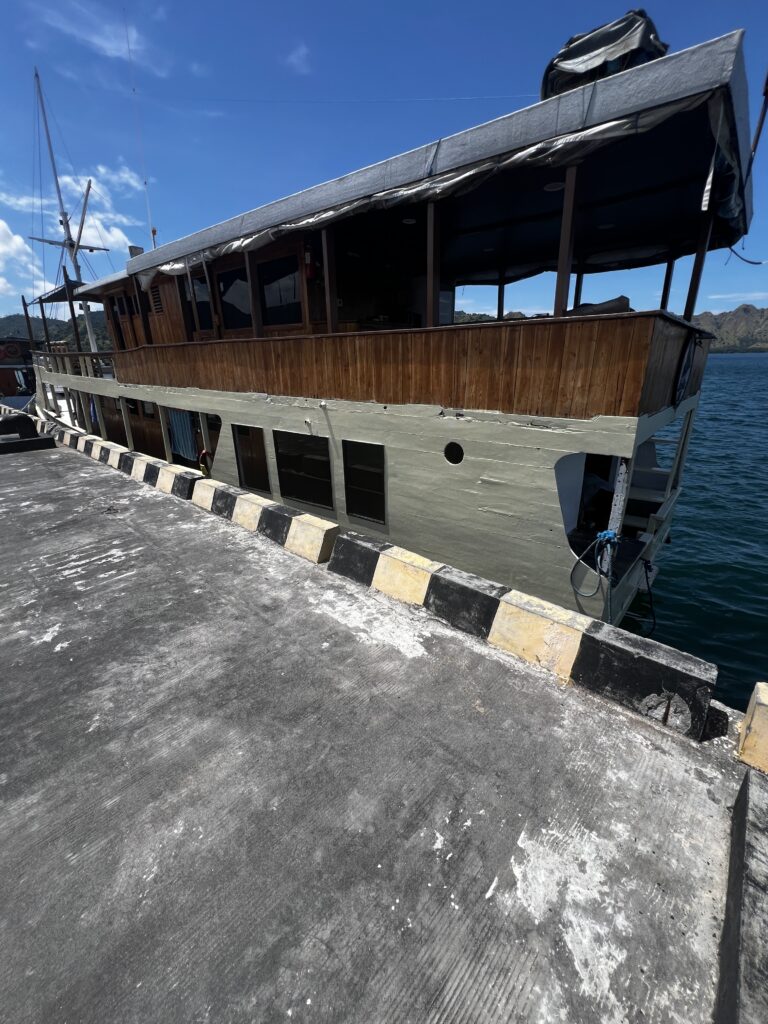
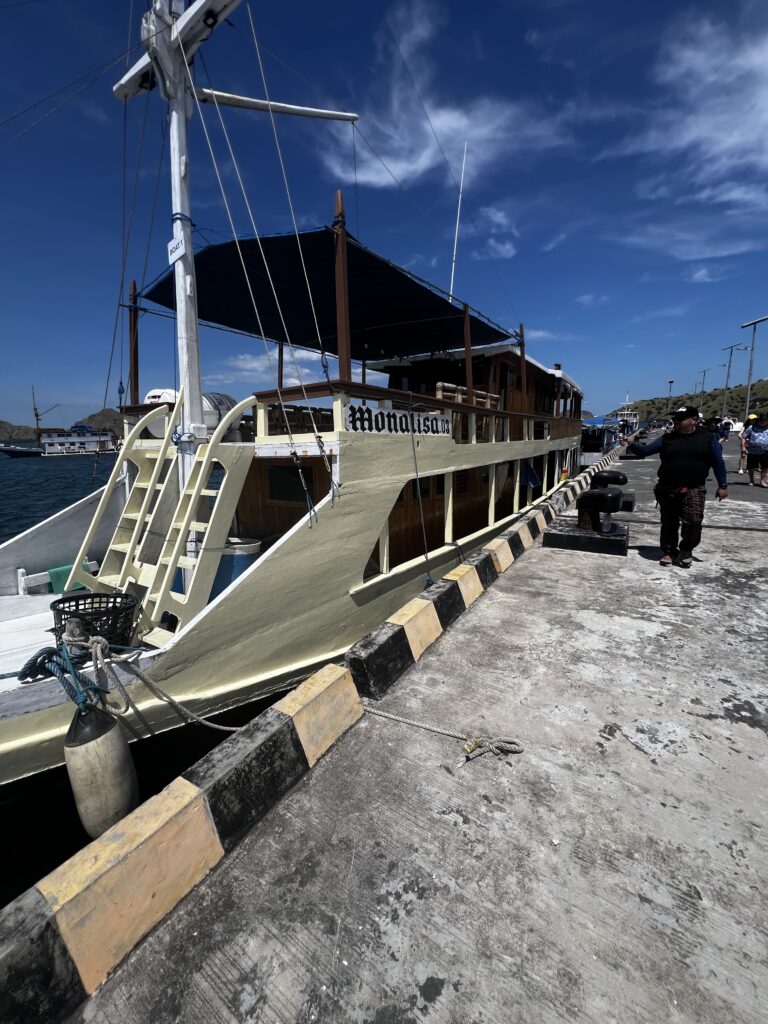
Photo of a boat that was docked at the Komodo Island Pier
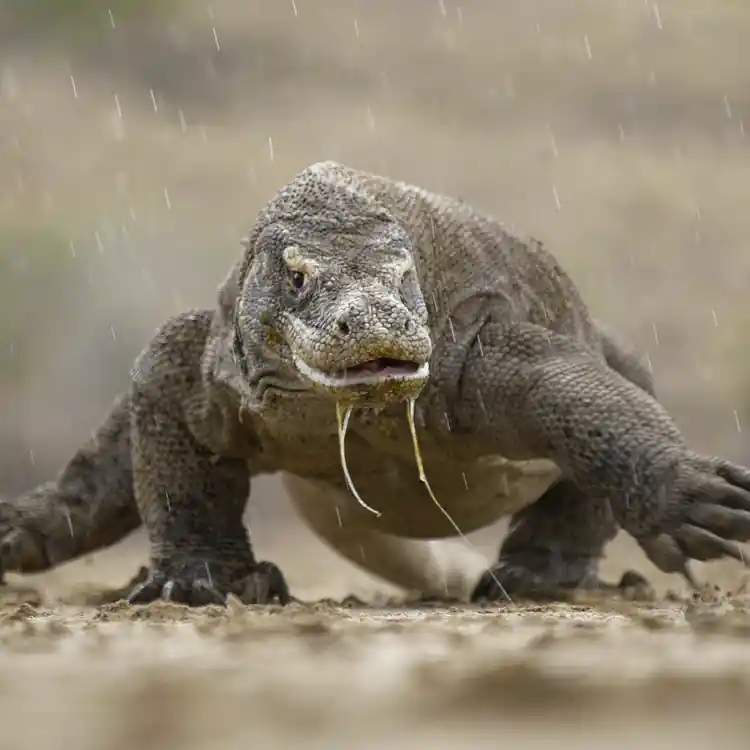
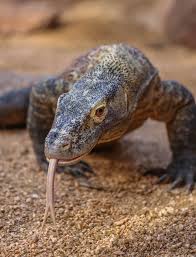
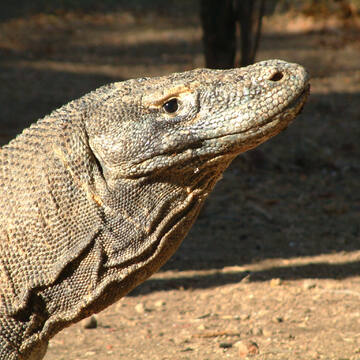
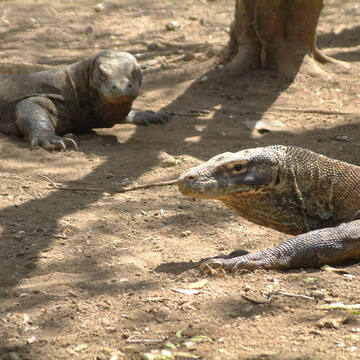
Information below from the Komodo National Park website and Wikipedia along with some stock photos from the National Park website that I had in case we did not see any Komodo Dragons.
Komodo National Park
These volcanic islands are inhabited by a population of around 5,700 giant lizards, whose appearance and aggressive behaviour have led to them being called ‘Komodo dragons’. They exist nowhere else in the world and are of great interest to scientists studying the theory of evolution. The rugged hillsides of dry savannah and pockets of thorny green vegetation contrast starkly with the brilliant white sandy beaches and the blue waters surging over coral.
Komodo National Park, located in the center of the Indonesian archipelago, between the islands of Sumbawa and Flores, is composed of three major islands (Rinca, Komodo, and Padar) and numerous smaller ones, all of them of volcanic origin. Located at the juncture of two continental plates, this national park constitutes the “shatter belt” within the Wallacea Biogeographical Region, between the Australian and Sunda ecosystems. The property is identified as a global conservation priority area, comprising unparalleled terrestrial and marine ecosystems and covers a total area of 219,322 ha. The dry climate has triggered specific evolutionary adaptation within the terrestrial flora that range from open grass-woodland savanna to tropical deciduous (monsoon) forest and quasi cloud forest. The rugged hillsides and dry vegetation highly contrast with the sandy beaches and the blue coral-rich waters.
The most remarkable inhabitant of Komodo National Park is the Komodo Lizard, Varanus komodoensis. These giant lizards, existing no-where else in the world, are of great scientific interest, especially for their evolutionary implications. Most commonly known as ‘Komodo Dragons’, due to its appearance and aggressive behavior, the Komodo Lizard, is the largest living species of lizard, growing to an average length of 2 to 3 meters. The species is the last representative of a relic population of large lizards that once lived across Indonesia and Australia. As well as being home to the Komodo dragon, the Park provides a refuge for many other notable terrestrial species such as the orange-footed scrub fowl, an endemic rat, and the Timor deer. The rich coral reefs of Komodo host a great diversity of species, and the strong currents of the sea attract the presence of sea turtles, whales, dolphins and dugongs.
Criterion (vii): Komodo National Park is a landscape of contrasts between starkly rugged hillsides of dry savanna, pockets of thorny green vegetation, brilliant white sandy beaches and blue waters surging over coral, unquestionably one of the most dramatic landscapes in all of Indonesia. Demonstrating exceptional natural beauty that is all the more remarkable as a counterpoint to the dominant lushness of vegetation which characterizes vast areas of forested Indonesia, and with which most of the world associates the archipelago. An irregular coastline characterized by bays, beaches and inlets separated by headlands, often with sheer cliffs falling vertically into the surrounding seas which are reported to be among the most productive in the world adds to the stunning natural beauty of landscapes dominated by contrasting vegetation types, providing a patchwork of colours.
Criterion (x): Komodo National Park contains the majority of the world’s areas in which wild populations of the Komodo dragon lizard still exist. The largest and heaviest of the world’s lizards, the species is widely known for its impressive size and fearsome appearance, its ability to effectively prey on large animals, and a tolerance of extremely harsh condition. The population, estimated at around 5,700 individuals is distributed across the islands of Komodo, Rinca, Gili Motong and some coastal regions of western and northern Flores.
Other fauna recorded in the park are characteristic of the Wallacean zoogeographic region with seven species of terrestrial mammal, including an endemic rat (Rattus rintjanus) and the crab-eating macaque (Macaca fascicularis) and 72 species of birds, such as the lesser sulphur-crested cockatoo (Cacatua sulphurea), the orange-footed scrub fowl (Megapodius reinwardt), and noisy friarbird (Philemon buceroides). The coral reefs fringing the coast of Komodo are diverse and luxuriant due to the clear water, intense sunlight and rapid exchange of nutrient-rich water from deeper areas of the archipelago. The marine fauna and flora are generally the same as that found throughout the Indo Pacific area, though species richness is very high, notable marine mammals include blue whale (Balaenoptera musculus) and sperm whale (Physeter catodon) as well as 10 species of dolphin, dugong (Dugong dugon) and five species of sea turtles.
Komodo National Park (Indonesian: Taman Nasional Komodo) is a national park in Indonesia located within the Lesser Sunda Islands in the border region between the provinces of East Nusa Tenggara and West Nusa Tenggara. The park includes the three larger islands Komodo, Padar and Rinca, and 26 smaller ones, with a total area of 1,733 km2 (669 sq mi), with 603 km2 (233 sq mi) of it land. The national park was founded in 1980 to protect the Komodo dragon, the world’s largest lizard. Later it was dedicated to protecting other species, including marine species. In 1991 the national park was declared a UNESCO World Heritage Site and a Man and Biosphere Reserve. It is considered one of the world’s 25 biodiversity hotspots.
Komodo National Park has been selected as one of the New 7 Wonders of Nature. The waters surrounding Komodo island contain rich marine biodiversity. Komodo islands is also a part of the Coral Triangle, which contains some of the richest marine biodiversity on Earth.
It is also a WWF Global 200 Marine Eco-region, a WWF/IUCN Centre of Plant Diversity, one of the world’s Endemic Bird Areas and an ASEAN Heritage Park.
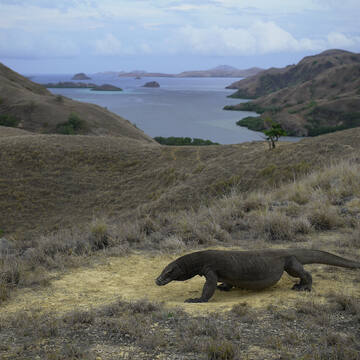
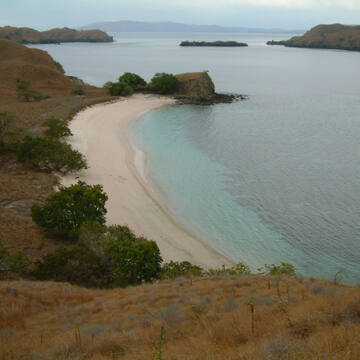
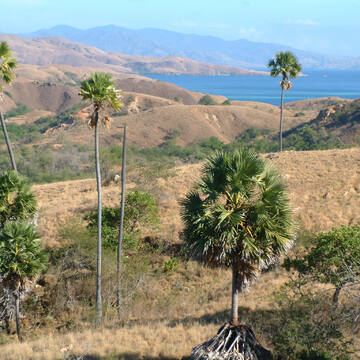
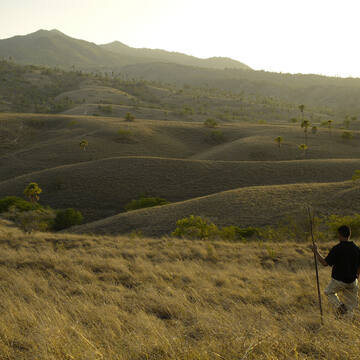
The island is entering the winter season and the rain stops and all grass and plants die making it a desert area.
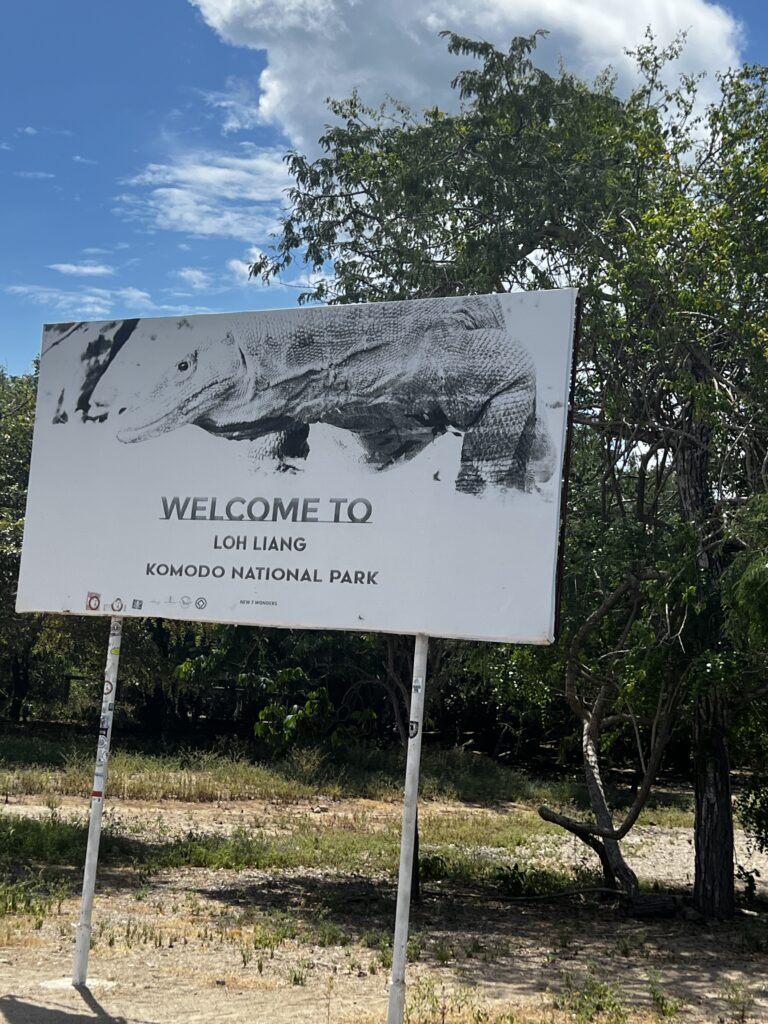
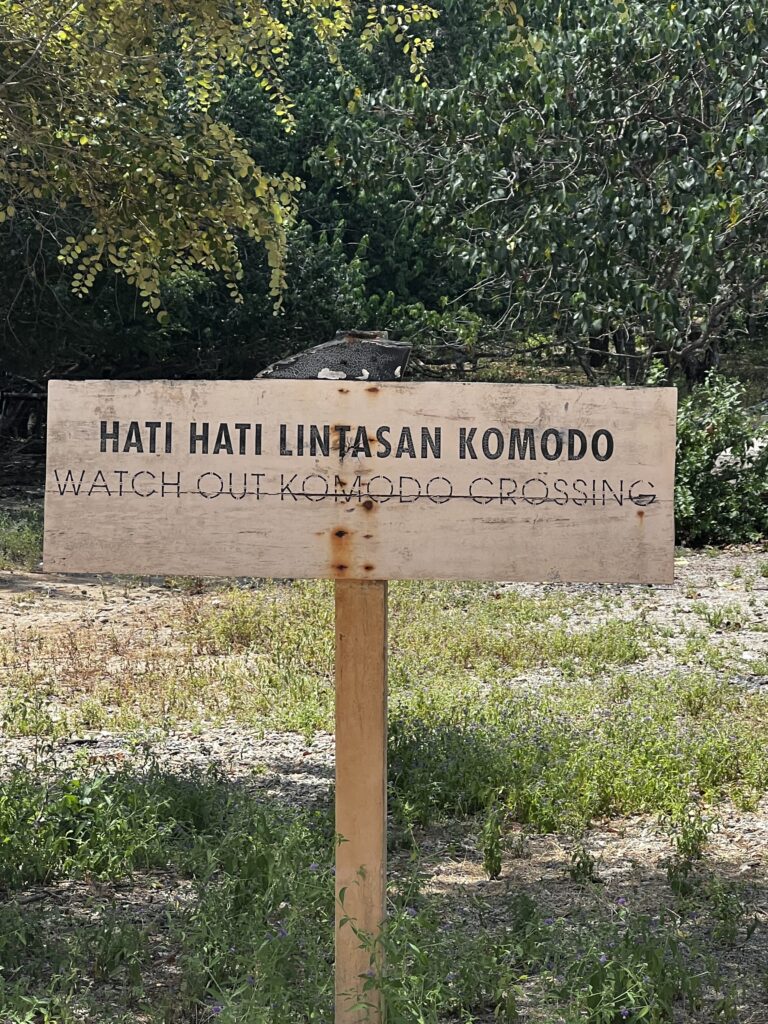
Signs that we saw once off the long pier to the land of the Komodo National Park
The land was dry and the weather was hot with a temperature that felt like 99F according to the Weather app.

Just a cute photo of a kid’s pair of clogs left behind by some steps, I am sure they were recovered later.

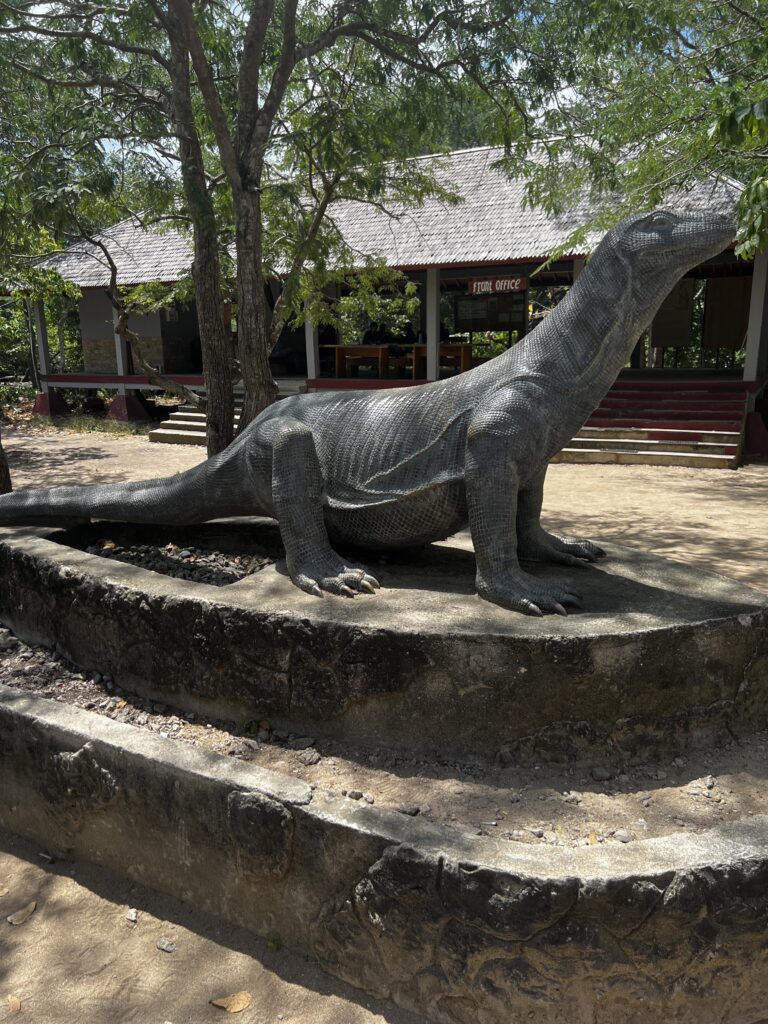
A Komodo statue at the park entrance
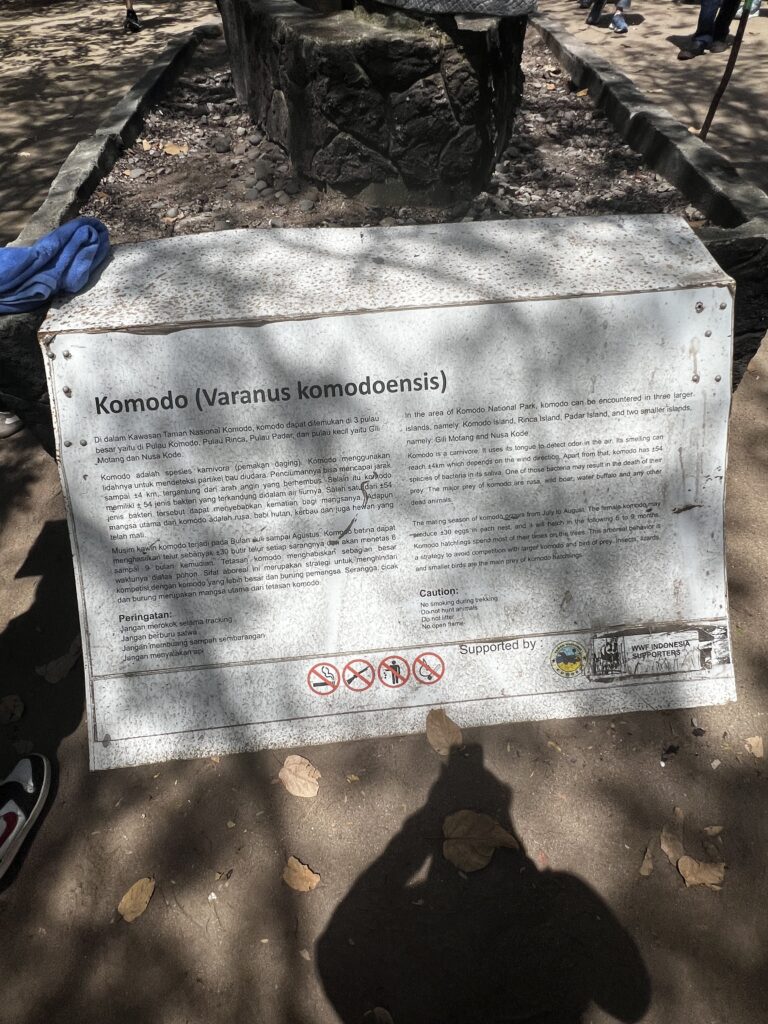
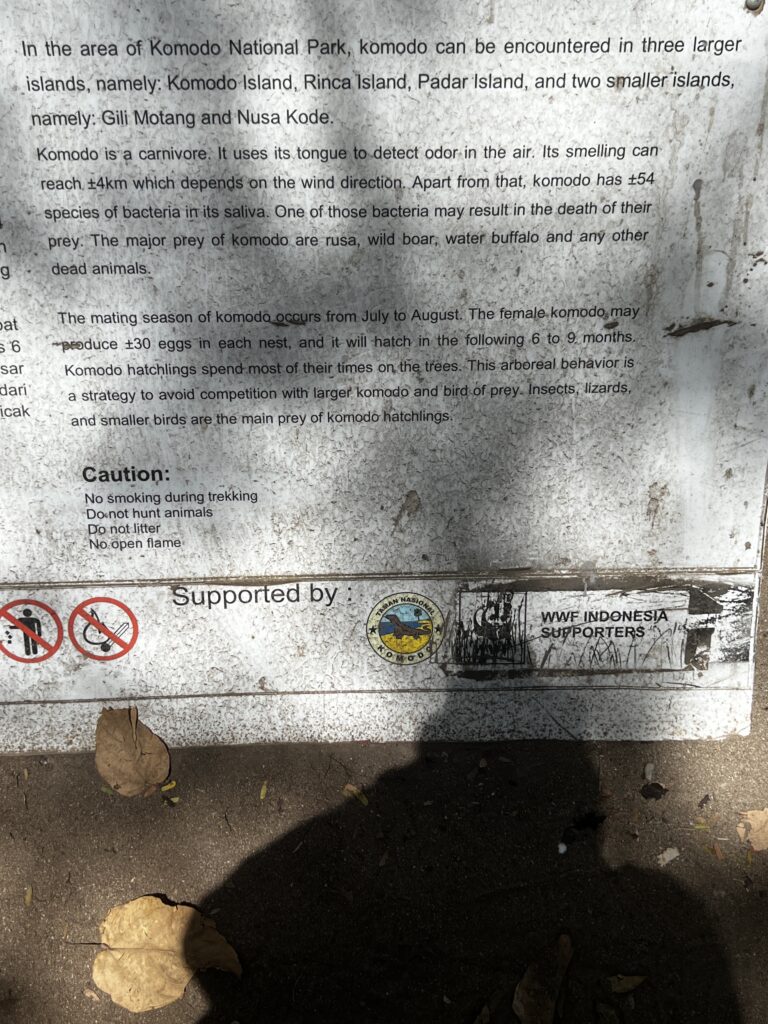
Physical Description
Komodo dragons are large lizards with long tails, strong and agile necks, and sturdy limbs. Their tongues are yellow and forked. Adults are an almost-uniform stone color with distinct, large scales, while juveniles may display a more vibrant color and pattern.
The muscles of the Komodo’s jaws and throat allow it to swallow huge chunks of meat with astonishing rapidity. Several movable joints, such as the intramandibular hinge opens the lower jaw unusually wide. The stomach expands easily, enabling an adult to consume up to 80 percent of its own body weight in a single meal, which most likely explains some exaggerated claims for immense weights in captured individuals. When threatened, Komodos can throw up the contents of their stomachs to lessen their weight in order to flee.
Although males tend to grow larger and bulkier than females, no obvious morphological differences mark the sexes. One subtle clue does exist: a slight difference in the arrangement of scales just in front of the cloaca. Sexing Komodos remains a challenge for human researchers; the dragons themselves appear to have little trouble figuring out who is who.
Size
The Komodo dragon is the largest living lizard in the world. These wild dragons typically weigh about 154 pounds (70 kilograms), but the largest verified specimen reached a length of 10.3 feet (3.13 meters) and weighed 366 pounds (166 kilograms). Males tend to grow larger and bulkier than females.
Native Habitat
Komodo dragons are limited to a few Indonesian islands of the Lesser Sunda group, including Rintja, Padar and Flores, and of course the island of Komodo, the largest at 22 miles (35 kilometers) long. They have not been seen on the island of Padar since the 1970s.
They live in tropical savanna forests but range widely over the islands, from beach to ridge top.
Lifespan
Komodo dragons live about 30 years in the wild, but scientists are still studying this.
Food/Eating Habits
Komodo dragons eat almost any kind of meat, scavenging for carcasses or stalking animals that range in size from small rodents to large water buffalo. Young feed primarily on small lizards and insects, as well as snakes and birds. If they live to be 5 years old, they move onto larger prey, such as rodents, monkeys, goats, wild boars and deer (the most popular meal). These reptiles are tertiary predators at the top of their food chain and are also cannibalistic.
Although the Komodo dragon can briefly reach speeds of 10 to 13 mph (16 to 20 kph), its hunting strategy is based on stealth and power. It can spend hours in one spot along a game trail — waiting for a deer or other sizable and nutritious prey to cross its path — before launching an attack.
Most of the monitor’s attempts at bringing down prey are unsuccessful. However, if it is able to bite its prey, bacteria and venom in its saliva will kill the prey within a few days. After the animal dies, which can take up to four days, the Komodo uses its powerful sense of smell to locate the body. A kill is often shared between many Komodo dragons.
Monitors can see objects as far away as 985 feet (300 meters), so vision does play a role in hunting, especially as their eyes are better at picking up movement than at discerning stationary objects. Their retinas possess only cones, so they may be able to distinguish color but have poor vision in dim light. They have a much smaller hearing range than humans and, as a result, cannot hear sounds like low-pitched voices or high-pitched screams.
The Komodo dragon’s sense of smell is its primary food detector. It uses its long, yellow, forked tongue to sample the air. It then moves the forked tip of its tongue to the roof of its mouth, where it makes contact with the Jacobson’s organs. These chemical analyzers “smell” prey, such as a deer, by recognizing airborne molecules. If the concentration of molecules present on the left tip of the tongue is greater than that sample from the right, the Komodo dragon knows that the deer is approaching from the left.
This system, along with an undulatory walk, in which the head swings from side to side, helps the dragon sense the existence and direction of food. At times, these reptiles can smell carrion, or rotting flesh, up to 2.5 miles (4 kilometers) away.
This lizard’s large, curved and serrated teeth are its deadliest weapon, tearing flesh with efficiency. The tooth serrations hold bits of meat from its most recent meal, and this protein-rich residue supports large numbers of bacteria. Some 50 different bacterial strains, at least seven of which are highly septic, have been found in the saliva. Researchers have also documented a venom gland in the dragon’s lower jaw. In addition to the harmful bacteria, the venom prevents the blood from clotting, which causes massive blood loss and induces shock.
The Komodo’s bite may be deadly, but not to another Komodo dragon. Those wounded while sparring with each other appear to be unaffected by the bacteria and venom. Scientists are searching for antibodies in Komodo dragon blood that may be responsible.
The lizard’s throat and neck muscles allow it to rapidly swallow huge chunks of meat. Several movable joints, such as the intramandibular hinge, open its lower jaw unusually wide. The dragon’s stomach also easily expands, enabling an adult to consume up to 80 percent of its own body weight in a single meal. When threatened, Komodo dragons can throw up the contents of their stomachs to lessen their weight in order to flee.
Komodo dragons are efficient eaters, leaving behind only about 12 percent of their prey. They eat bones, hooves and sections of hide, as well as intestines (after swinging them to dislodge their contents).
Sleep Habits
They escape the heat of the day and seek refuge at night in burrows that are just barely large enough for them.
Social Structure
Because large Komodos cannibalize young ones, the young often roll in fecal material, thereby assuming a scent that the large dragons are programmed to avoid. Young dragons also undergo rituals of appeasement, with the smaller lizards pacing around a feeding circle in a stately ritualized walk. Their tail is stuck straight out and they throw their body from side to side with exaggerated convulsions.
Reproduction and Development
Determining the sex of a Komodo dragon is challenging for researchers, as no obvious morphological differences distinguish males from females. One subtle clue is a slight difference in the arrangement of scales just in front of the cloaca. Courtship opportunities arise when groups assemble around carrion to feed, and mating occurs between May and August.
Dominant males compete for females in ritual combat. Using their tails for support, they wrestle in upright postures, grabbing each other with their forelegs as they attempt to throw the opponent to the ground. Blood is often drawn, and the loser either runs away or remains prone and motionless.
Females lay about 30 eggs in depressions dug on hill slopes or within the pilfered nests of megapodes — large, chicken-like birds that make nests of heaped earth mixed with twigs that may be as long as 3 feet (1 meter) in height and 10 feet (3 meters) across.
Delays in egg laying may occur, which could help the clutch avoid the brutally hot months of the dry season. Additionally, unfertilized eggs may have a second chance with subsequent mating. While the eggs incubate in the nest for about nine months, the female may lay on the nest to protect the eggs. No evidence of parental care for newly hatched Komodos exists.
The hatchlings weigh less than 3.5 ounces (100 grams) and average 16 inches (40 centimeters) in length. Their early years are precarious, and they often fall victim to predators, including other Komodo dragons. At 5 years old, they weigh about 55 pounds (25 kilograms) and average 6.5 feet (2 meters) long. At this time, they begin to hunt larger prey. They continue to grow slowly throughout their lives.
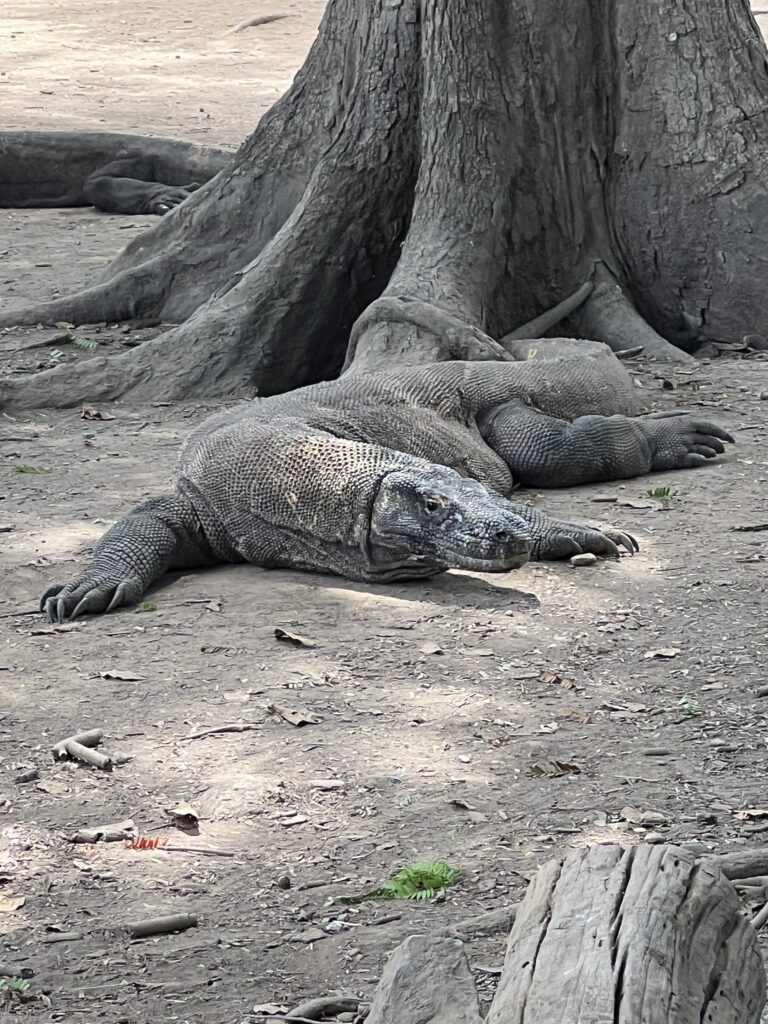
After walking for about 30 minutes with a few stops along the way for people to rest we saw our first Komodo Dragon at a watering hole.
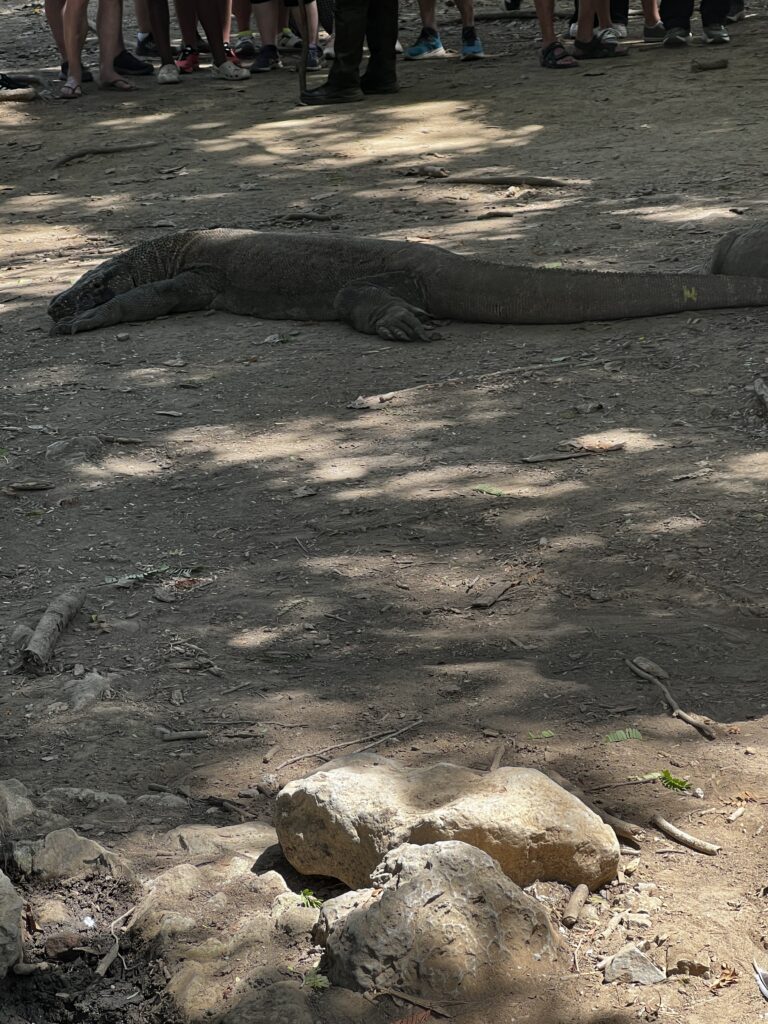
There was a second dragon laying nearby. We stayed at this location for about 20 minutes with the only dragon movement was one of them picking up its head.
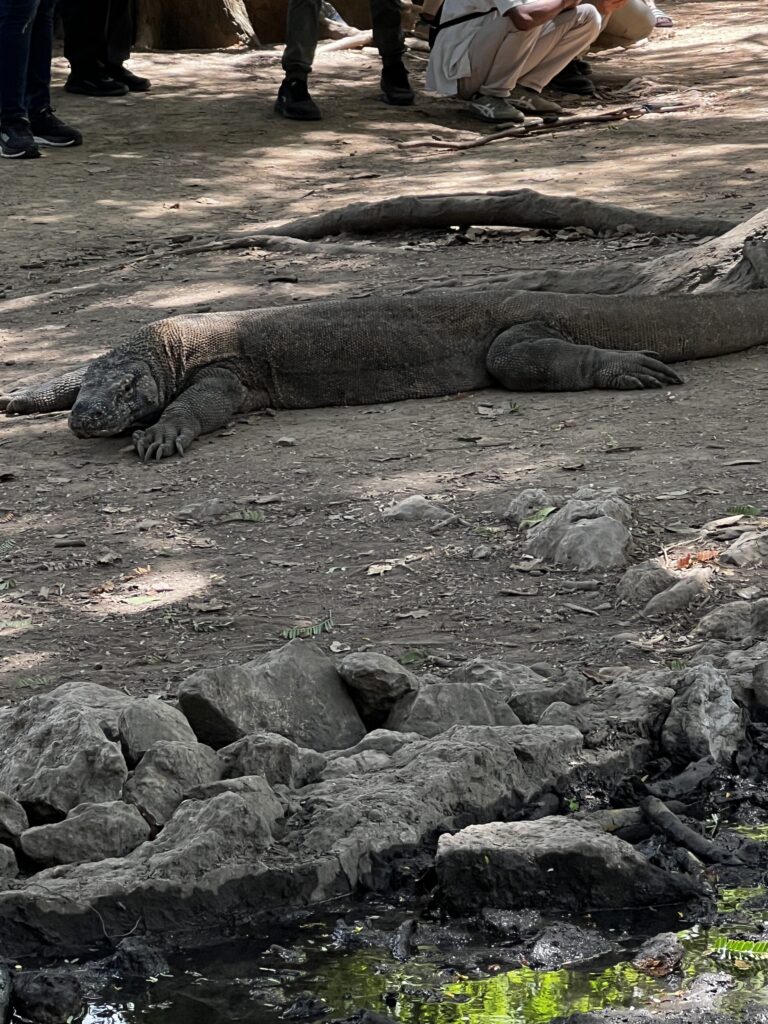
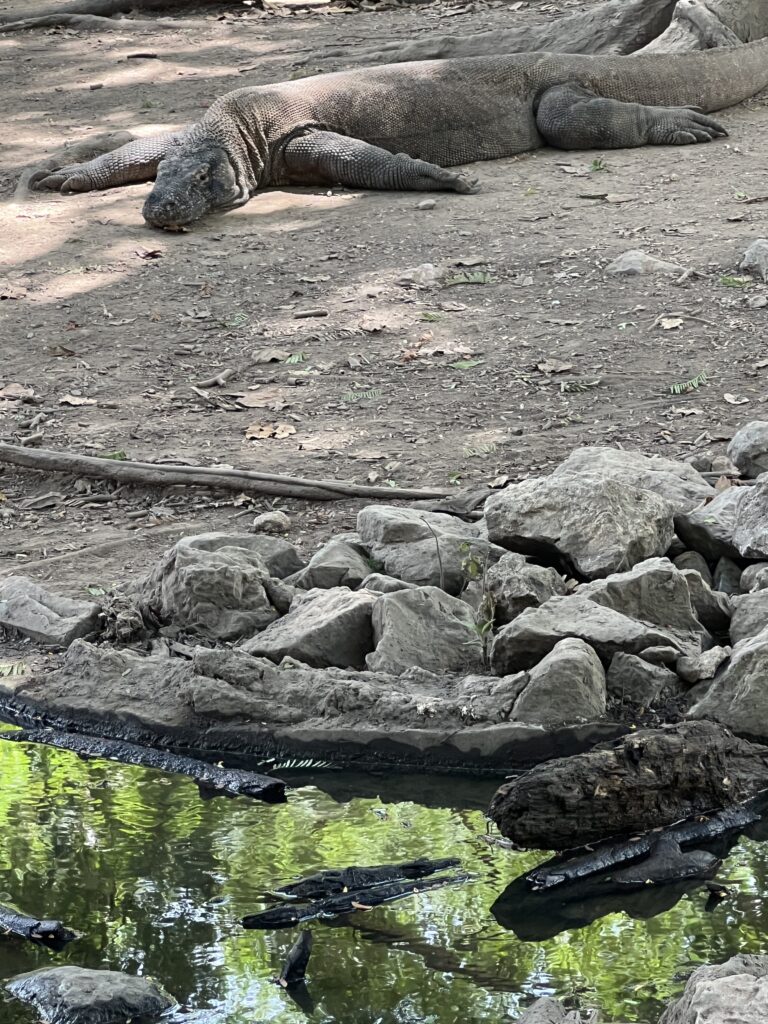
Yes, we are really brave… laughing. We are still about 15-20 feet away from the Komodo Dragon
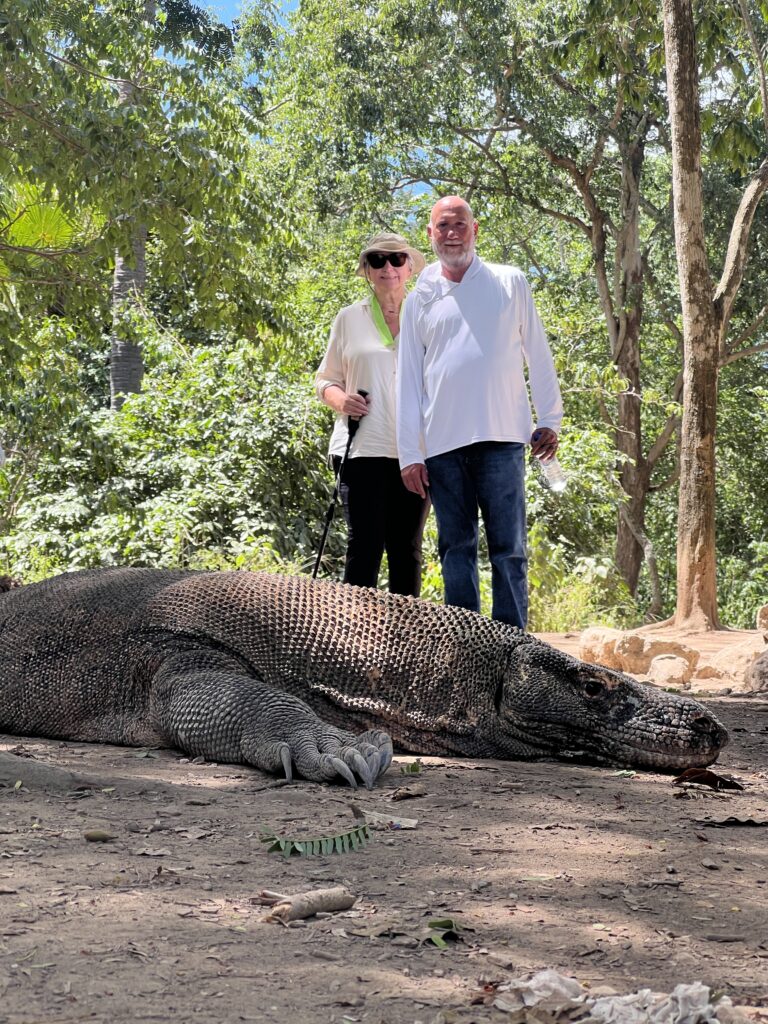
This one picked up his head and the only movement we saw to make us know these were not Disney animations. But I do not know as the Disney animations are pretty good.
Earlier excursion groups saw much more movement from the dragons, but we were in the last group, and we saw them just resting in the hot day.
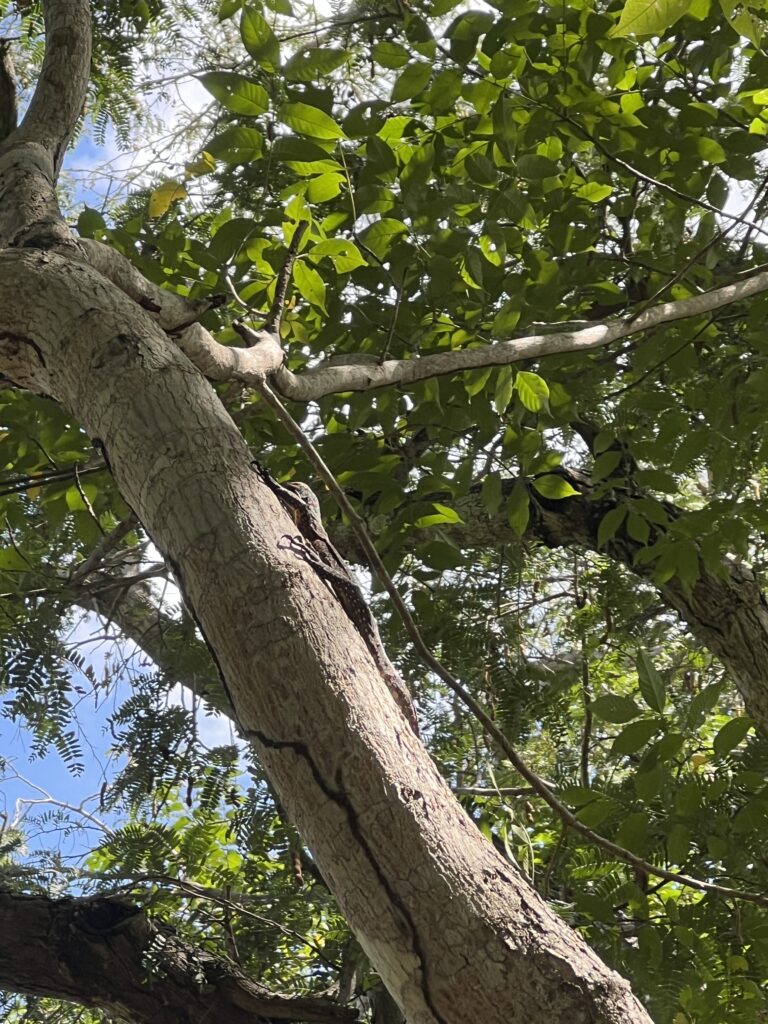
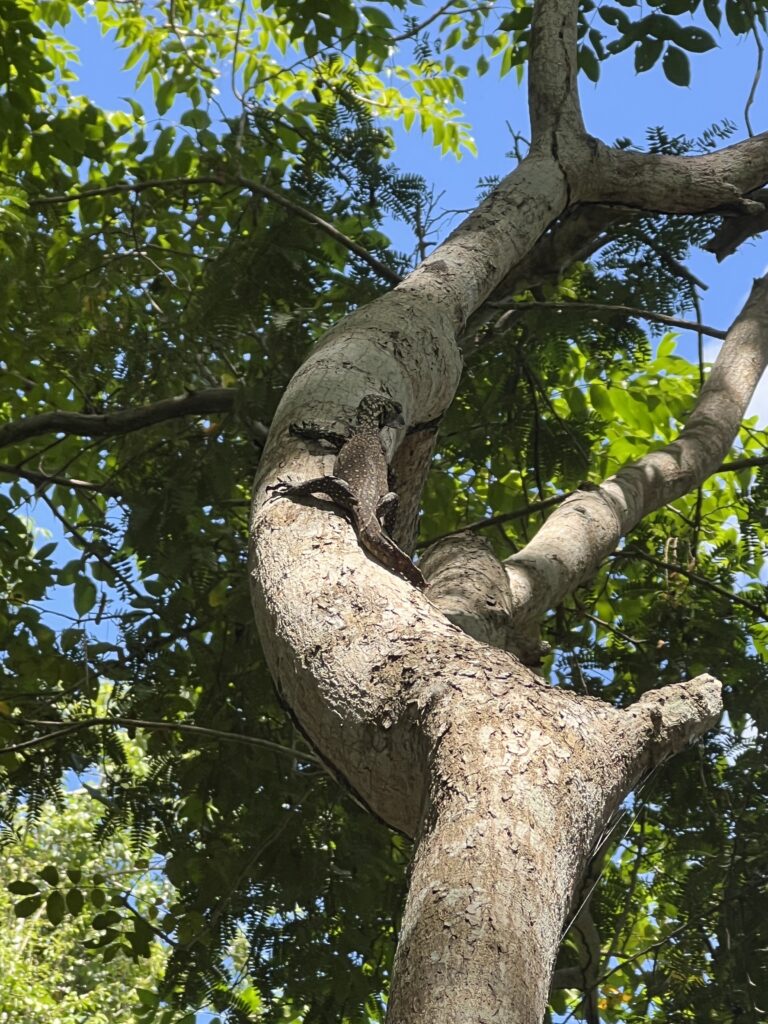
By this time, the one hour of heat took its toll and we opted out of the next hour of the excursion and headed back to the ship. On the way back we caught this small Komodo Lizard up in a tree. The small Komodo Lizards spend most of their time in the trees as protection against the adult lizards who will eat the small ones if they catch it.
Exhausted from the heat we got back to the ship and cabin and slept from 3pm to 8pm tonight, then went to the Terrace Cafe for dinner.
Jackie had a grilled chicken breast with mashed potatoes

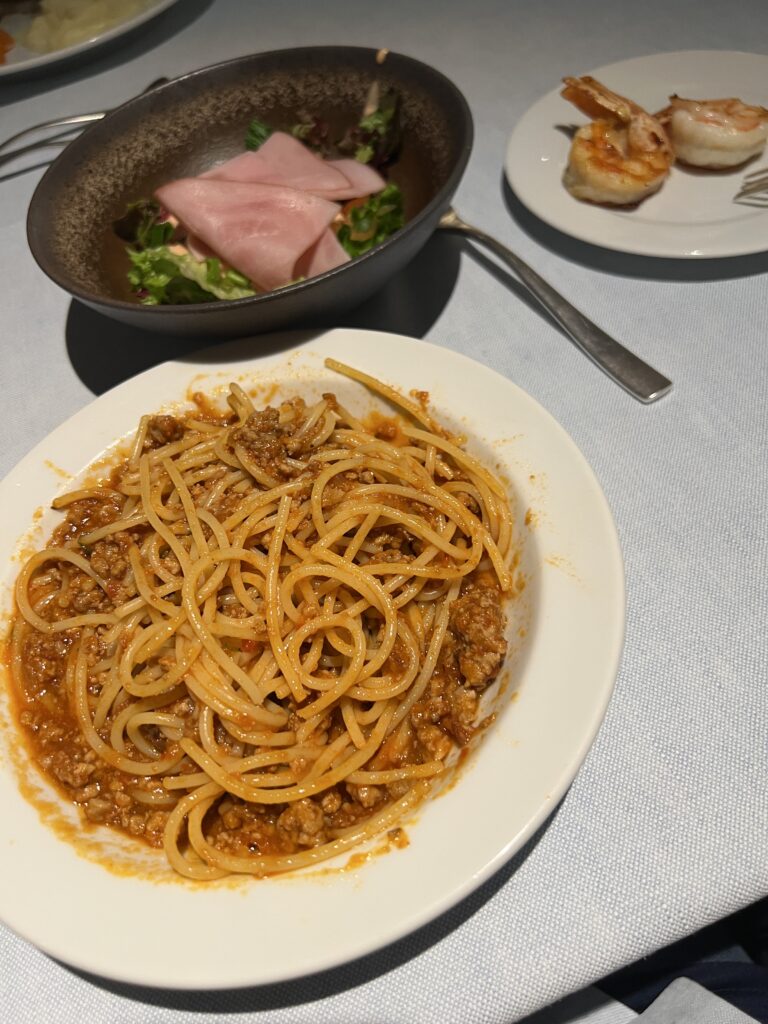
Lane had a couple of grilled shrimp, salad and spaghetti bolognese
Tomorrow is Benoa, Bali. We have an overnight stay with a guide to visit temples and other locations in the countryside.



2 thoughts on “Day 46 April 21 – Komodo, Indonesia”
Interesting info and pictures. I will pass on those Komodo dragons. Eek! They would terrify me, especially after reading about the strength of their jaws and neck.
It was interesting to learn about their hunting processes. They just lay still in the woods and wait for an animal to pass by and will bite the animal and inject the venom that might take a few days to kill the prey. Then the dragon will smell where the animal now lays dead and a group will eat on the animal. I believe the guide told us the dragons only eat once a month.