
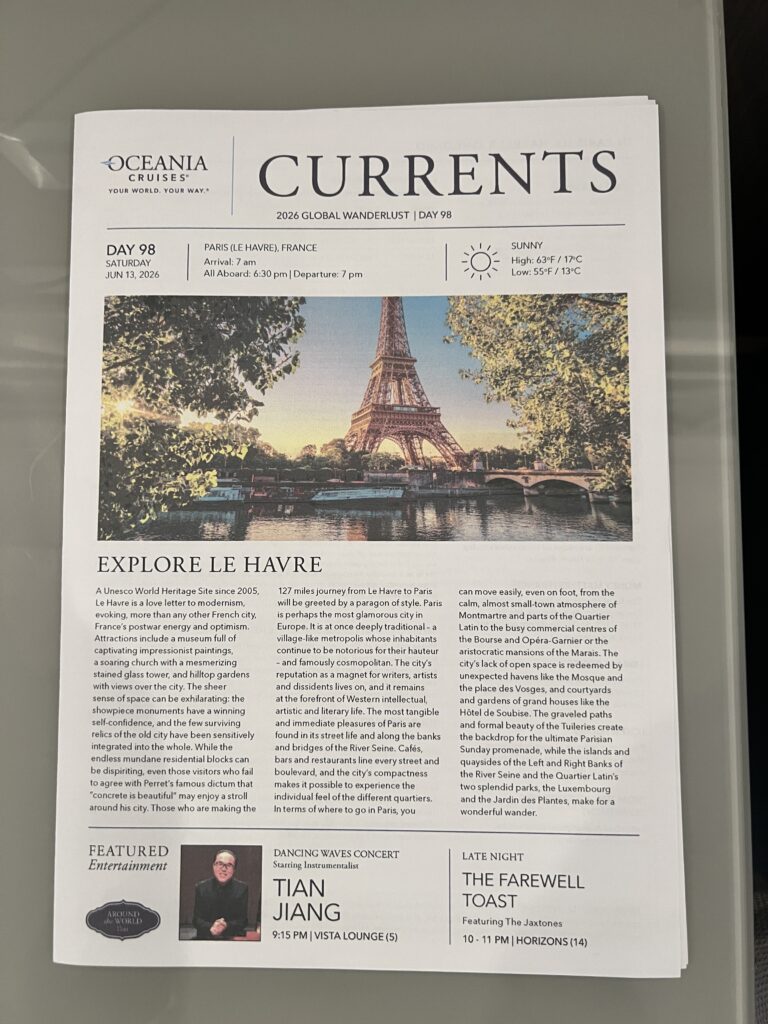
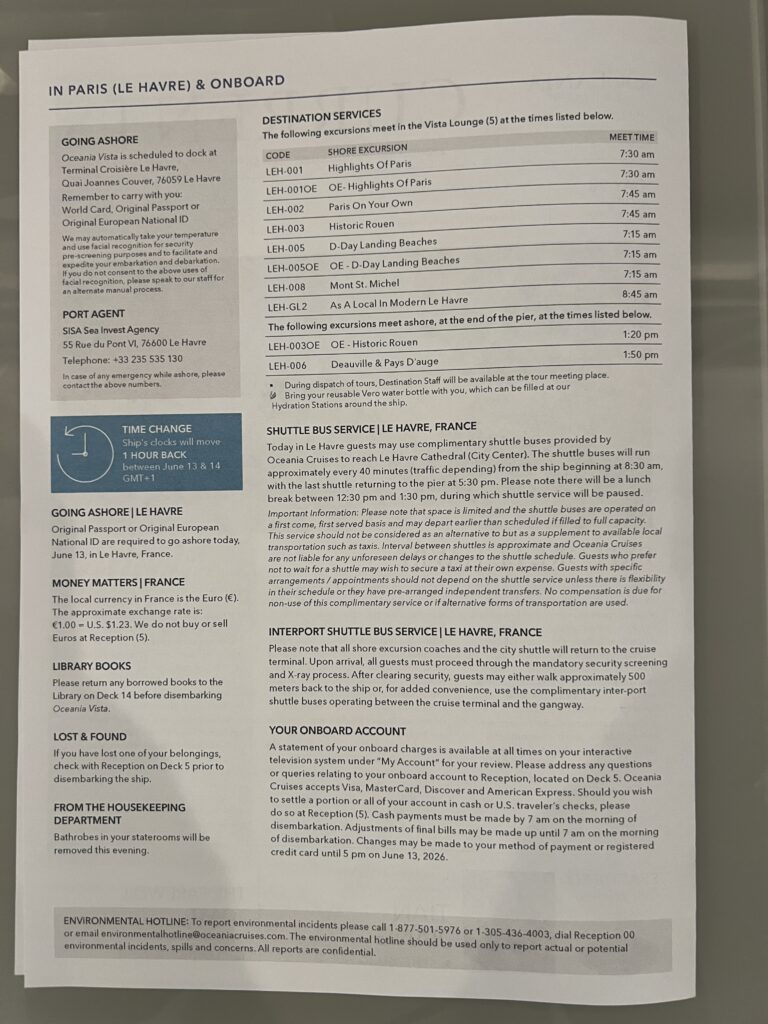
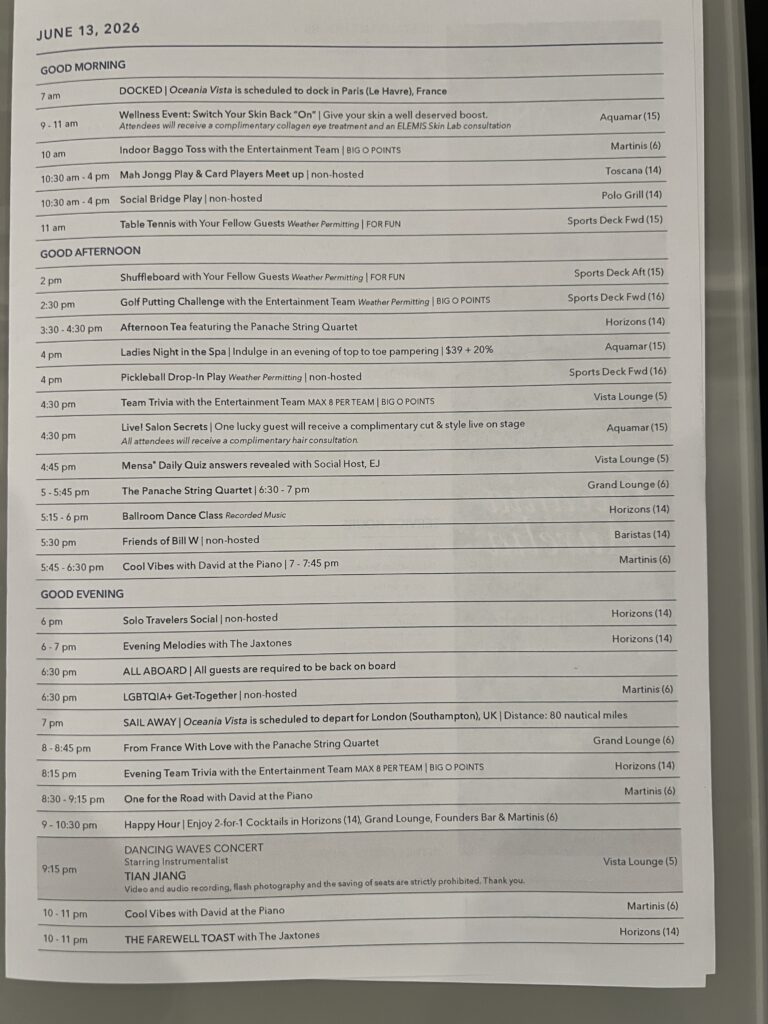
Day 98 Saturday June 13th (22 days to go) — Today we took an Oceania excursion to the city of Rouen. The majority of the ship took excursions to Paris or Normandy, but we have been to both locations previously and have never visited Rouen. The main thing we were hoping to visit was the Cathedral in Rouen. Our excursion consisted of a 90-minute drive to Rouen, a walking tour of 90 minutes, 30 minutes on our own and then a 90-minute drive back to the ship.
The day was a good one although the time in Rouen was short. The city looked to be a fun place to visit for more than one day. Definitely will be added to the list of places that we need to visit again one day.


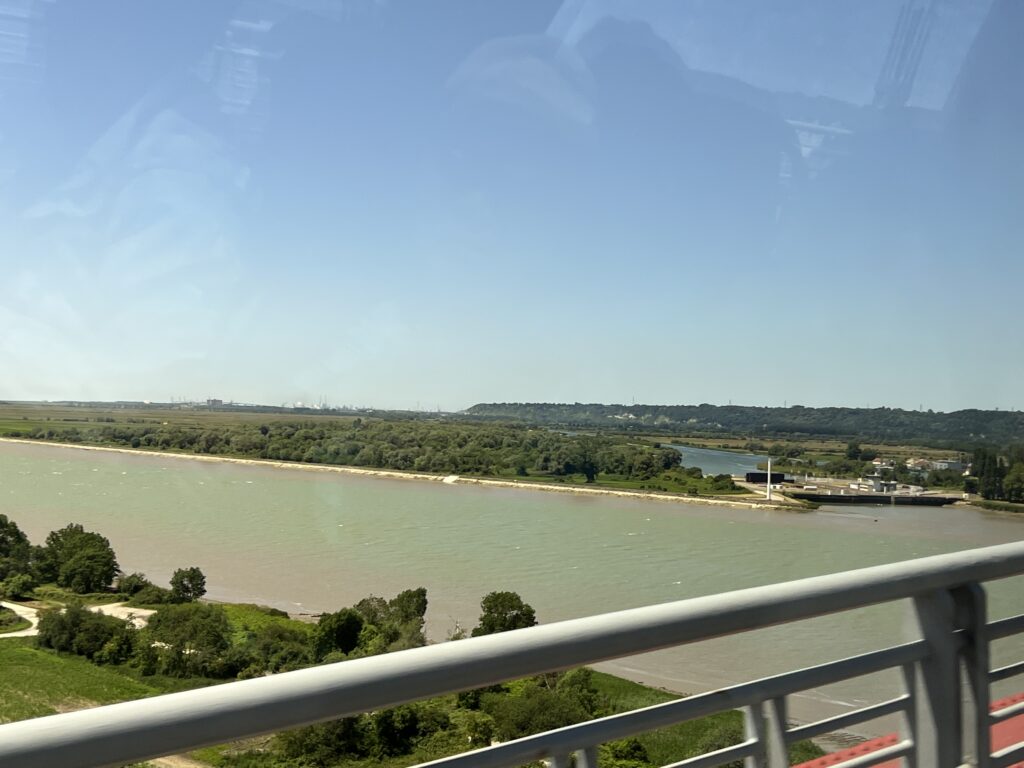
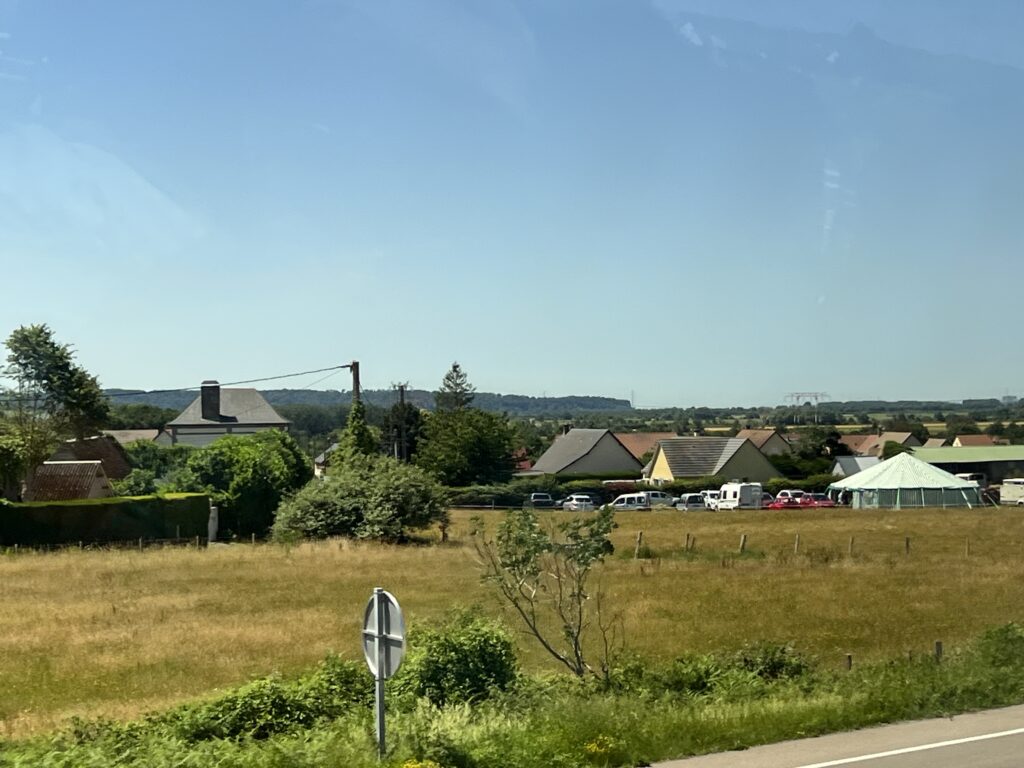
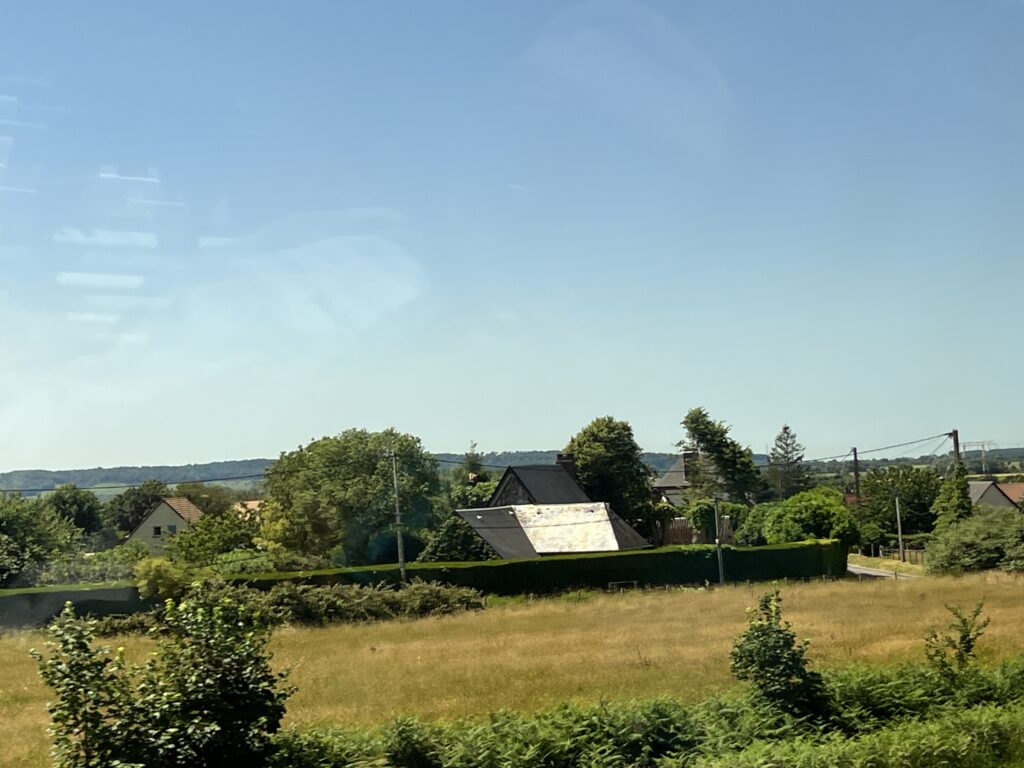
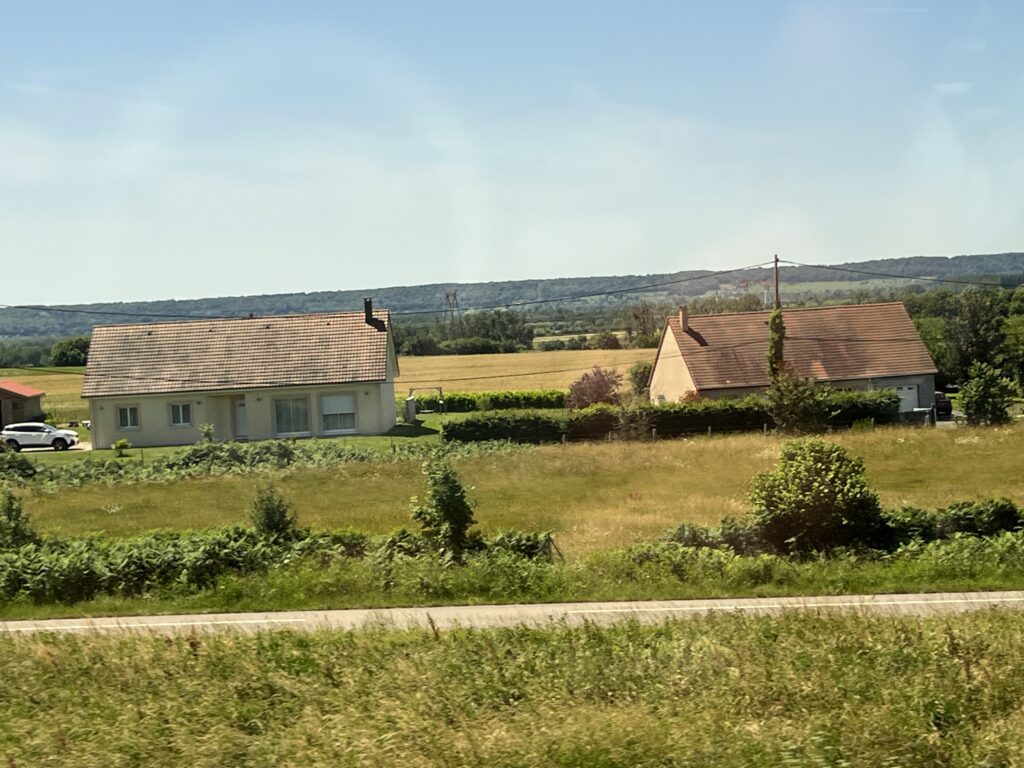
Views of the countryside driving from Le Havre to Rouen
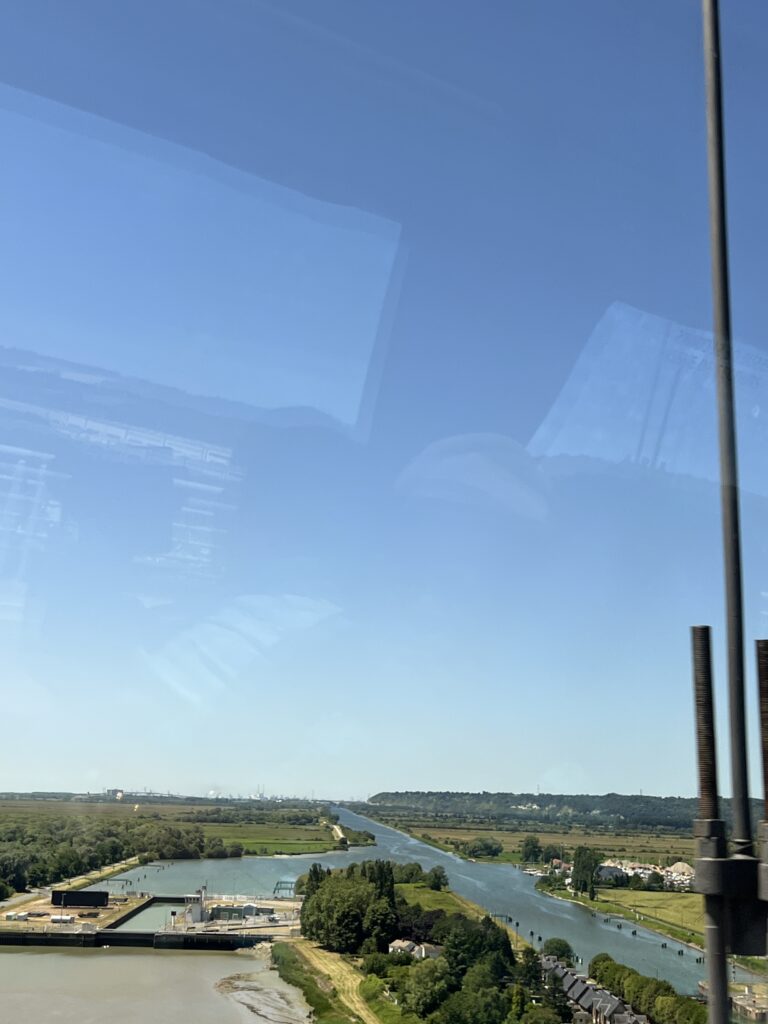
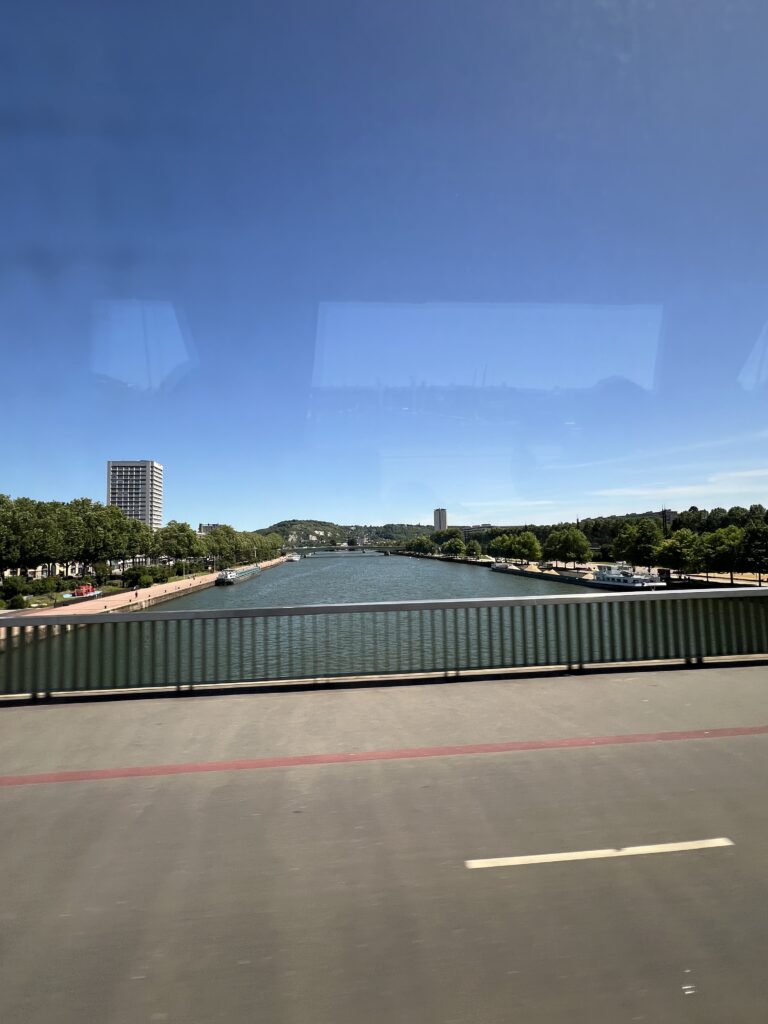
La Seine River outside of Rouen
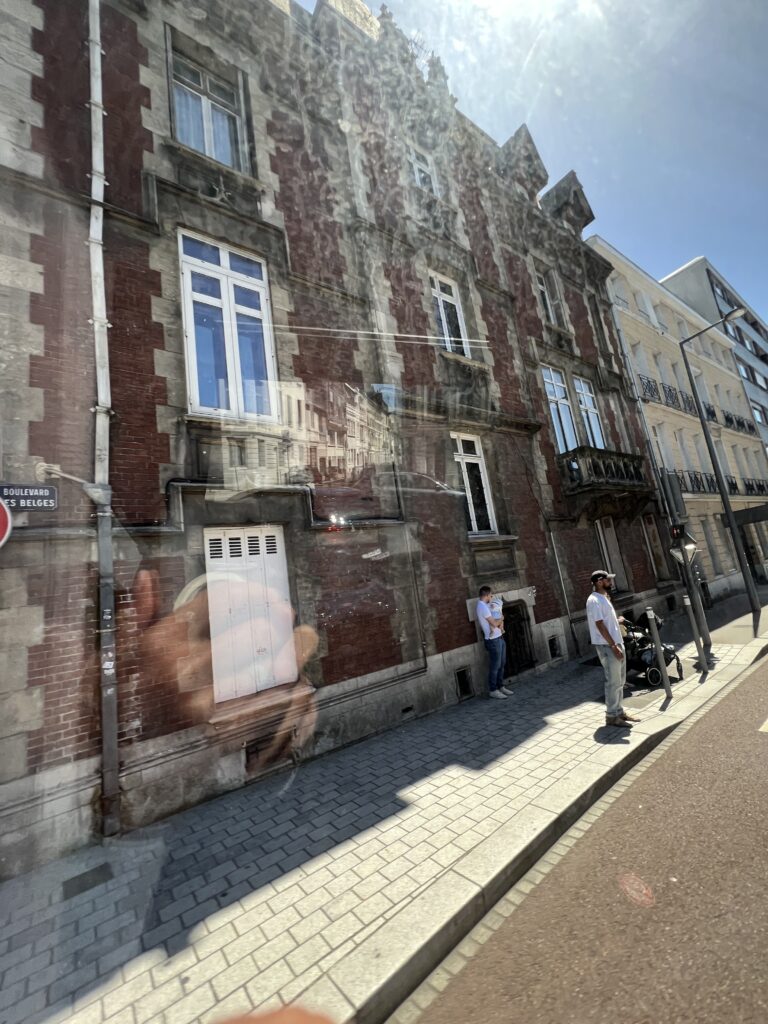
Entering the city of Rouen
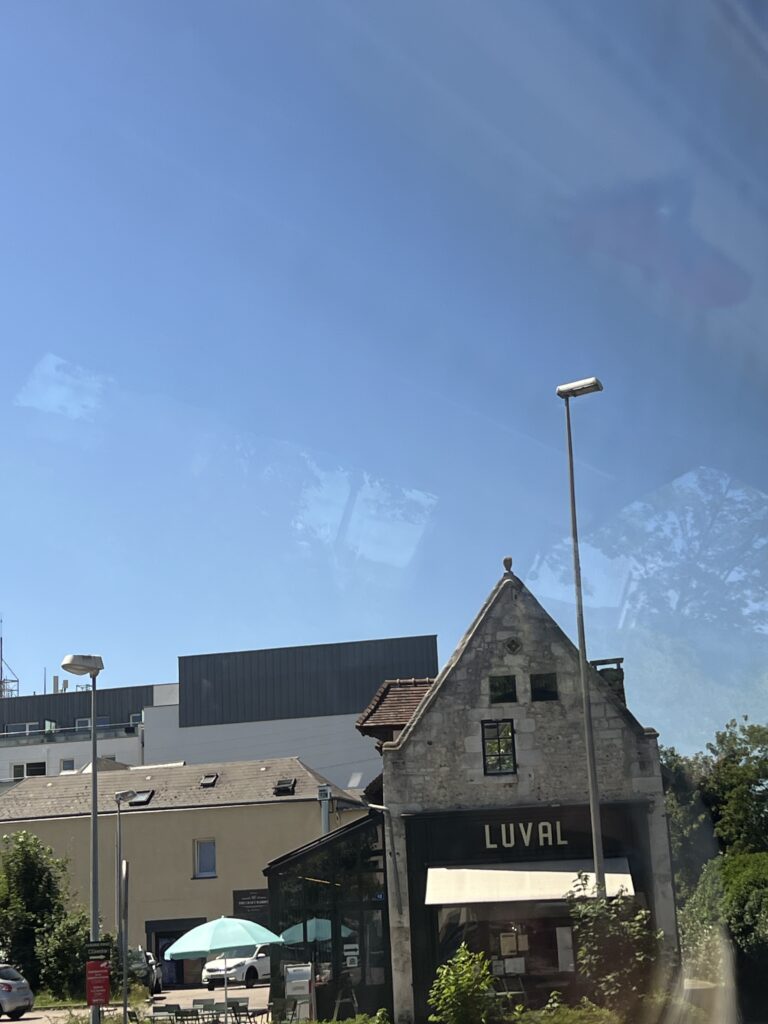
La Seine River. The Seine is a 777-kilometer-long river in northern France that flows through Paris and empties into the English Channel. It is deeply intertwined with French history, culture, and Parisian life, famous for its scenic bridges and the iconic landmarks situated along its banks.
Key Facts About the Seine
- Source: Rises at Source-Seine on the Langres plateau in northeastern France.
- Mouth: Drains into the English Channel between Le Havre and Honfleur.
- Paris Connection: Divides the French capital into the Left Bank (Rive Gauche) and Right Bank (Rive Droite) and features 37 iconic bridges within the city.
- Notable Landmarks: The river flows directly past the Eiffel Tower, Notre-Dame Cathedral, the Louvre Museum, and the Musée d’Orsay.
Activities & Navigation
- River Cruises: The Seine is a central hub for tourism, offering popular sightseeing and dining cruises (such as the Bateaux Parisiens).
- Commercial Use: It is a vital commercial waterway, allowing cargo ships to navigate all the way up to the port of Paris (Gennevilliers).
- Recreation: The riverbanks (les berges) have been transformed into pedestrian-friendly promenades, walking paths, and parks.
In 1431, a young shepherdess became the greatest heroine of French History. Born in Lorraine, France, Jeanne claimed she heard voices telling her to free France from the English occupation. With her hair cut short and dressed like a man, she fights and wins the battle against the English, alongside the future French King Charles VII. Victorious, she leads the King to his coronation at Reims Cathedral in 1429. Later, in Paris, she is taken prisoner by the Burgundians and sold to the English, who imprison her in Rouen Castle and execute her at age 19. Her crime: heresy – including being a feminist and wearing men’s clothes.
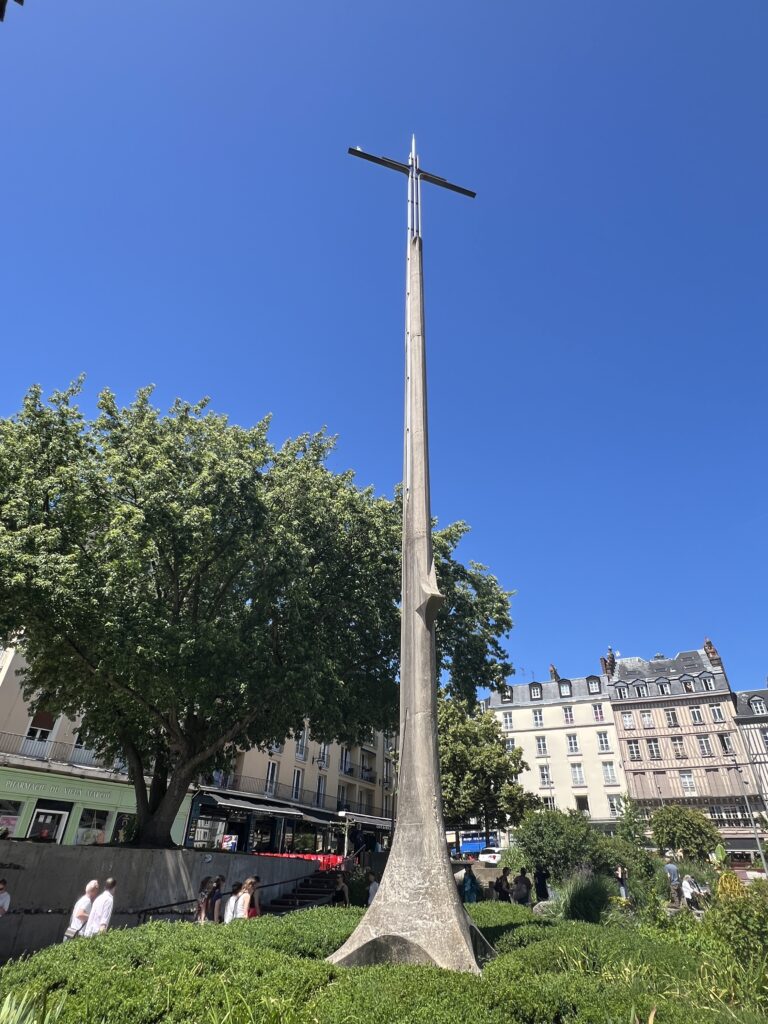
Just two hours from Paris by train, the 2,000-year-old city of Rouen is dedicated to the memory of Joan of Arc. Today, a large silver cross marks the spot where she was burned at the stake in the Place du Vieux-Marché. At the time, her ashes were tossed into the Seine River. Today, Joan of Arc is a patron saint of France and was canonized by the Pope in 1920. Every May, Rouen celebrates the memory of Jeanne d’Arc on the anniversary of her death.
From Joan of Arc to Claude Monet’s paintings of its Gothic cathedral to Richard the Lionheart’s deep love for France, Rouen is a city that never forgets the moments that changed history.
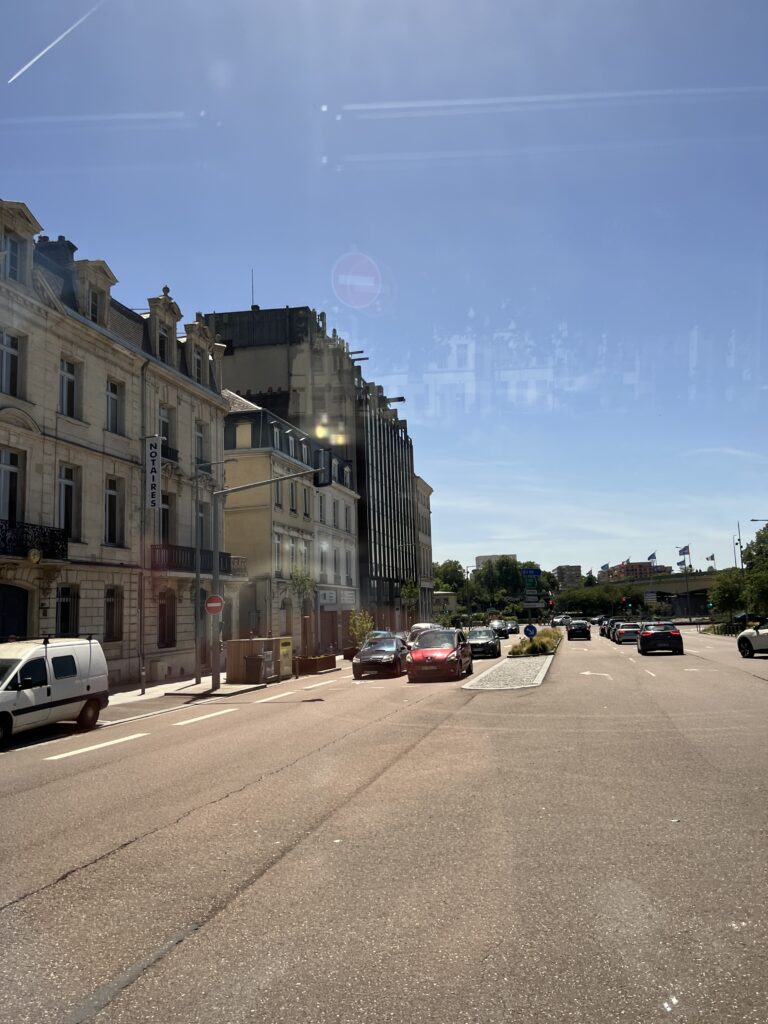
Rouen (UK: /ˈruːɒ̃, ˈruːɒn/, US: /ruːˈɒ̃, ruːˈɒn/; is a city on the River Seine, in northwestern France. It is in the prefecture of region of Normandy and the department of Seine-Maritime. Formerly one of the largest and most prosperous cities of medieval Europe, the population of the metropolitan area (French: aire d’attraction) is 712,886 (2022). People from Rouen are known as Rouennais.
Rouen was the seat of the Exchequer of Normandy during the Middle Ages. It was one of the capitals of the Anglo-Norman and Angevin dynasties, which ruled both England and large parts of modern France from the 11th to the 15th centuries. From the 13th century onwards, the city experienced a remarkable economic boom, thanks in particular to the development of textile factories and river trade. Claimed by both the French and the English during the Hundred Years’ War, it was on its soil that Joan of Arc was tried and burned alive on 30 May 1431. Severely damaged by the wave of bombing in 1944, it nevertheless regained its economic dynamism in the post-war period thanks to its industrial sites and its large seaport, which merged with the ports of Le Havre and Paris in 2021 to form the HAROPA Port.
Endowed with a prestige established during the medieval era, and with a long architectural heritage in its historical monuments, Rouen is an important cultural capital. Several renowned establishments are located here, such as the Museum of Fine Arts, Le Secq des Tournelles museum, and Rouen Cathedral.
Seat of an archdiocese, it also hosts a court of appeal and a university. Every four to six years, Rouen becomes the showcase for a large gathering of sailing ships called “L’Armada”; this event makes the city an occasional capital of the maritime world.
History
Rouen was founded by the Gaulish tribe of the Veliocasses, who controlled a large area in the lower Seine valley. They called it Ratumacos; the Romans called it Rotomagus. It was considered the second city of Gallia Lugdunensis after Lugdunum (Lyon) itself. Under the reorganization of Diocletian, Rouen was the chief city of the divided province Lugdunensis secunda and reached the apogee of its Roman development, with an amphitheatre and thermae of which foundations remain. In the 5th century, it became the seat of a bishopric and later a capital of Merovingian Neustria.
From their first incursion into the lower valley of the Seine in 841, the Normans overran Rouen. From 912, Rouen was the capital of the Duchy of Normandy and residence of the local dukes, until William the Conqueror moved his residence to Caen. In 1150, Rouen received its founding charter which permitted self-government.
During the 12th century, Rouen was the site of a yeshiva known as La Maison Sublime. Discovered in 1976, it is now a museum.At that time, about 6,000 Jews lived in the town, comprising about 20% of the population.
On 24 June 1204, King Philip II Augustus of France entered Rouen and definitively annexed Normandy to the French Kingdom. He demolished the Norman castle and replaced it with his own, the château Bouvreuil, built on the site of the Gallo-Roman amphitheatre. A textile industry developed based on wool imported from England, for which the cities of Flanders and Brabant were constantly competitors, and finding its market in the Champagne fairs. Rouen also depended for its prosperity on the river traffic of the Seine, on which it enjoyed a monopoly that reached as far upstream as Paris.
In the 13th and 14th centuries urban strife threatened the city: in 1291, the mayor was assassinated and noble residences in the city were pillaged. Philip IV reimposed order and suppressed the city’s charter and the lucrative monopoly on river traffic, but he was quite willing to allow the Rouennais to repurchase their old liberties in 1294. In 1306, he decided to expel the Jewish community of Rouen, then numbering some five or six thousand. In 1389, another urban revolt of the underclass occurred, the Harelle. It was suppressed with the withdrawal of Rouen’s charter and river-traffic privileges once more.
During the Hundred Years’ War, on 19 January 1419, Rouen surrendered after a long siege to Henry V of England, who annexed Normandy once again to the Plantagenet domains. French soldier Alain Blanchard summarily hung English prisoners of war from the city walls during the siege, for which he was beheaded after Rouen fell, while canon and vicar general of Rouen Robert de Livet excommunicated Henry V, resulting in De Livet being imprisoned for five years in England. Joan of Arc, who supported a return to French rule, was burned at the stake on 30 May 1431 in Rouen, where most inhabitants supported the duke of Burgundy, the French king’s enemy. The king of France, Charles VII, recaptured the town in 1449.
Rouen was staunchly Catholic during the French Wars of Religion, and underwent an unsuccessful five-month siege in 1591/2 by the Protestant Henry IV of France and an English force under Earl of Essex. A brief account by an English participant has survived.
During the repression of January and February 1894, the police conducted raids targeting the anarchists living there, without much success. The first competitive motor race ran from Paris to Rouen in 1894.
During the German occupation in World War II, the Kriegsmarine had its headquarters located in a chateau on what is now the Rouen Business School. The city was heavily damaged during the same war on D-Day, and its famed cathedral was almost destroyed by Allied bombs.
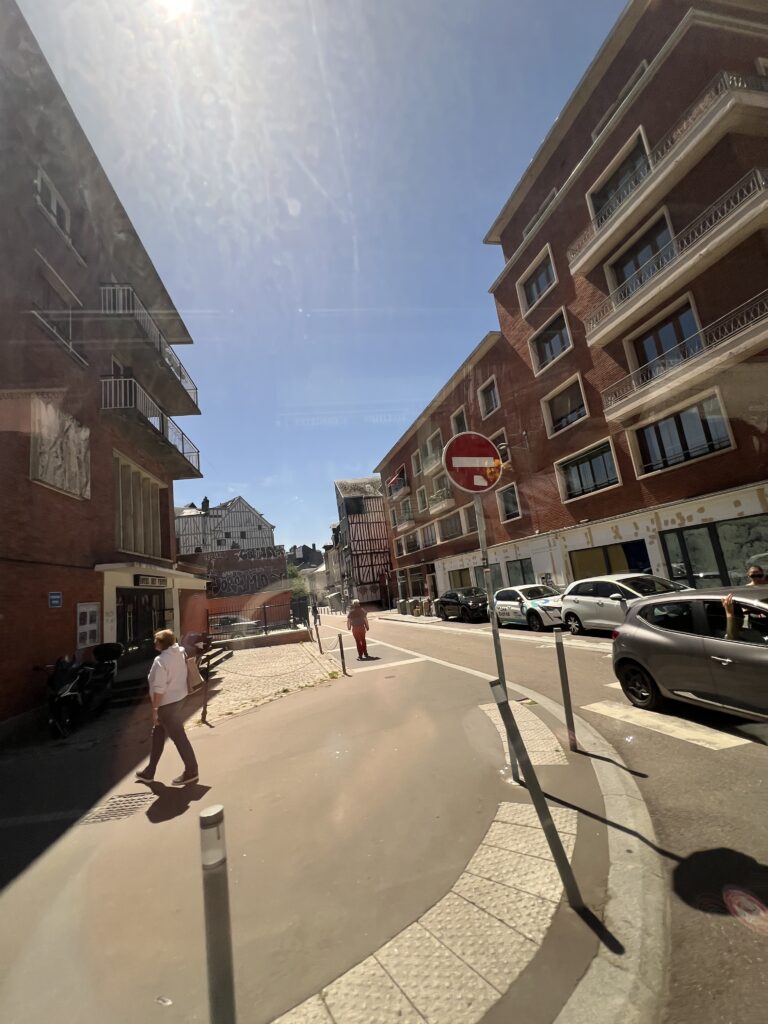
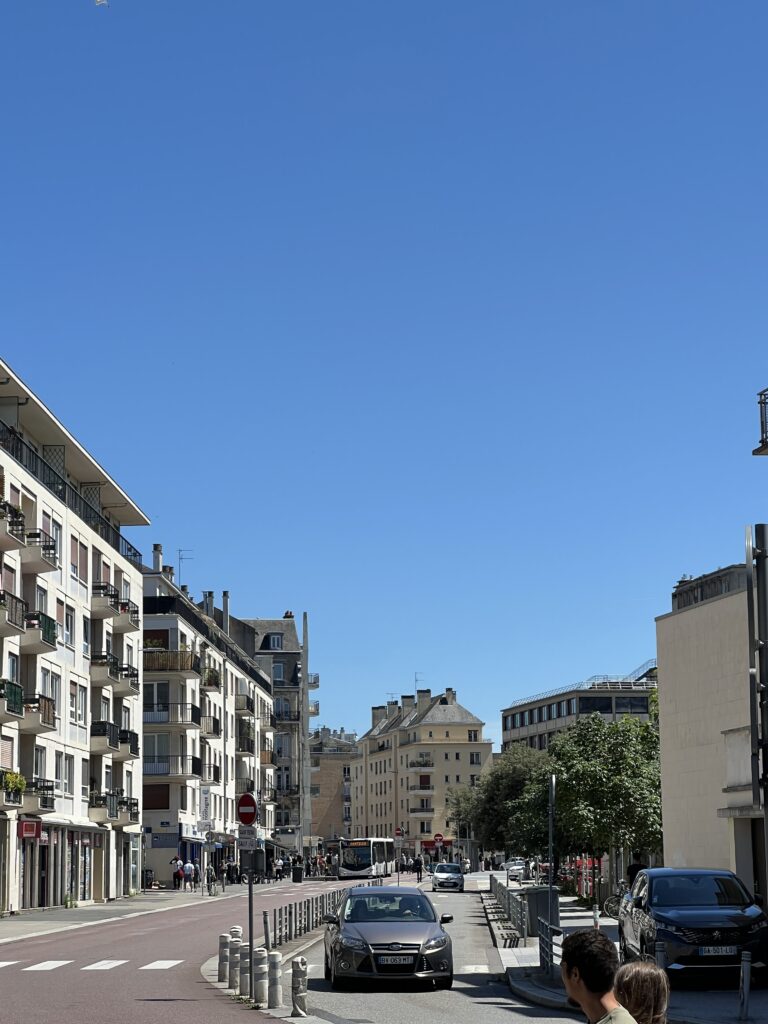
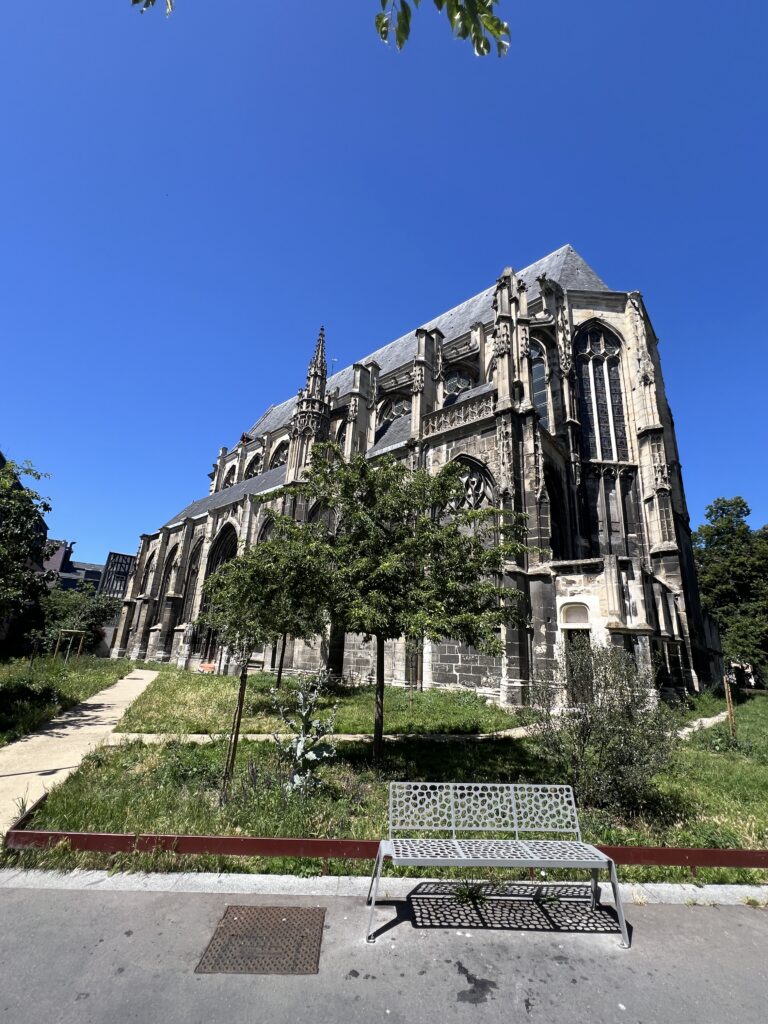
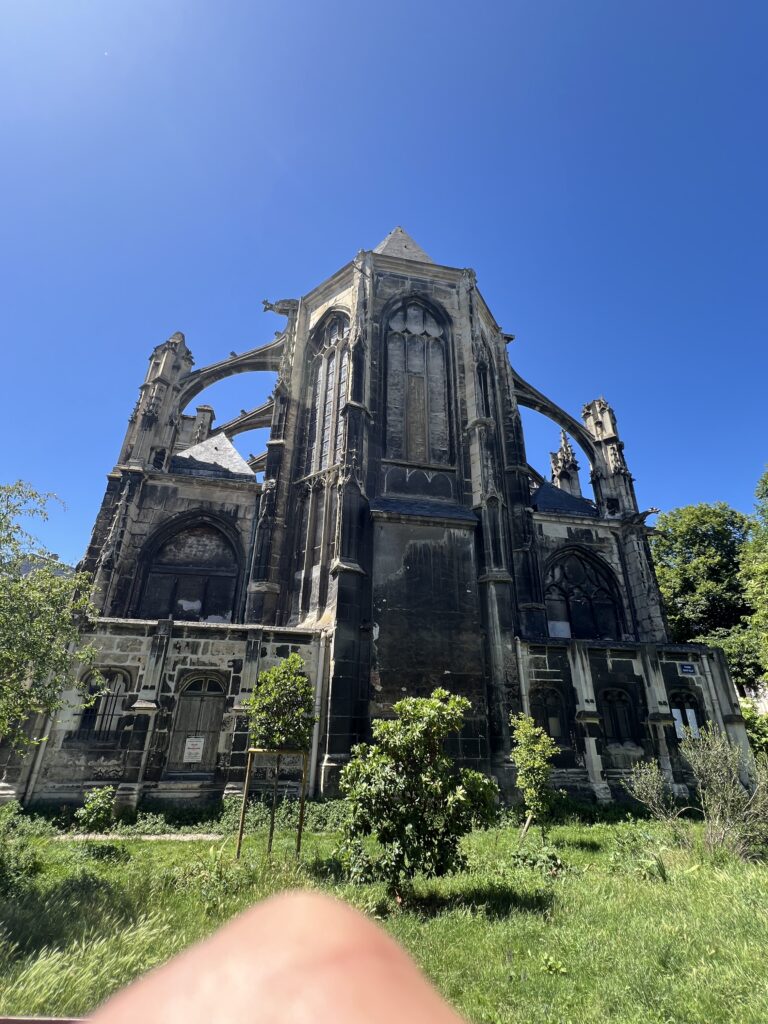
We came across this old church as we began our walking tour. The church looks closed and overgrown with weeds, but we were told that it is still used.
The Protestant Temple of Saint-Éloi de Rouen is a religious building located on the Place du Pasteur-Martin-Luther-King in Rouen. A former Catholic church from 1228 to the Revolution, it was assigned to the Reformed Church in 1803. The parish is now a member of the United Protestant Church of France.
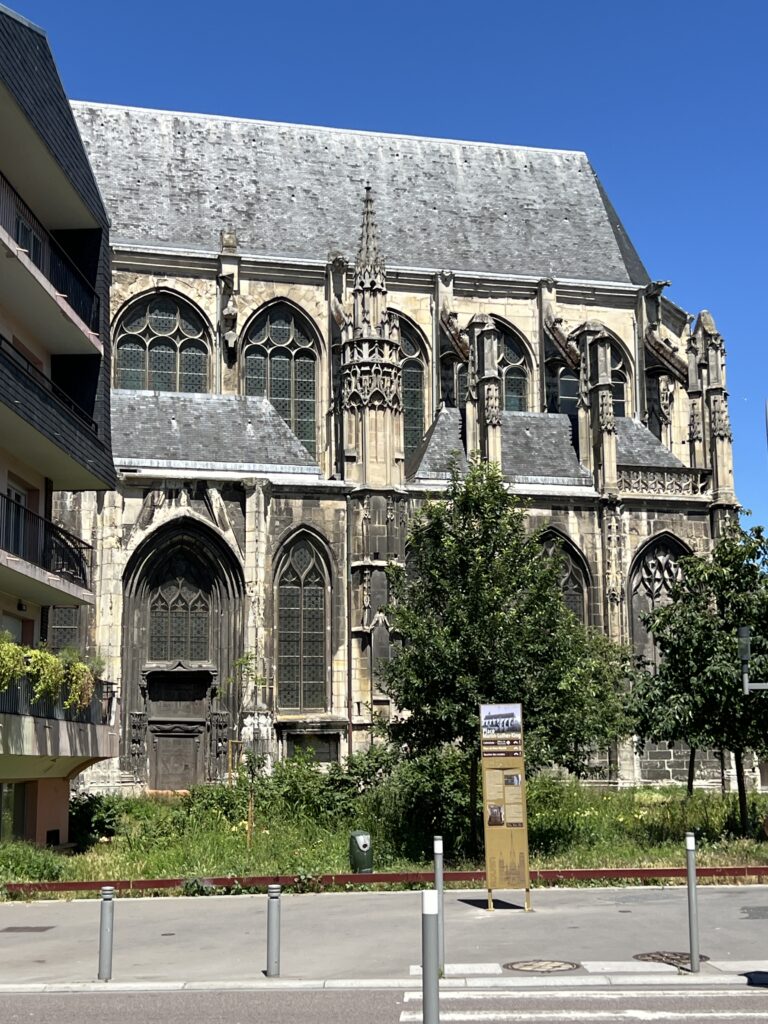
Catholic Church (1228–1791)
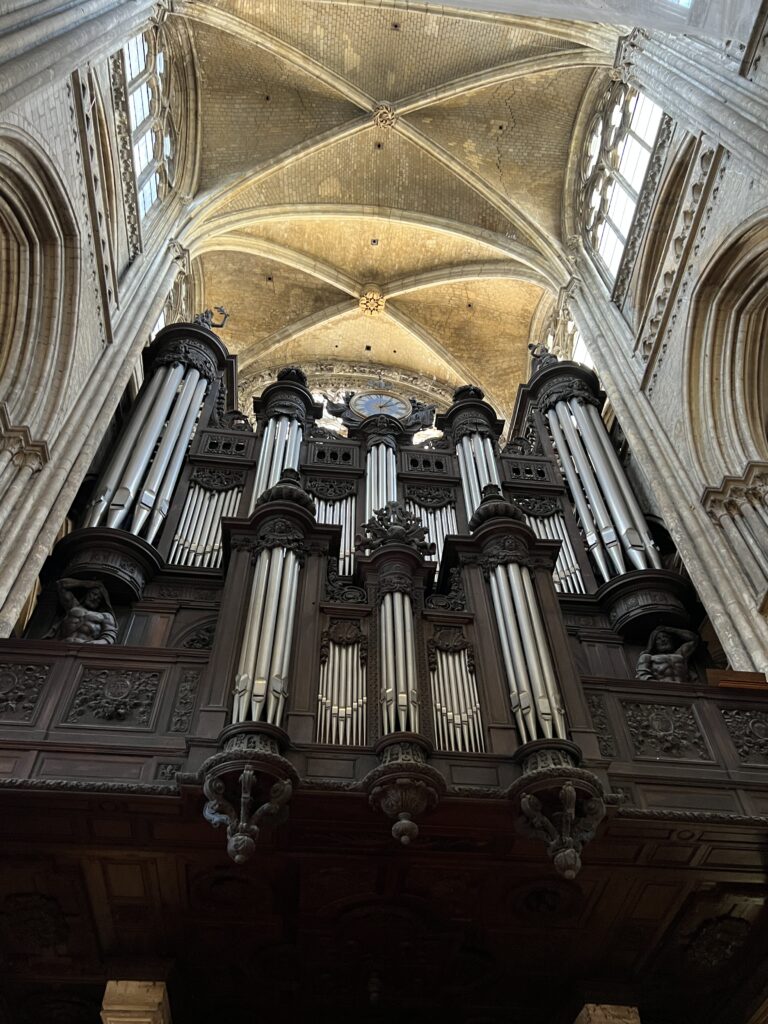
Nave and organ of the Saint-Éloi temple.

It was originally a chapel on an island, joined to the mainland during the period of the Dukes of Normandy. It became a parish when the district was built. A church was started on July 5, 1228. It depended on the chapter of the cathedral of Notre-Dame de Rouen.
The church, rebuilt at the beginning of the sixteenth century, was looted by the Huguenots on March 8, 1563. In 1580, the building was completed, with the tower and the rose on the main portal. Work was undertaken at the beginning of the eighteenth century by the architect Jean-Jacques Martinet.
Protestant temple (since 1803)
.jpg?uselang=fr)
In 1791, during the French Revolution, the church was expropriated and deconsecrated. It was transformed into a fodder store, then into a hunting lead factory, because of the presence of its bell tower.
Protestants obtained freedom of worship with the Declaration of the Rights of Man and of the Citizen of 1789. In 1802, Napoleon I organized the church into Reformed and Lutheran Consistories by departments with the organic articles of the French Concordat Regime. In 1803, the building was assigned to the Reformed Consistory of the Seine-Inferior
In 1857, the shops located against the temple were destroyed. The old church has been classified as a historical monument since June 22, 1911
The temple suffered damage during the Allied bombings of Red Week in 1944. It was reopened for worship on April 2, 1950.
In 2018 and 2019, the excavations carried out prior to the “Heart of the Metropolis” development work brought to light, near the temple, an old Catholic cemetery dating from the Middle Ages. The tight arrangement of the skeletons shows an intense use of space.
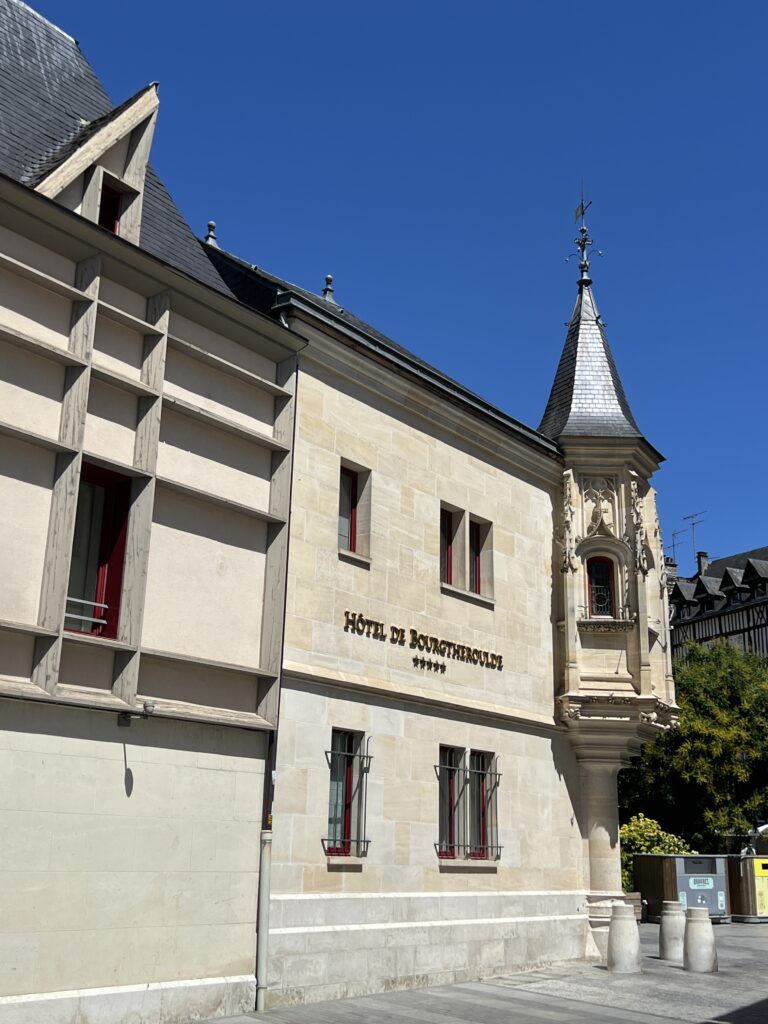
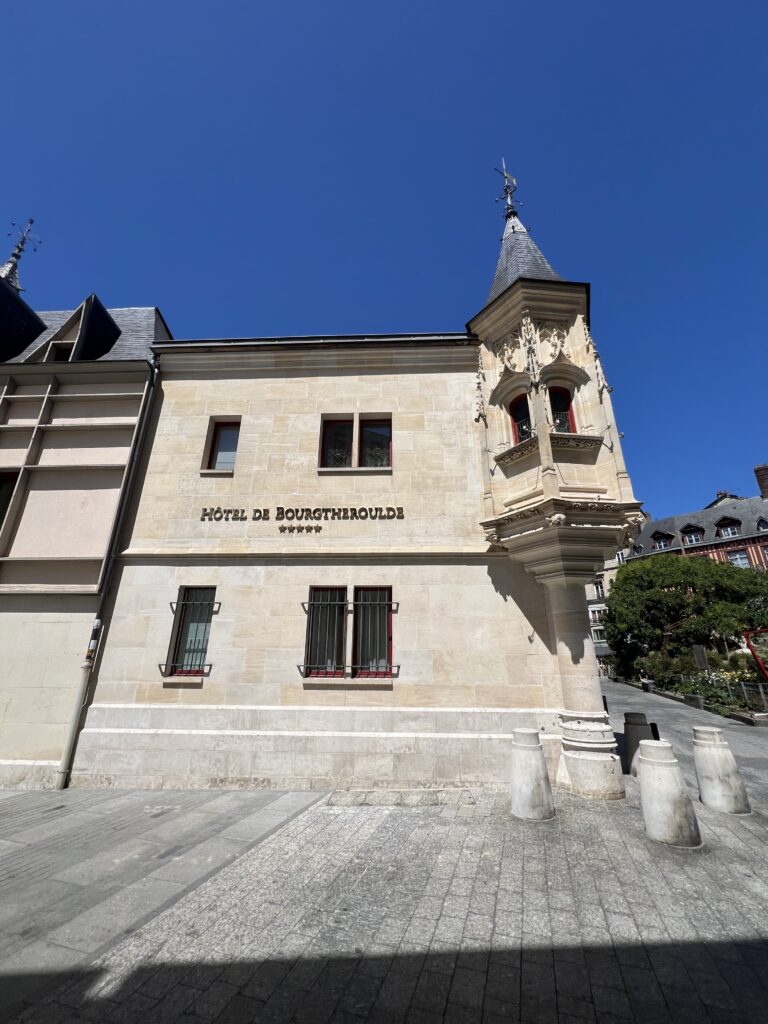
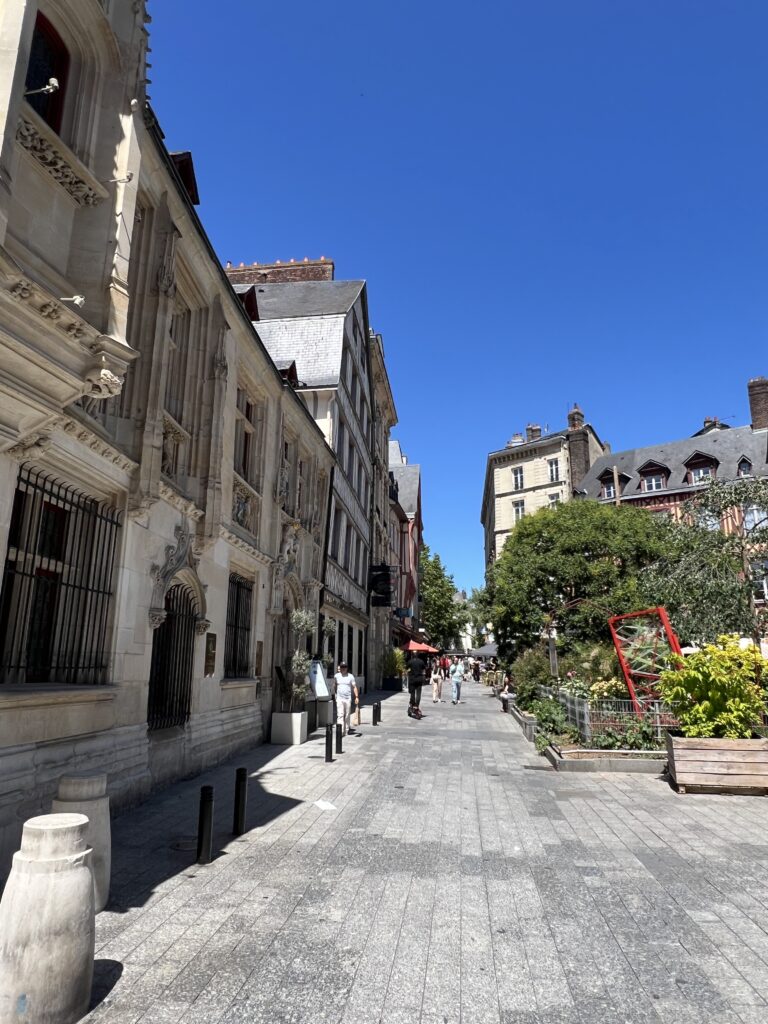
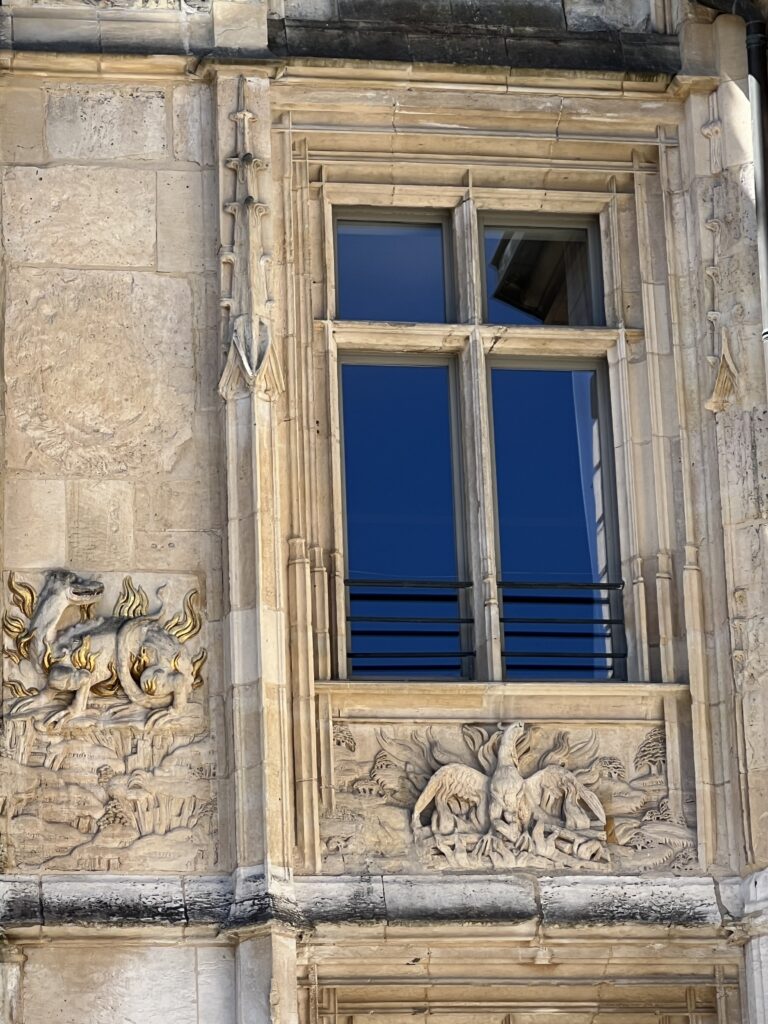
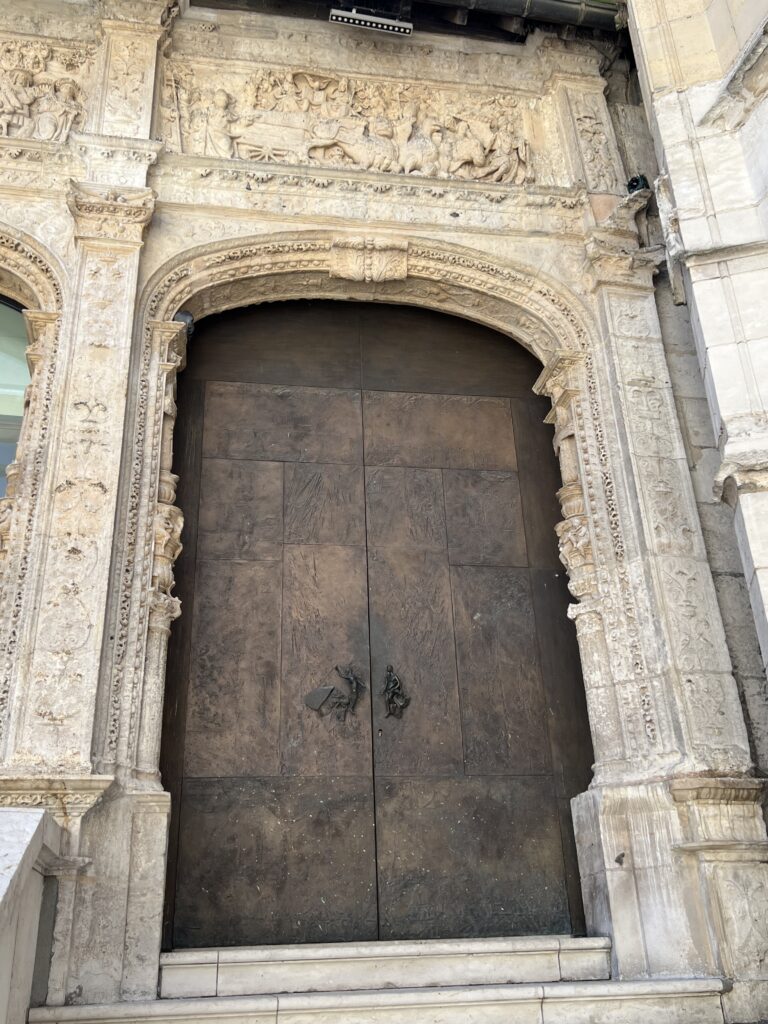
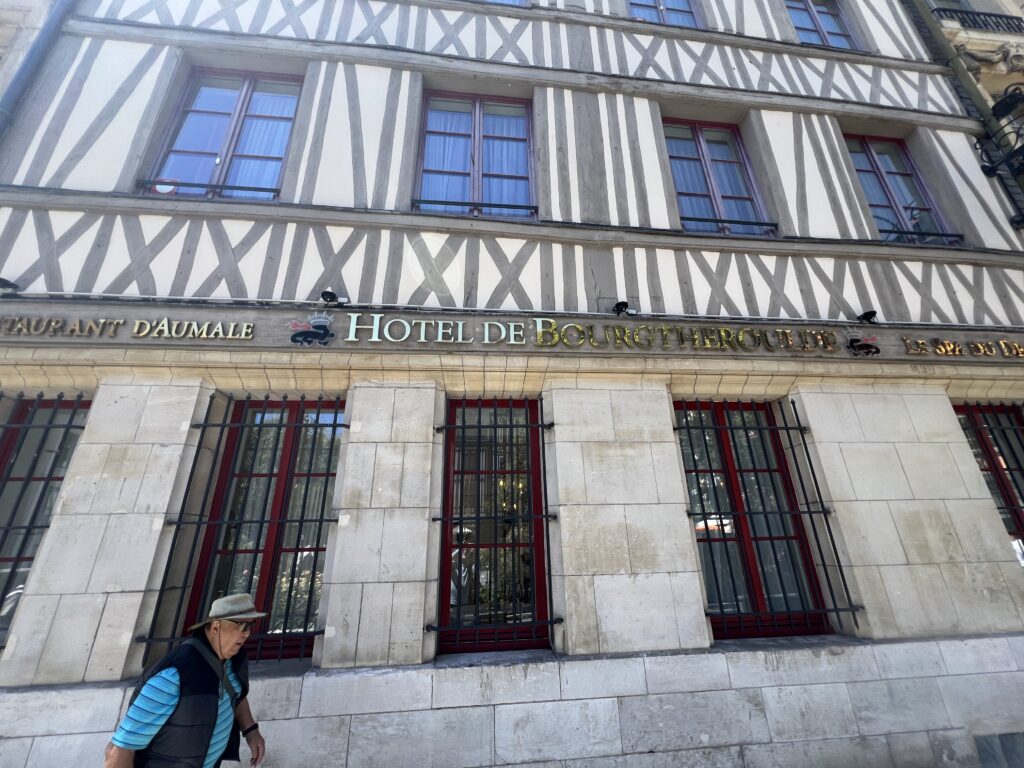
The hôtel de Bourgtheroulde is a former hôtel particulier at 15 place de la Pucelle (formerly the place du Marché aux veaux and long thought to have been the square where Joan of Arc was burned) in the historic city centre of Rouen.
It mostly dates to the 16th century. Its façades and rooves were made a monument historique on 11 January 1924. Its architecture is similar to that of the Rouen Courthouse and the city’s Bureau des Finances, both of the same date as the Hôtel.
Guillaume II Le Roux, lord of Bourgtheroulde and member of the Exchequer of Normandy, decided to build a stone townhouse worthy of his rank at the end of the 15th century and chose the Louis XII style, the transition between the Flamboyant Gothic style and French Renaissance architecture.
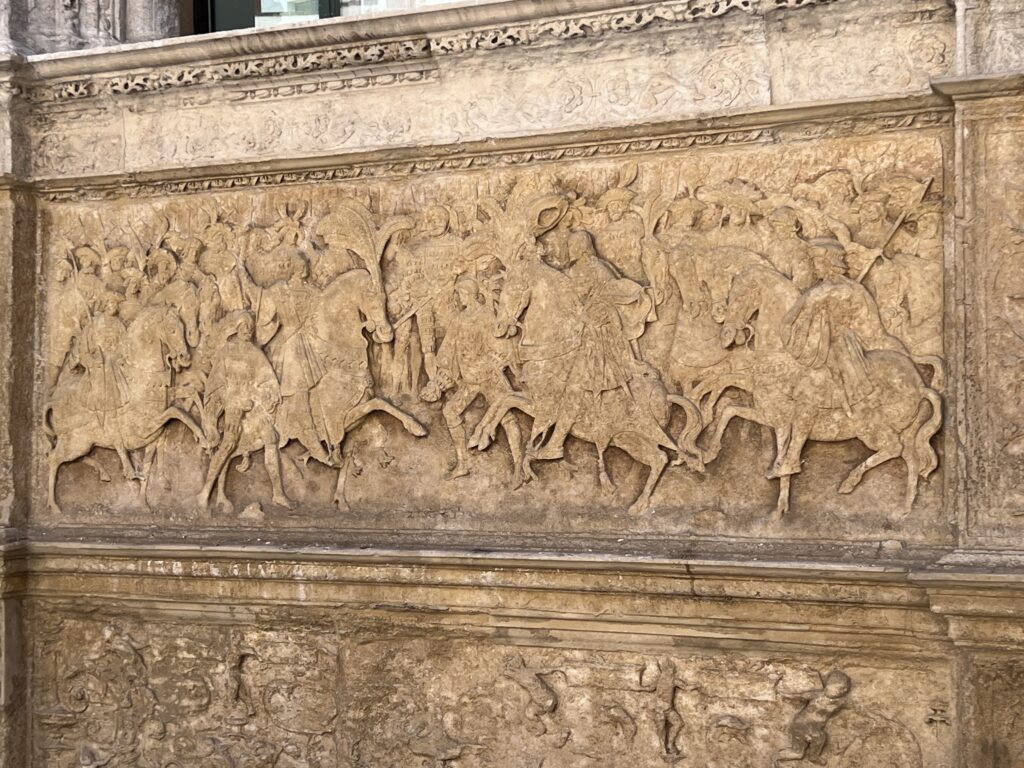
His son Guillaume III continued embellishing the building and completed his father’s work on it. In the inside courtyard, on the left, is the Aumale Gallery with high-quality Renaissance sculpted decoration showing the Field of the Cloth of Gold meeting between Francis I of France and Henry VIII of England and scenes from Petrarch‘s allegorical poem Triumphs.
The building was partially damaged on 19 April 1944 during ‘red week’ and its interior decor was destroyed by bombing on 26 August the same year, just before the city’s liberation. Until 2006 it housed the Crédit industriel de Normandie bank, before being completely restructured as a deluxe hôtel and reopening in April 2010.
Hôtel de Bourgtheroulde | Official website | 5-star hotel Normandy
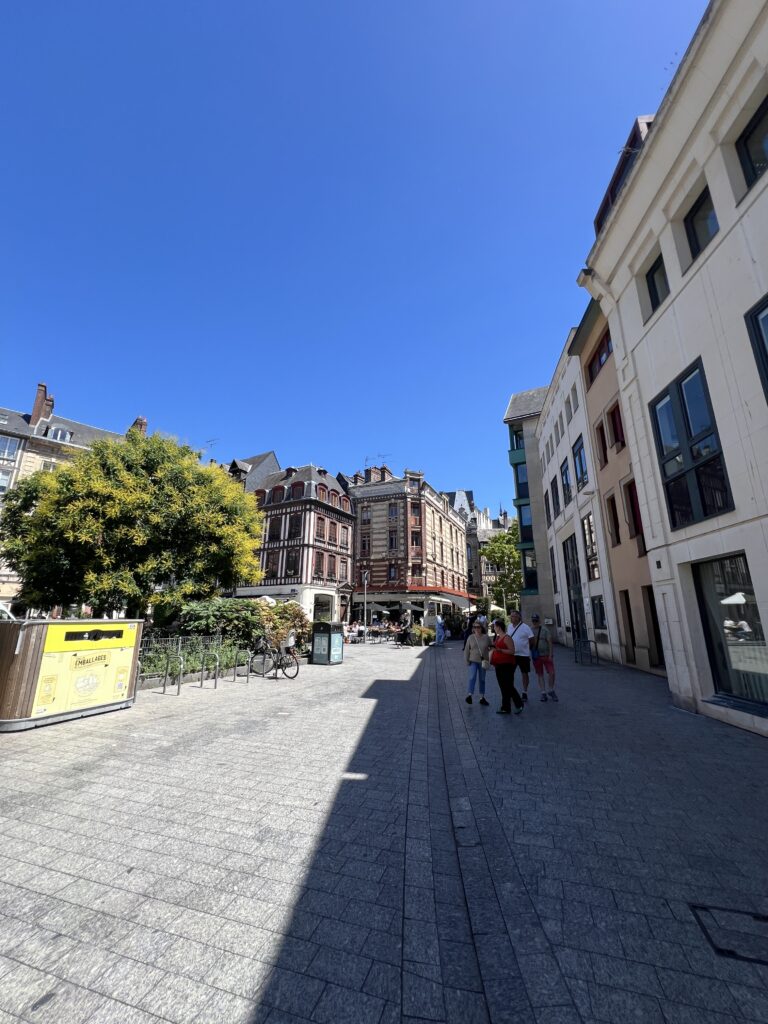
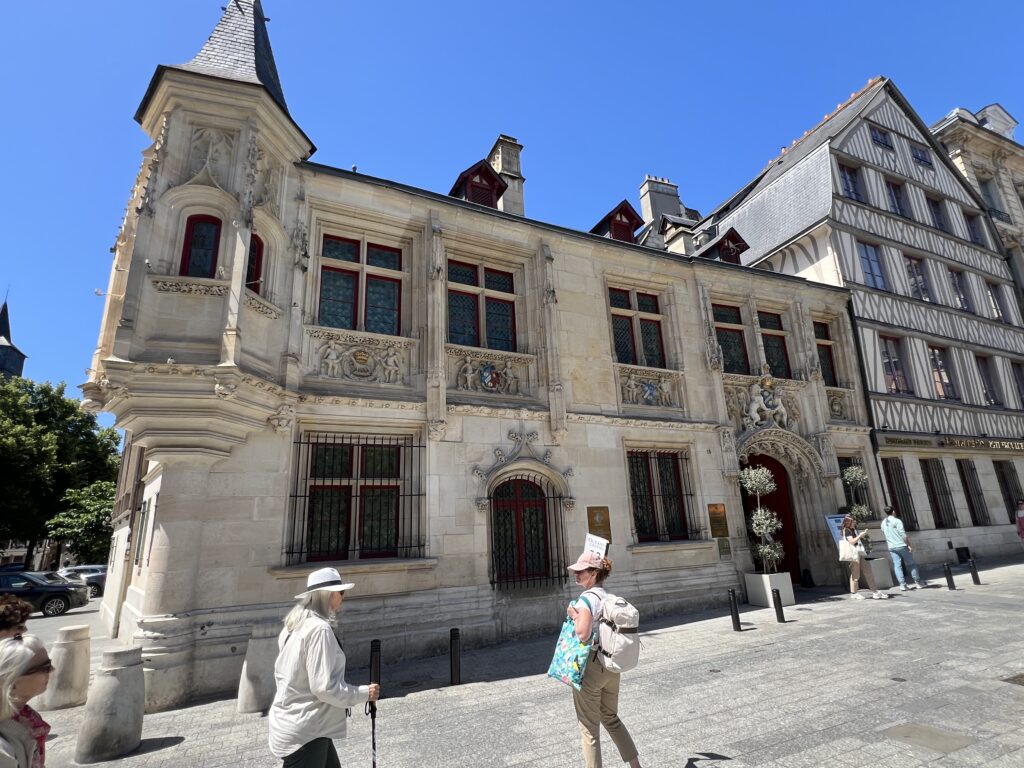
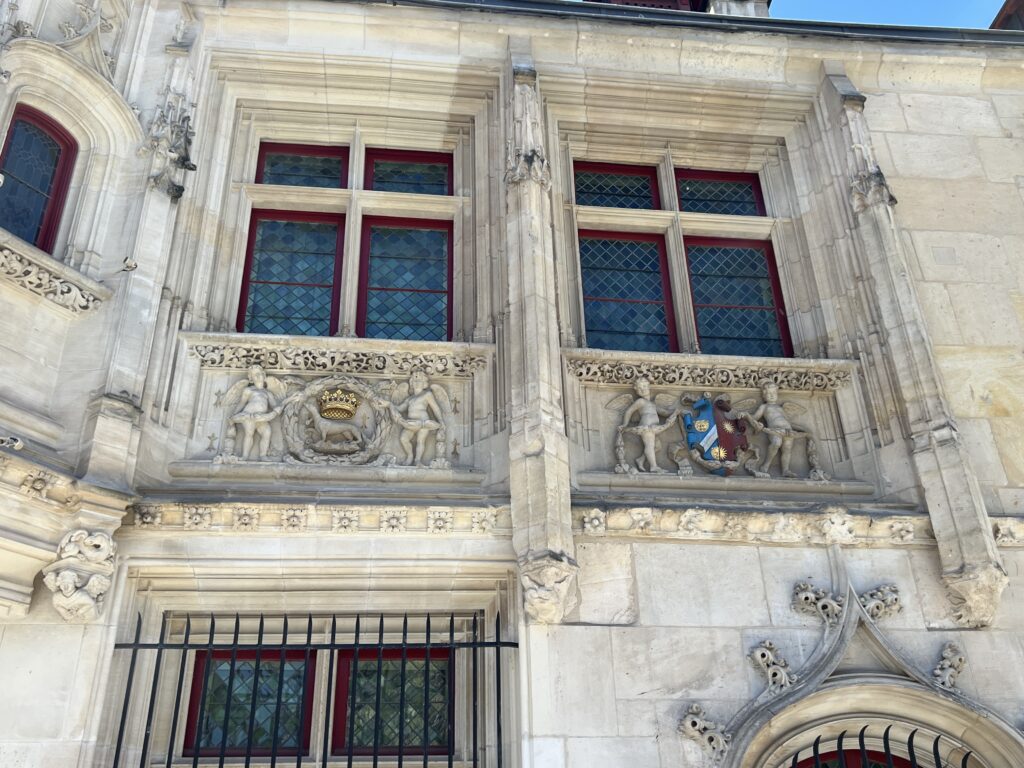
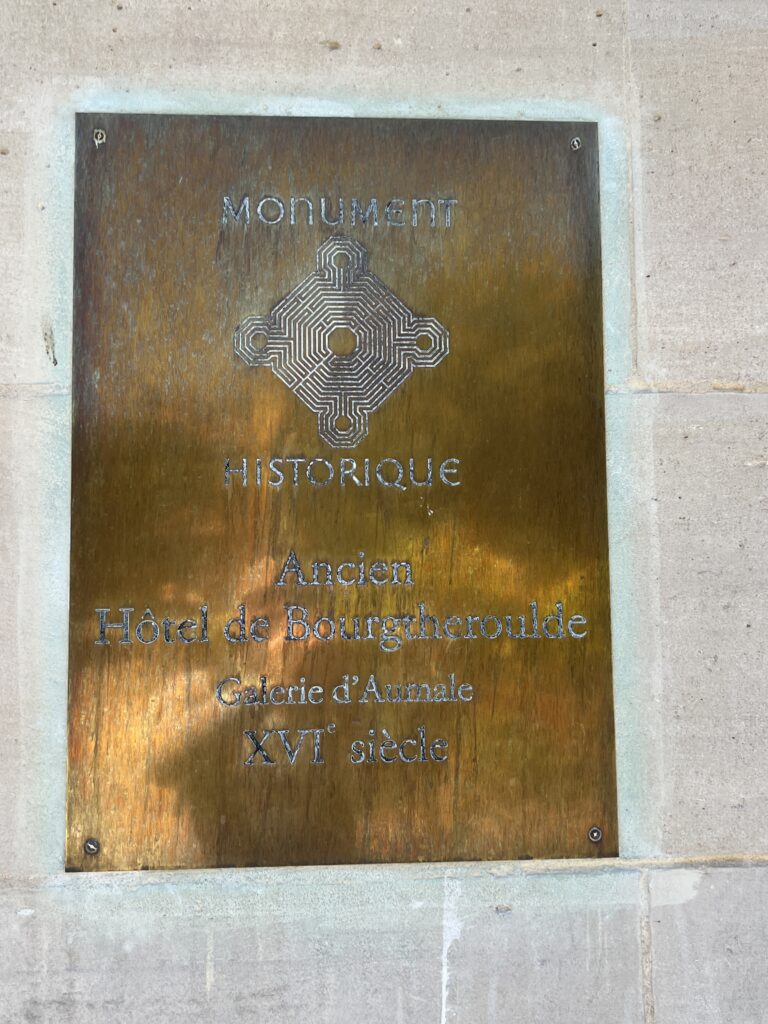
Inside the court area of the hotel
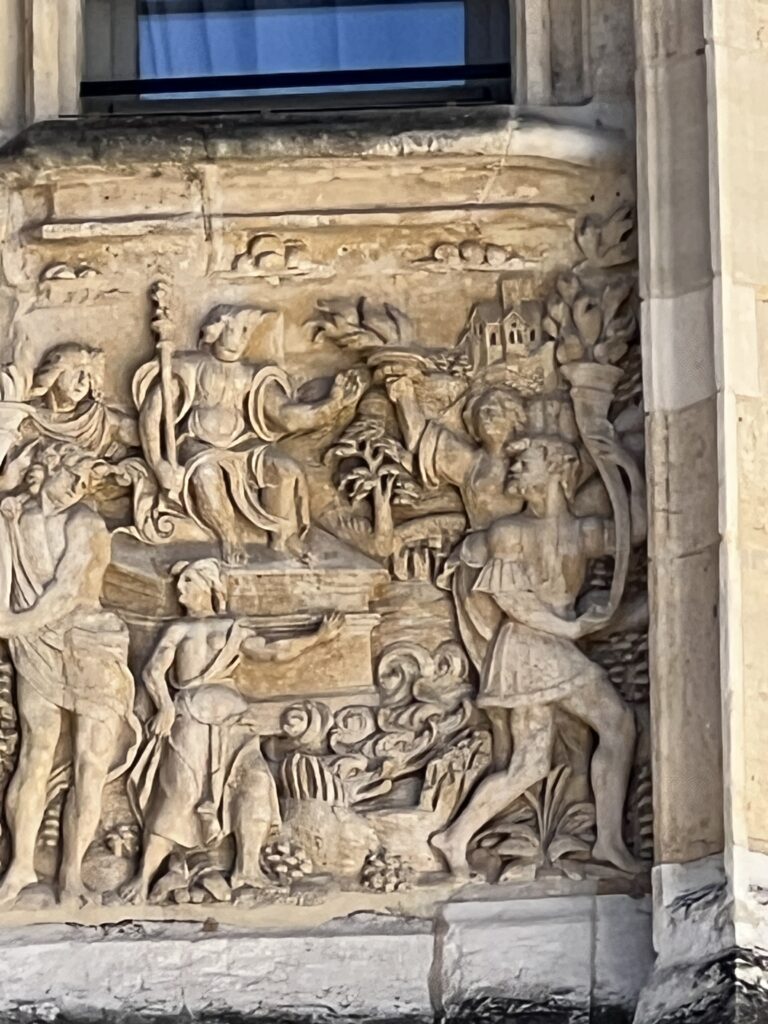
Wall sculpture showing the Field of the Cloth of Gold meeting between Francis I of France and Henry VIII of England
Place du Vieux-Marché, Rouen, Normandy, France
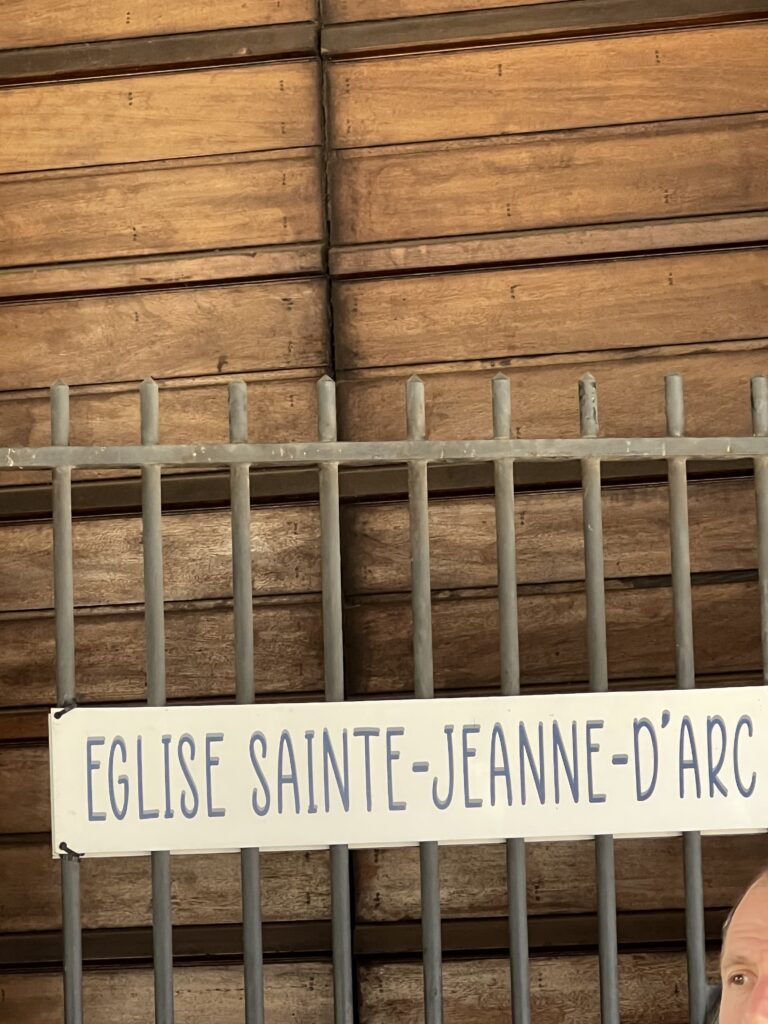
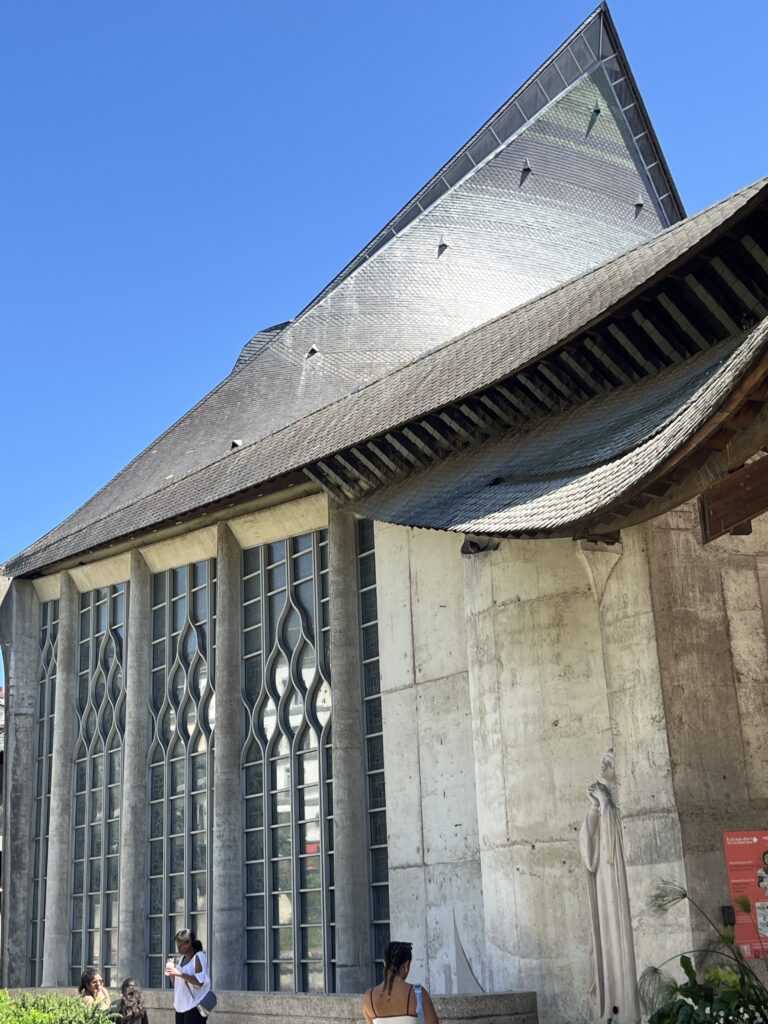
Church of Saint Joan of Arc, Rouen, France
- Address: Place du Vieux-Marché, Rouen, Normandy, France
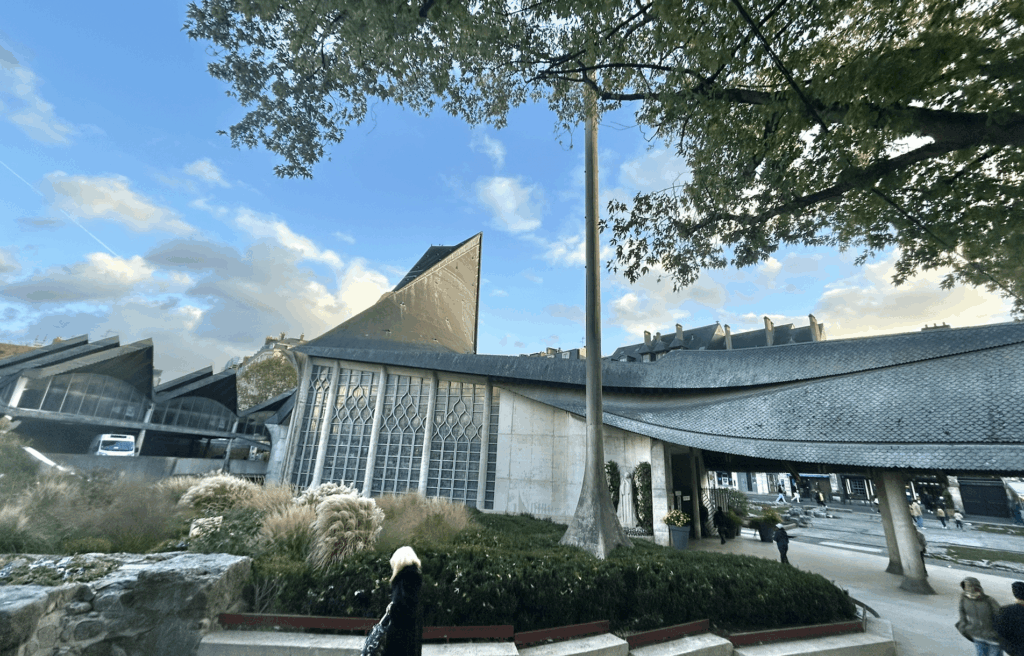
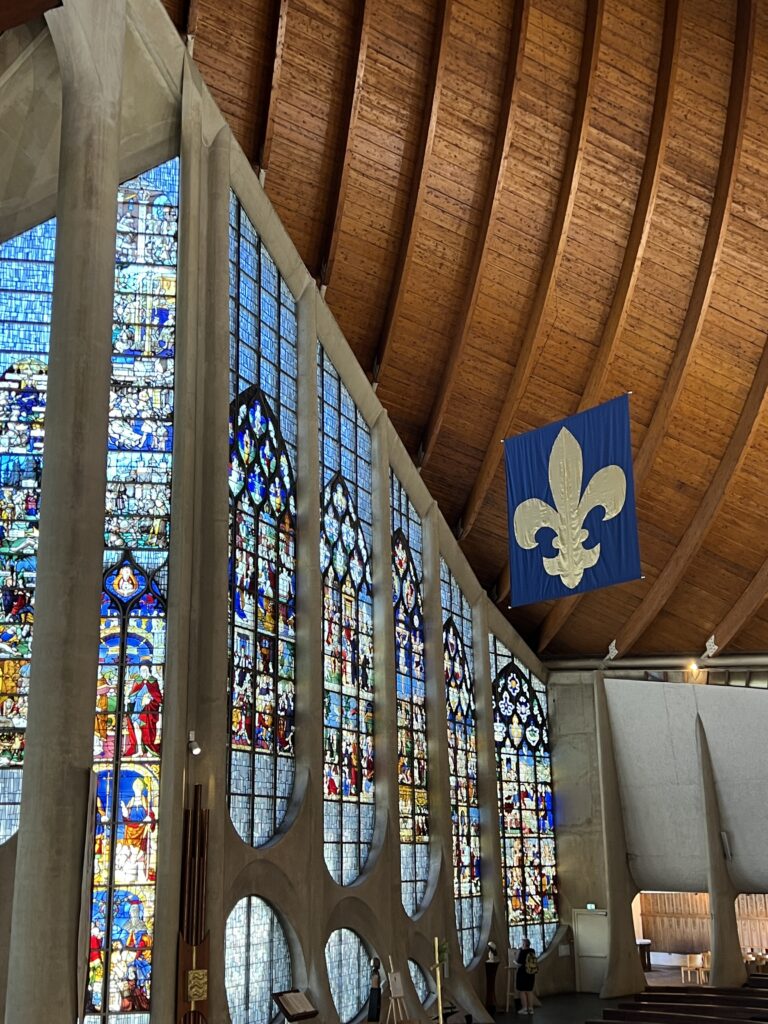
- Significance: Built in 1979 on the site where Joan of Arc was executed in 1431. The modern church features stained glass from the 16th century and a design symbolizing flames and overturned boats, reflecting Christian symbolism and Joan’s martyrdom
The cross marking the place where Joan of Arc was burned at the stake in 1431 with her church behind the cross
Cross indicating location where Joan of Arc was burned to death
Inside view of the Church of Joan of Arc
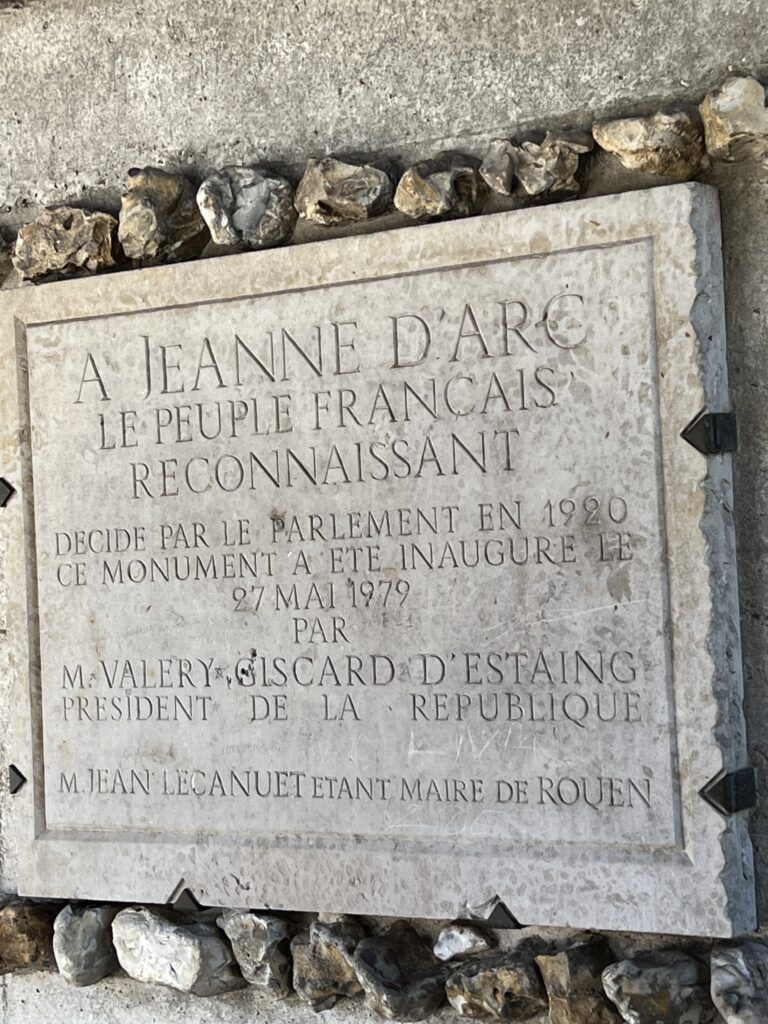
Plaque marking the spot of her death
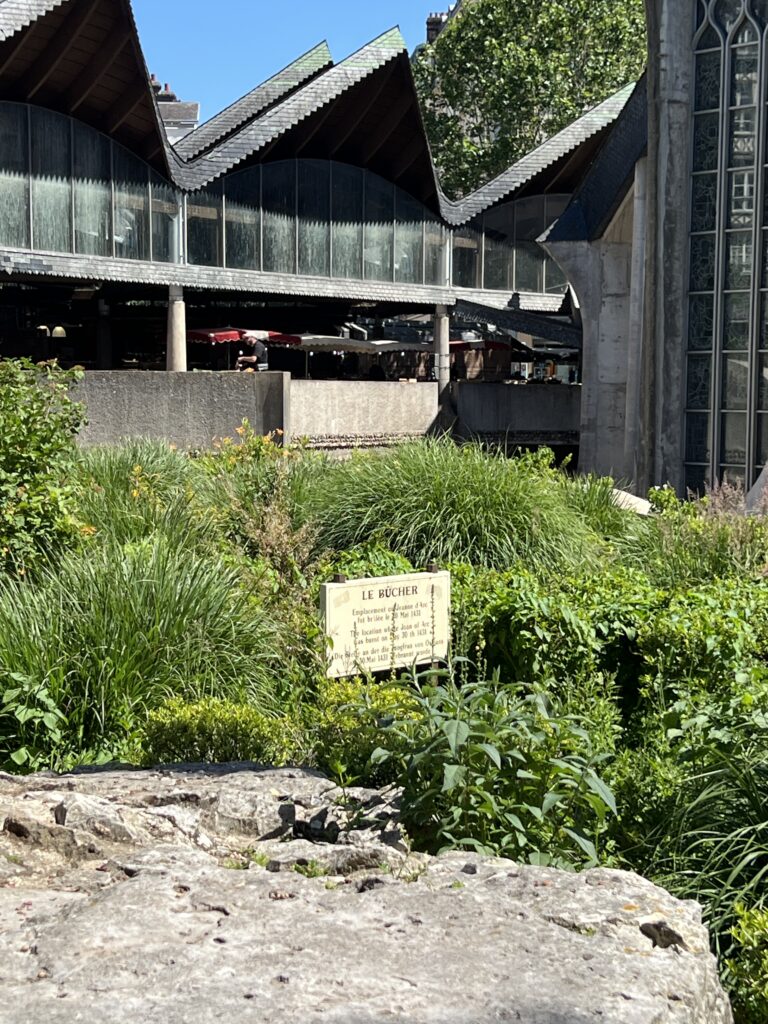
View of outside the church with the stained glass seen on the interior’s photo and video
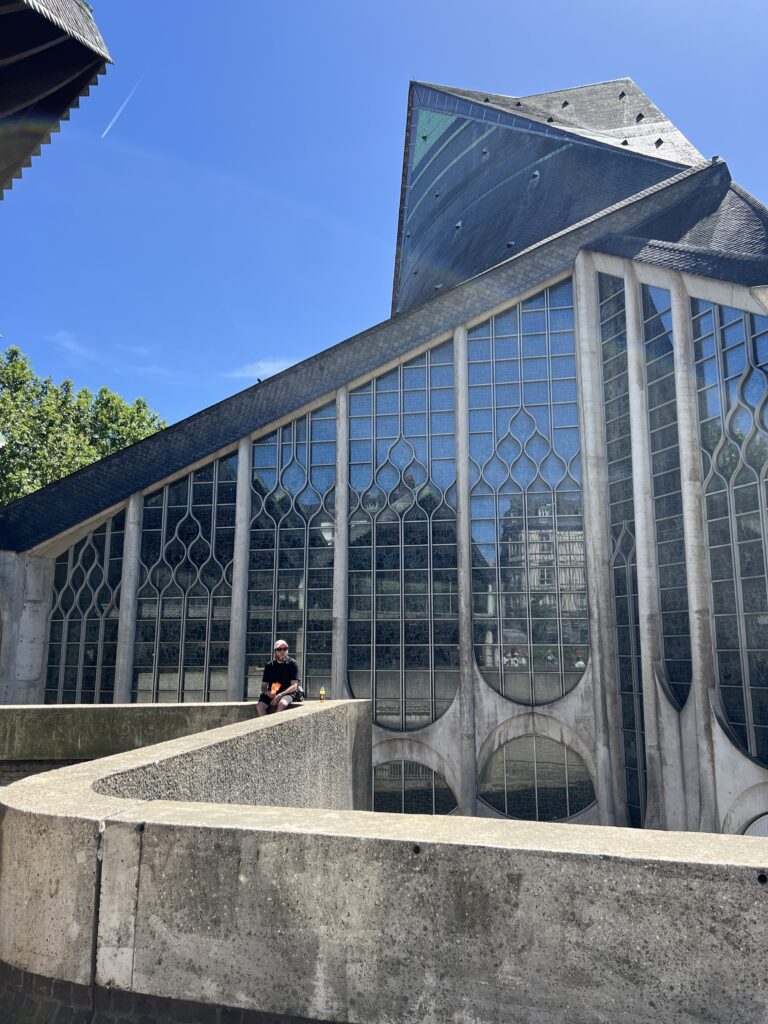
It was on this square, in the middle of the Hundred Years’ War, that Joan of Arc was burned alive on May 30, 1431. The place, as Joan of Arc saw it, did not look like it does today. The square was smaller and its space was occupied by the church of Saint-Sauveur, the church of Saint-Michel and by a large market hall. It was also the usual place of executions. A large cross has been erected on the site of the pyre.
In the middle of the square, the remains of the old Saint-Sauveur church have been uncovered. It was in this modest parish church that Pierre Corneille was baptized, his birthplace on rue de la Pie, now transformed into a museum located nearby.
Today, it is a lively square, around which there are restaurants and bars.
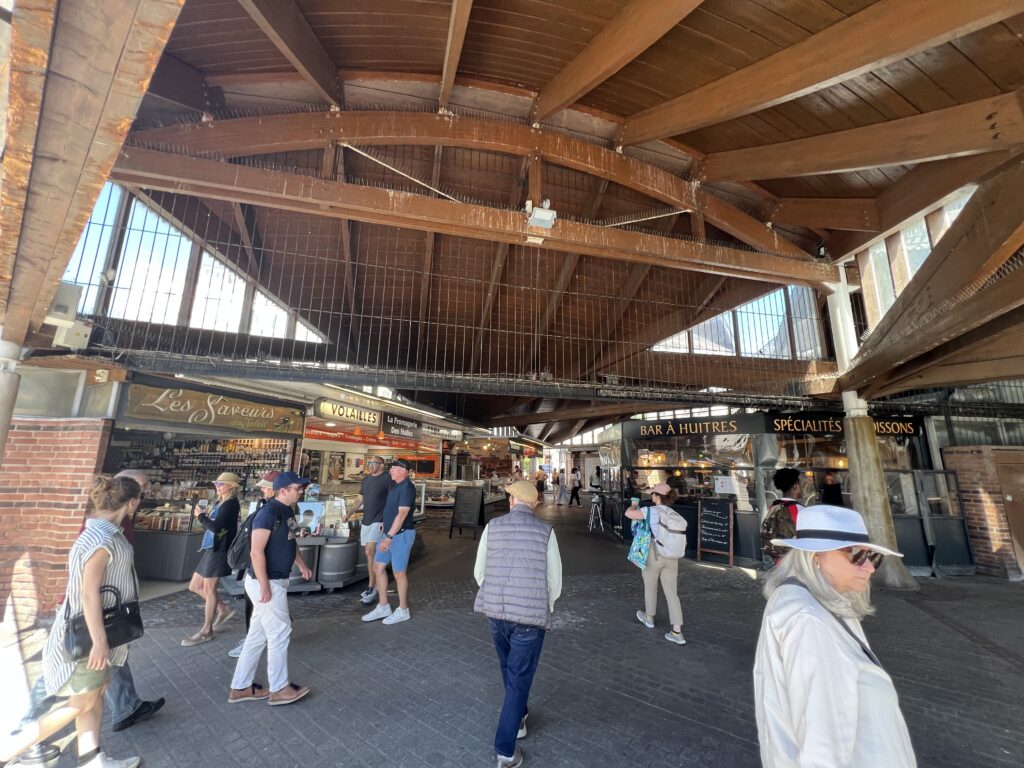
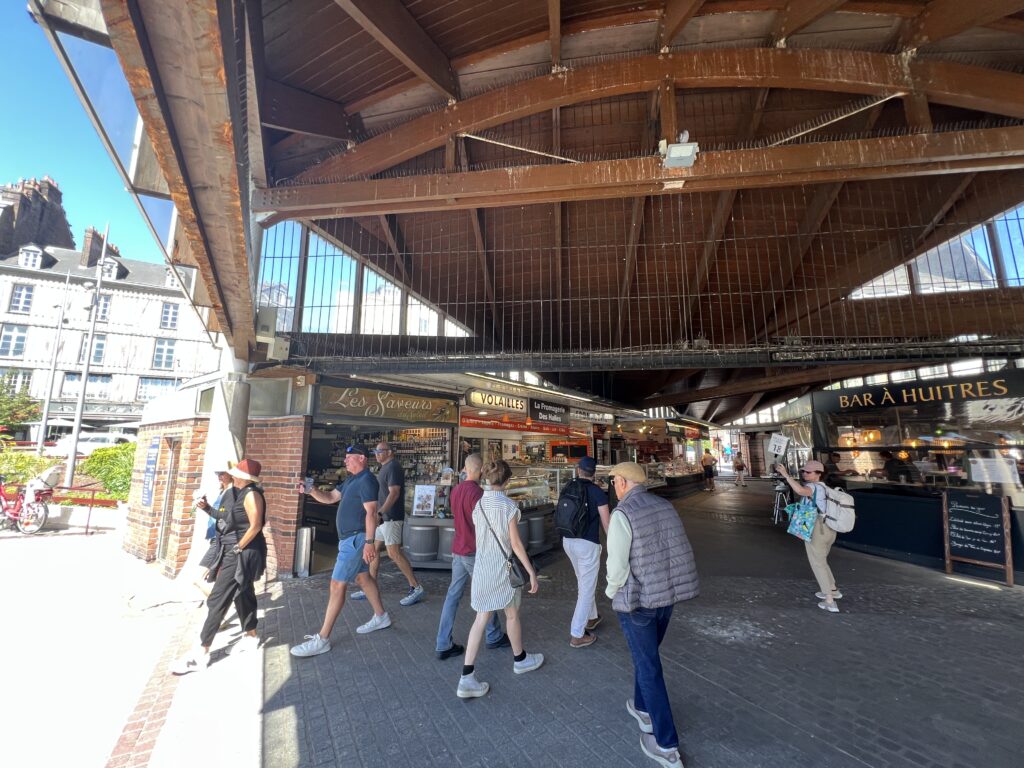
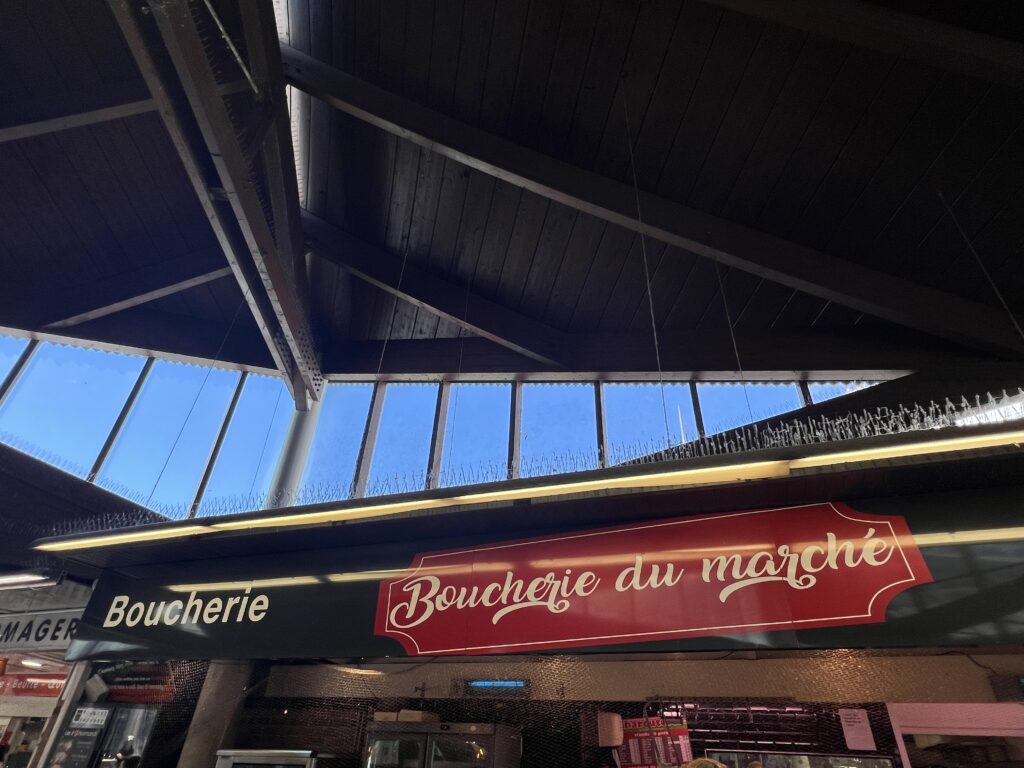
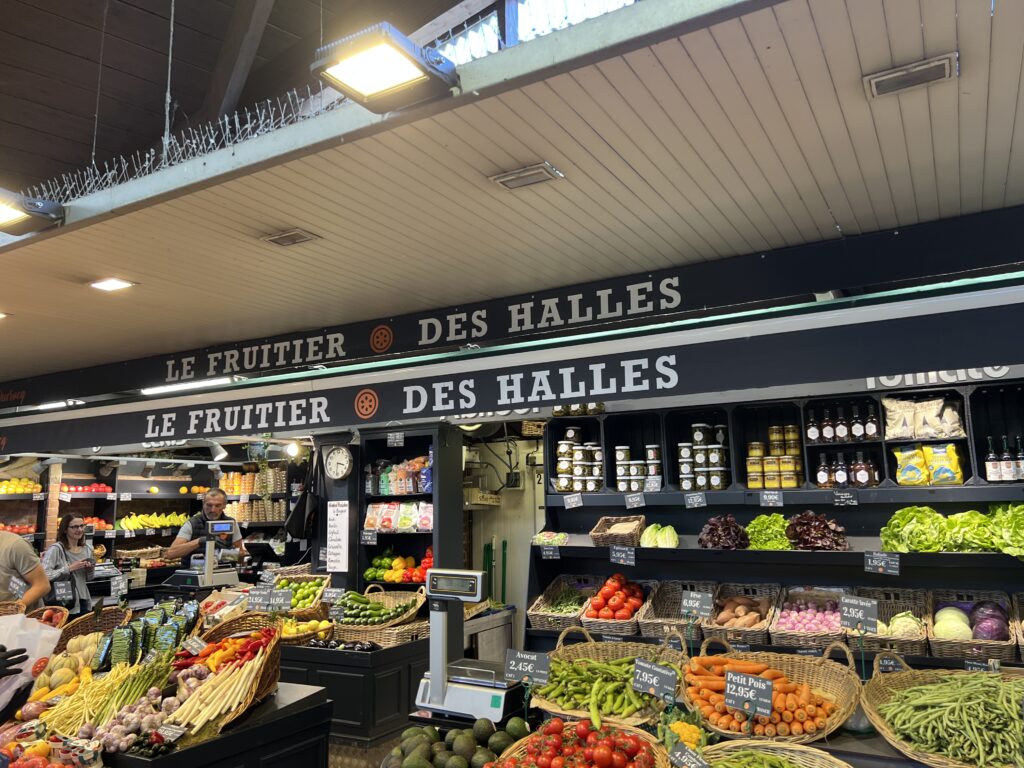
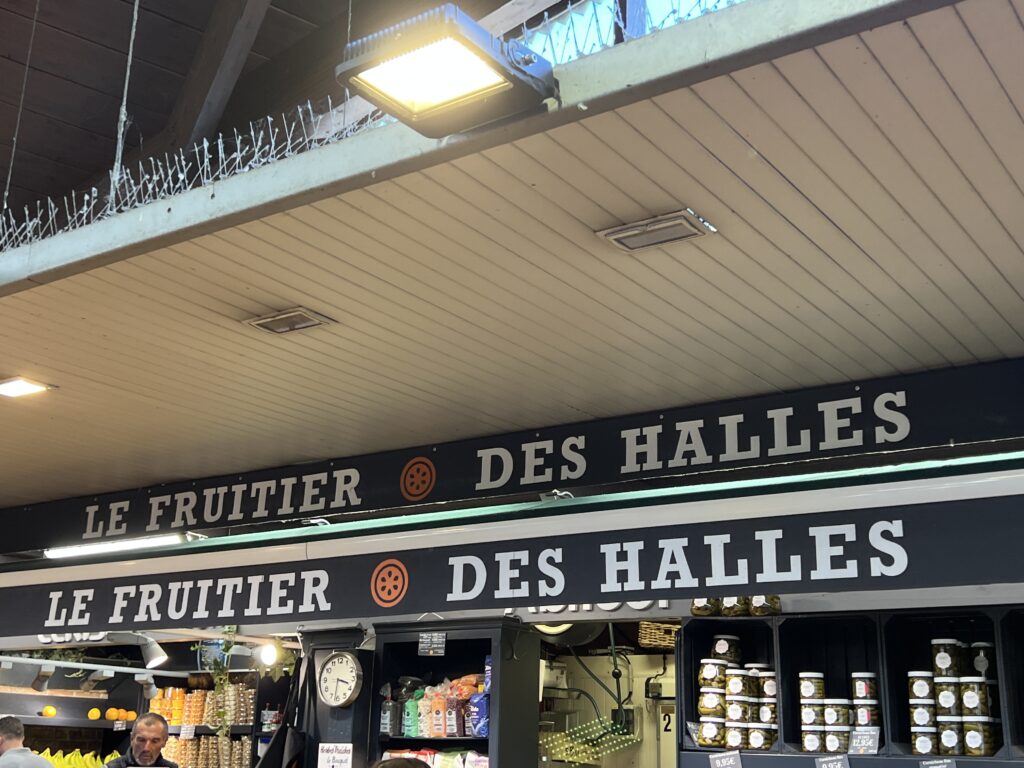
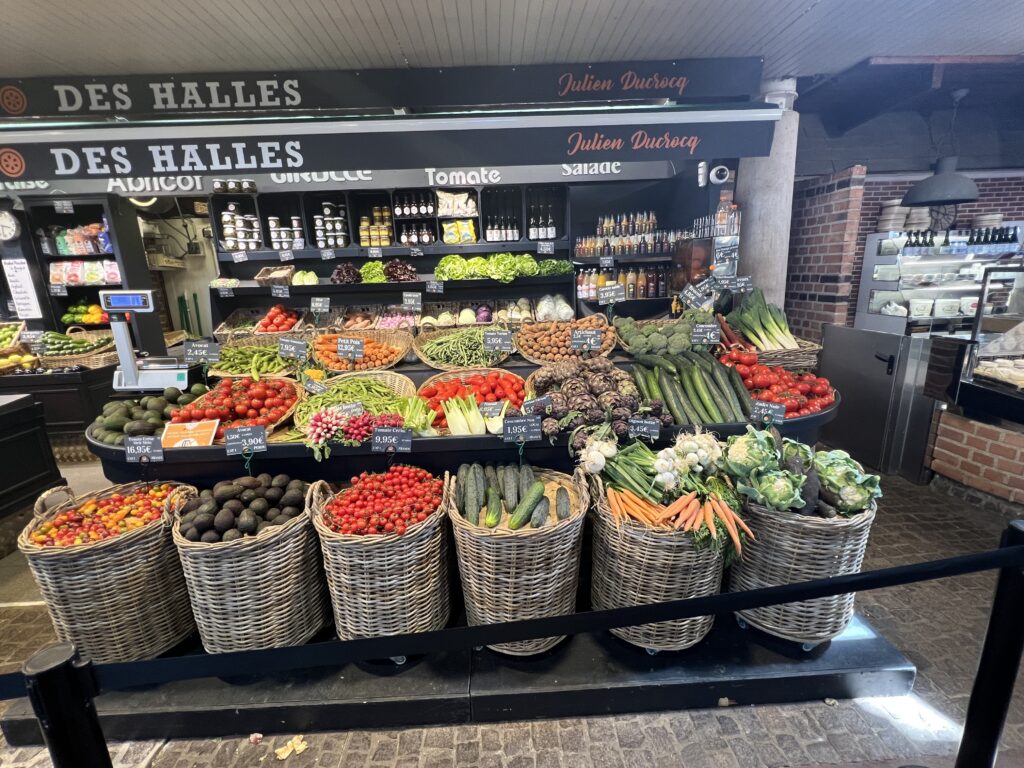
Videos of inside the market
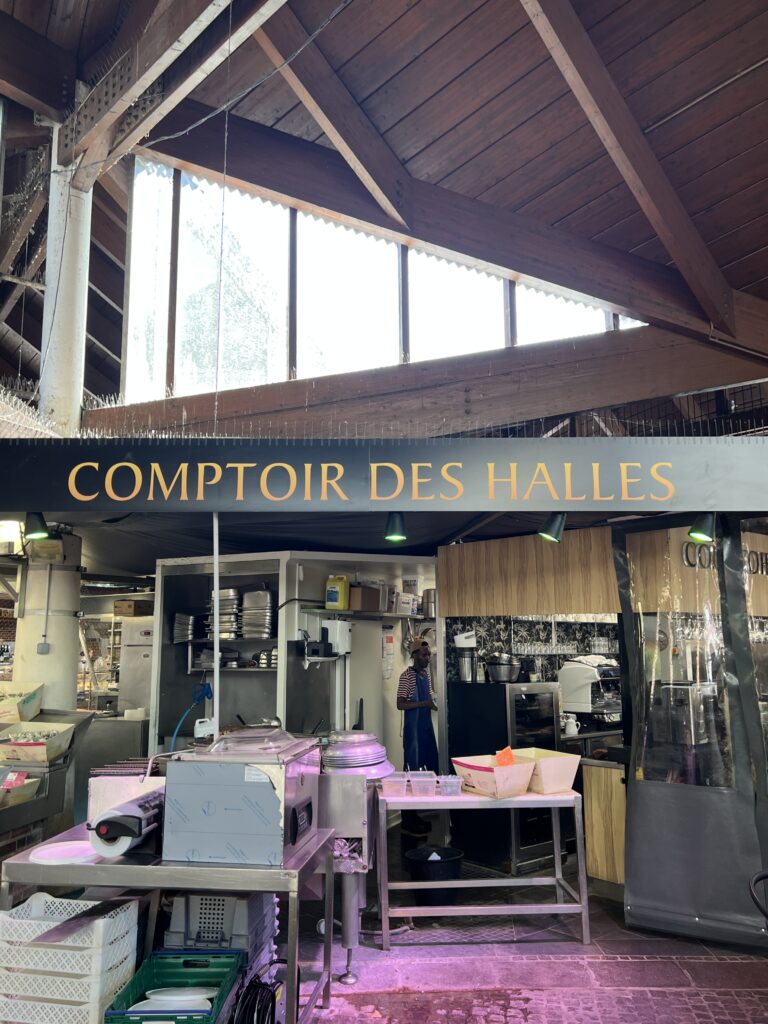
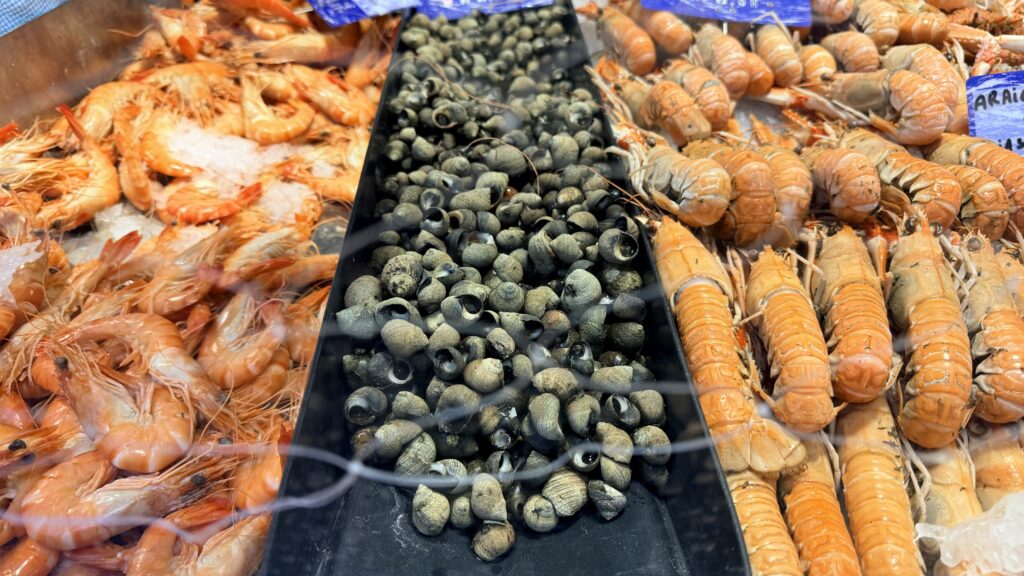
Photos inside the market
Rouen‘s Place du Vieux Marché, or Old Market Place, is best known as the spot where Joan of Arc was burned at the stake in 1431.
The modern Église Jeanne d’Arc dominates the center of the Place, which also hosts a daily market (except Monday).
Today the Place is also the centerpiece of a restaurant area, which includes La Couronne, best known as the restaurant where American TV chef Julia Child enjoyed her first meal in France—sole meunière—and was introduced to French cuisine.
You’ll find yourself drawn to the Place for a meal, or tea, or to get picnic goods, or to explore the interesting church.
It’s a great place for people watching as well, and just a short walk from the Cathédrale, the Gros Horloge, the Seine, and other points of interest.
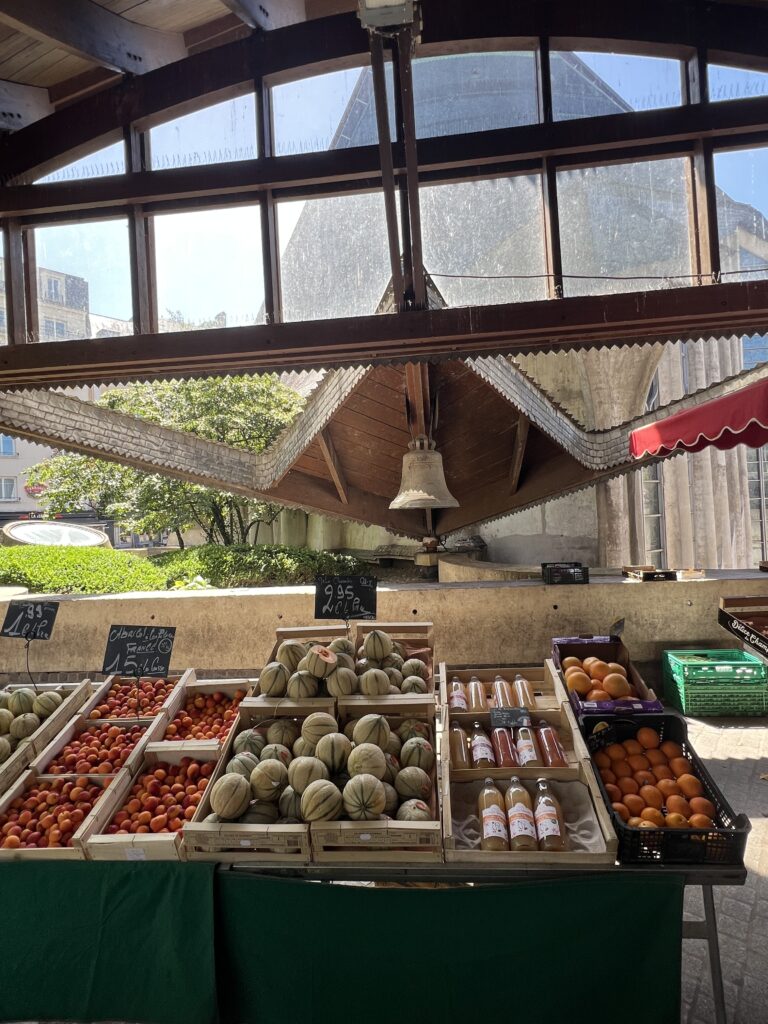
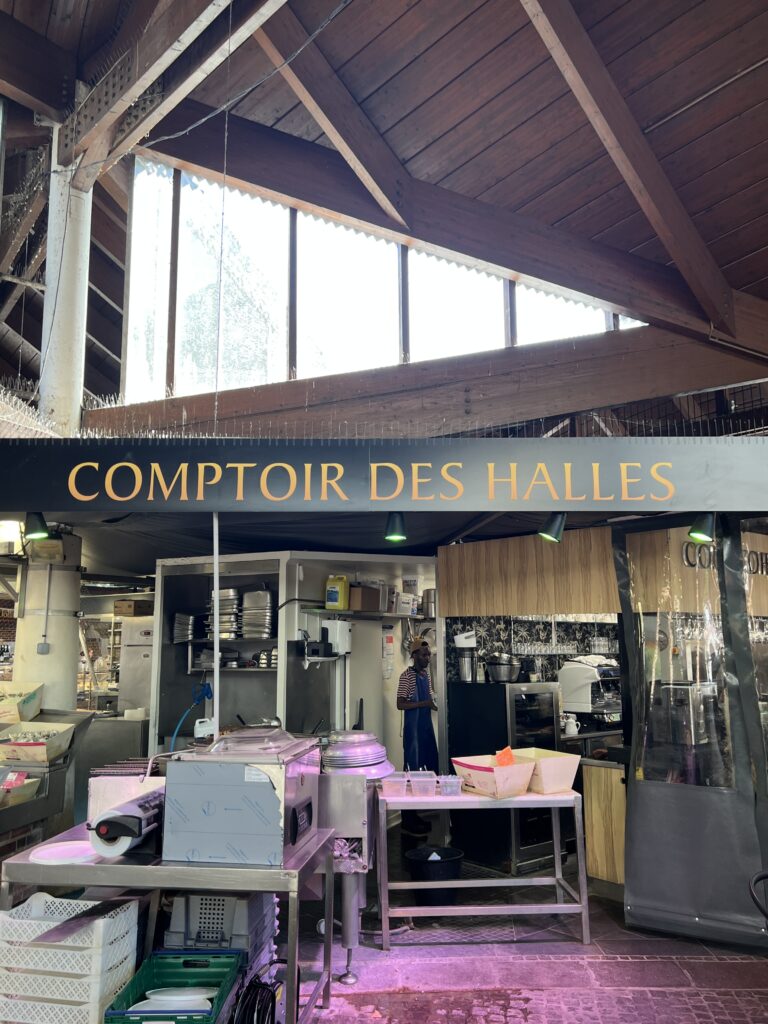
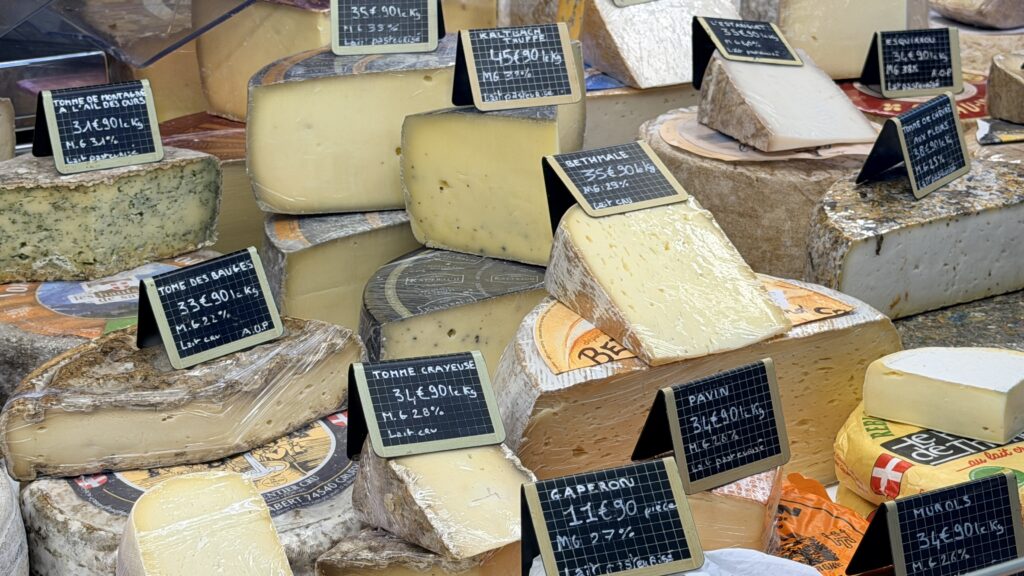
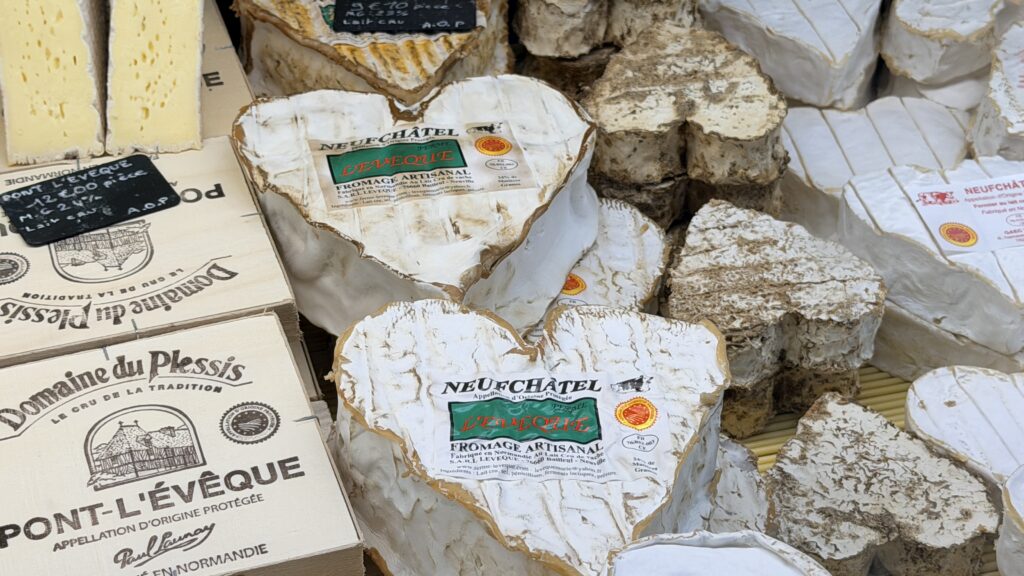
The Place du Vieux-Marché is a historic square on the right bank of the French commune of Rouen.
Location and access
The roads serving it are the streets of La Pie, Vieux-Palais, Crosne, Cauchoise and Gros-Horloge, as well as a lane of the Place de la Pucelle.
There is an underground car park and a Lovélo station.
Origin of the name
The name of the square refers to a market that was originally held there.
History
There are several half-timbered and/or corbelled houses, a large part of which is in fact only made up of old facades rebuilt at this location.
It housed the old church of Saint-Sauveur, destroyed during the Terror, in 1794-1795, but whose substructures were uncovered during the renovation of the square and are visible on the south side of the current church of Sainte-Jeanne d’Arc.
Pierre Corneille’s parents were buried in this church.
The fame of the square is linked to the torture of Joan of Arc who was burned alive on May 30, 1431. The site of the public executions with the pillory and the firewall wall for the pyres was exhumed at the same time as the foundations of the Saint-Sauveur church, during the excavations carried out from 1970 to 1976.
During the Second Empire, two covered markets were built on the square, which they turned into an active shopping centre. From the same period, and in a different register, the memory and worship of Joan of Arc became more significant and, with them, the concern to enhance the place of her martyrdom.
A cross was erected next to the site of the pyre, as had been stipulated during the annulment process (known as the “rehabilitation”) process in 1456. This cross has the value of a national monument in homage to Joan of Arc, erected in accordance with the law of 10 July 1920 instituting a national holiday of Joan of Arc, article 3 of which states: “A monument will be erected in honour of Joan of Arc, on the square of Rouen, where she was burned alive, with an inscription: To Joan of Arc THE GRATEFUL FRENCH PEOPLE.”
Rouen is known for Rouen Cathedral, with its Tour de Beurre (butter tower) financed by the sale of indulgences for the consumption of butter during Lent. The cathedral’s gothic façade (completed in the 16th century) was the subject of a series of paintings by Claude Monet, some of which are exhibited in the Musée d’Orsay in Paris.
The Gros Horloge is an astronomical clock dating back to the 14th century. It is located in the Gros Horloge street.
Other famous structures include Rouen Castle, whose keep is known as the tour Jeanne d’Arc, where Joan of Arc was brought in 1431 to be threatened with torture (contrary to popular belief, she was not imprisoned there but in the tour de lady Pucelle (since destroyed); the Church of Saint Ouen (12th–15th century); the Palais de Justice, which was once the seat of the Parlement (French court of law) of Normandy; the Gothic Church of St Maclou (15th century); and the Museum of Fine Arts and Ceramics which contains a splendid collection of faïence and porcelain for which Rouen was renowned during the 16th to 18th centuries. Rouen is also noted for its surviving half-timbered buildings.
There are many museums in Rouen: the Musée des Beaux-Arts de Rouen, an art museum with paintings by well-known artists such as Claude Monet and Géricault; the Musée maritime fluvial et portuaire, a museum on the history of the port of Rouen and navigation; Musée des Antiquités, an art and history museum with local works from the Bronze Age through the Renaissance; the Musée de la céramique, the Museum of Natural History, founded in 1834 and re-opened in 2007;and the Musée Le Secq des Tournelles, which houses various collections of objects.
The Jardin des Plantes de Rouen is a notable botanical garden once owned by Scottish banker John Law, dating from 1840 in its present form. It was the site of Élisa Garnerin‘s parachute jump from a balloon in 1817. There is also a park and garden at the Champs de Mars, to the east of the city center. The Paris–Rouen motor race of 1894, Le Petit Journal Horseless Carriages Contest, ended at the Champs de Mars.
In the center of the Place du Vieux Marché (the site of Joan of Arc’s pyre) is the modern church of St Joan of Arc. This is a large, modern structure which dominates the square. The form of the building represents an upturned Viking boat and a fish shape.
Rouen was also home to the French Grand Prix, hosting the race at the nearby Rouen-Les-Essarts track sporadically between 1952 and 1968. In 1999 Rouen authorities demolished the grandstands and other remnants of Rouen’s racing past. Today, little remains beyond the public roads that formed the circuit.
Rouen has an opera house, whose formal name is “Rouen Normandy Opera House – Theatre of Arts” (in French: Opéra de Rouen Normandie – Théâtre des arts).
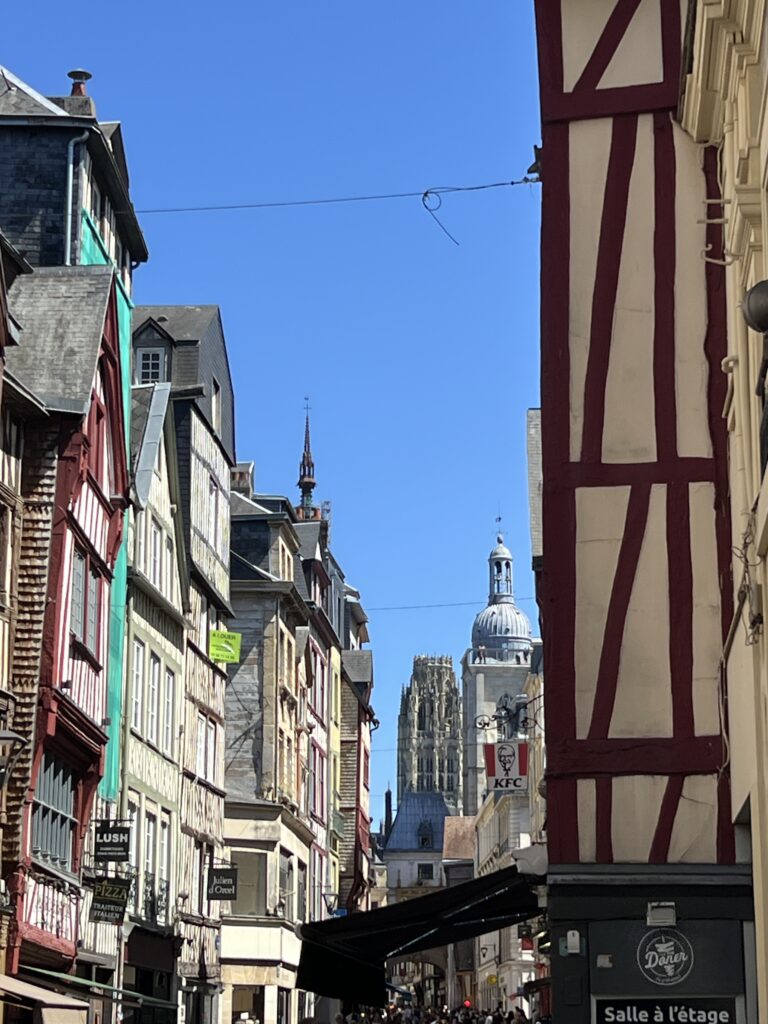
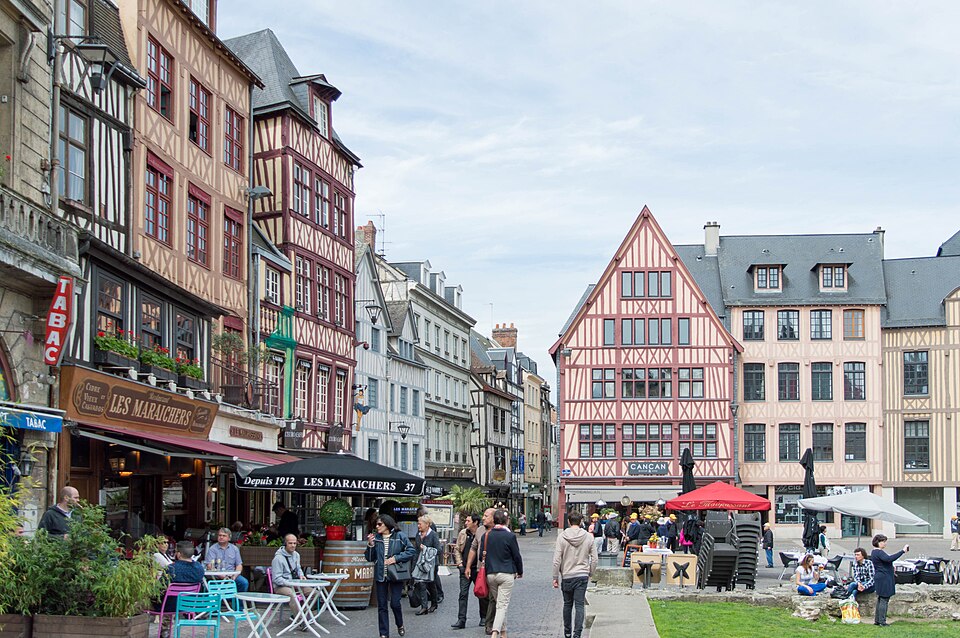
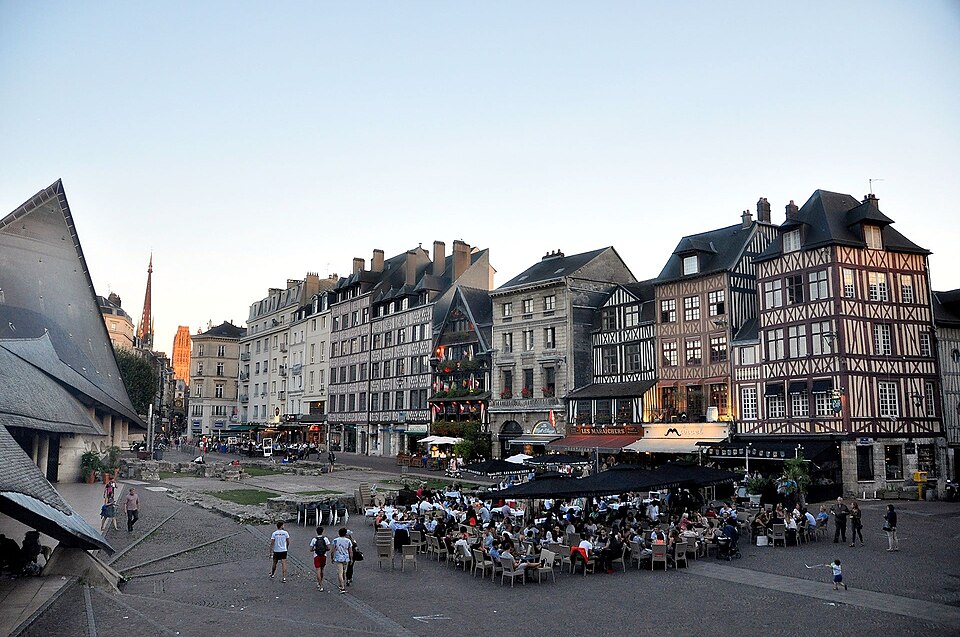
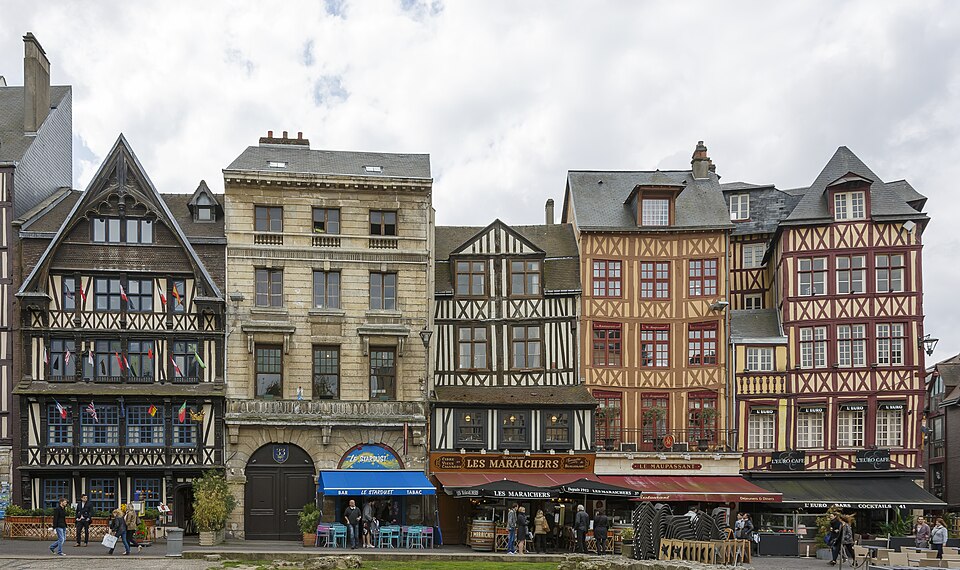
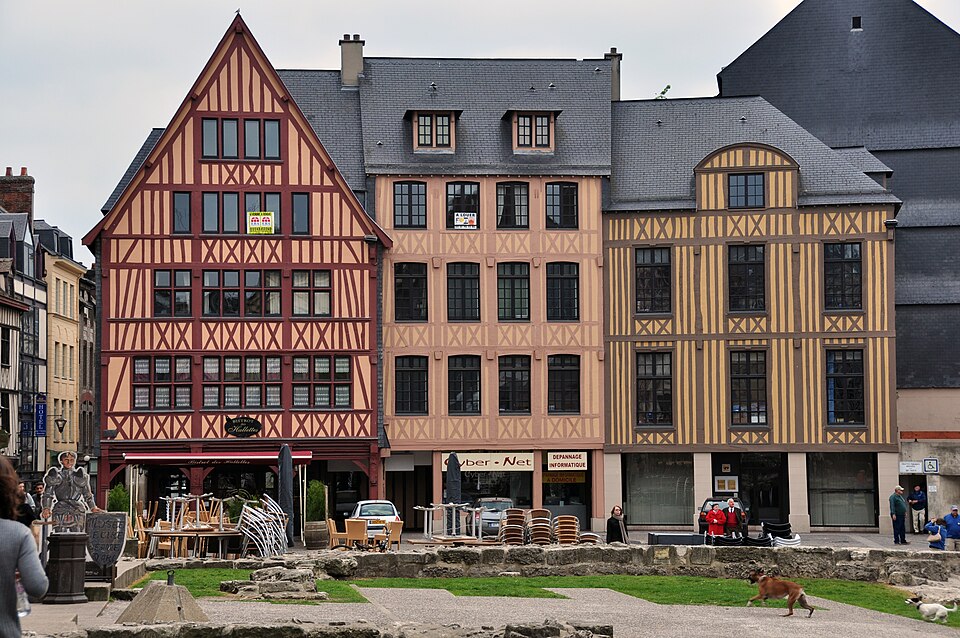
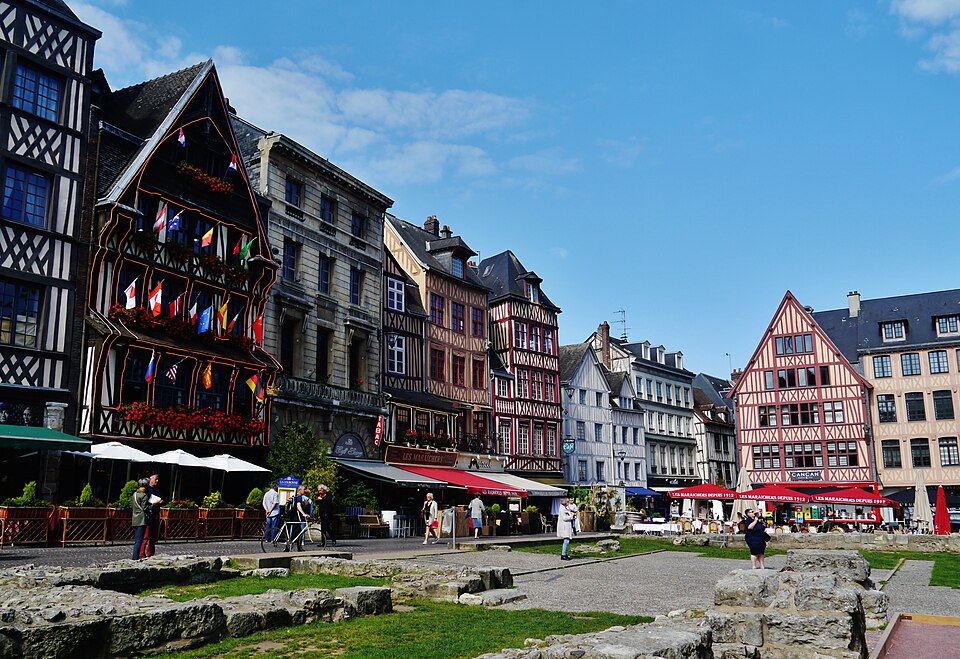
Photo taken by Ken and Jean. They were with us on the Chobe Safari and Ken takes some great 360 photos with a few below of the tour group in the market area
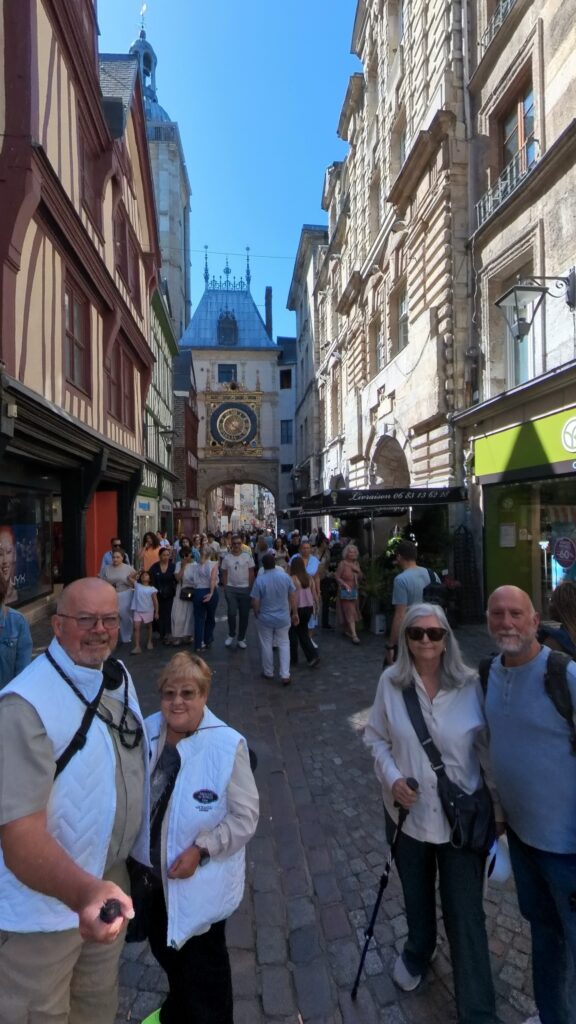
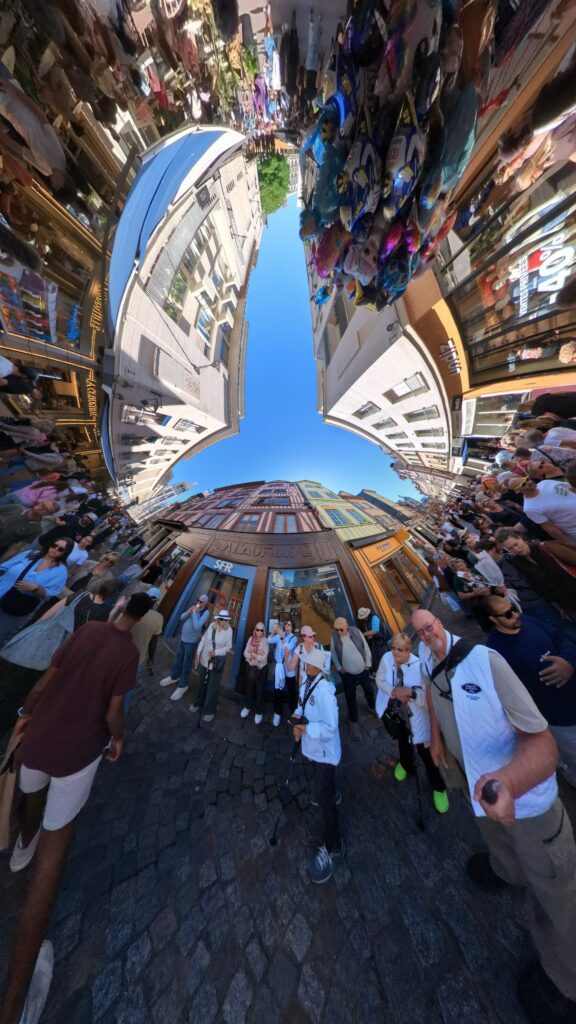
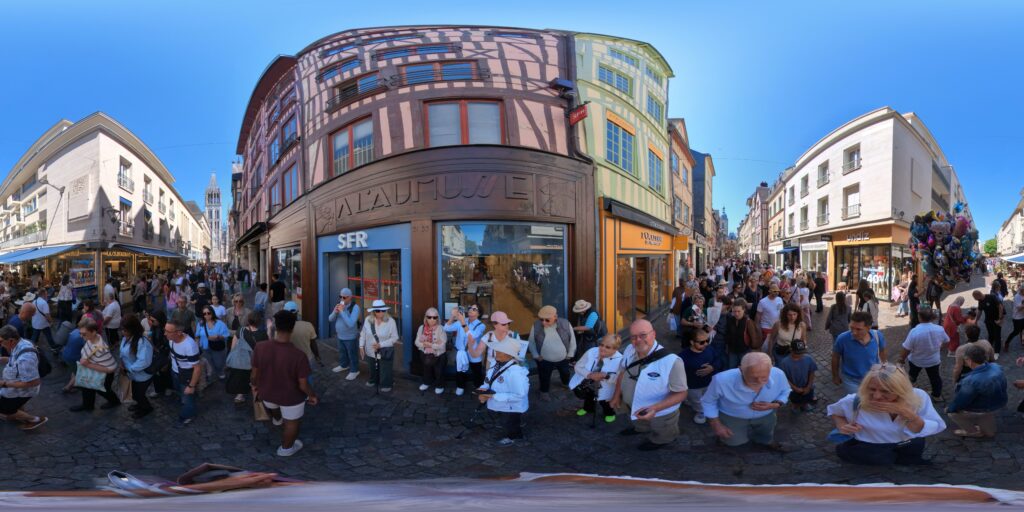
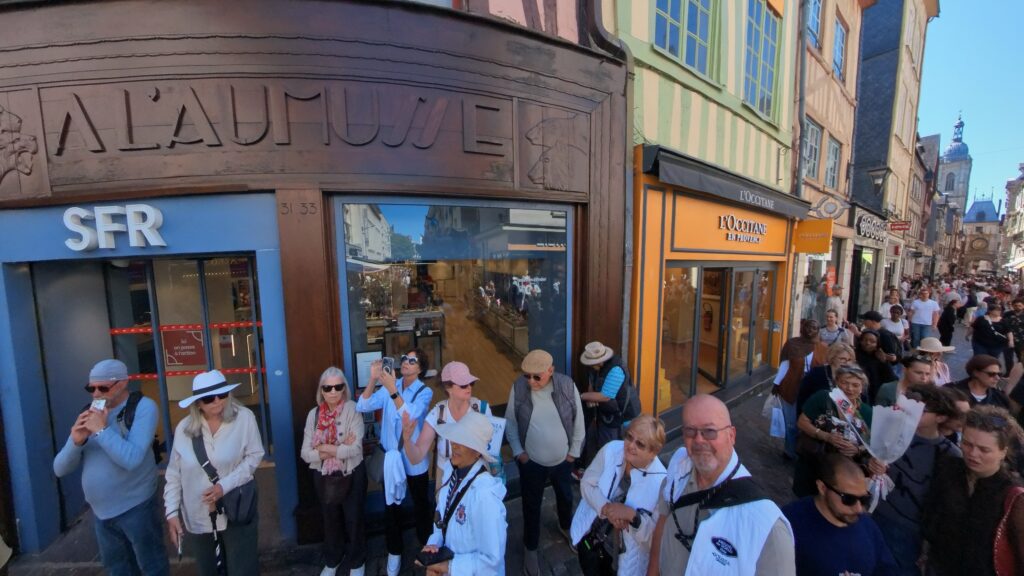
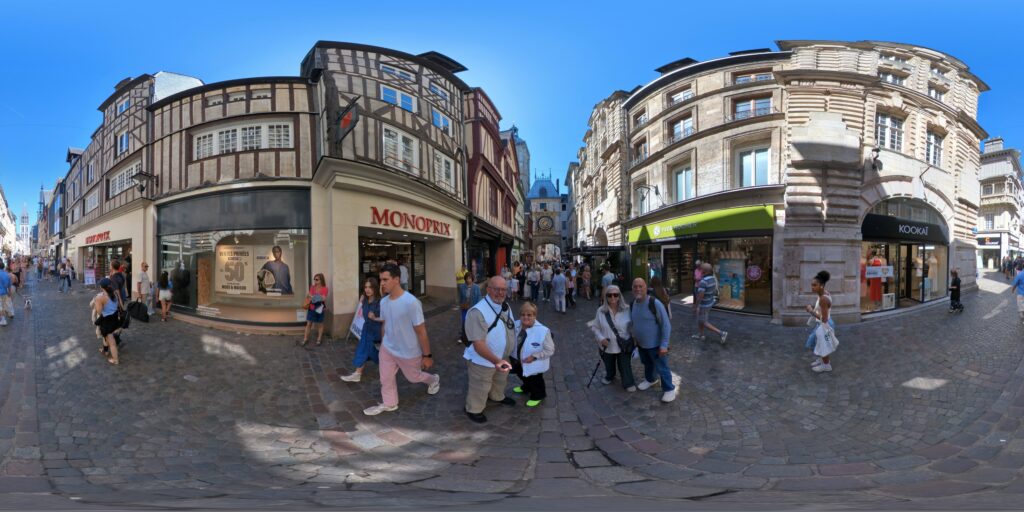
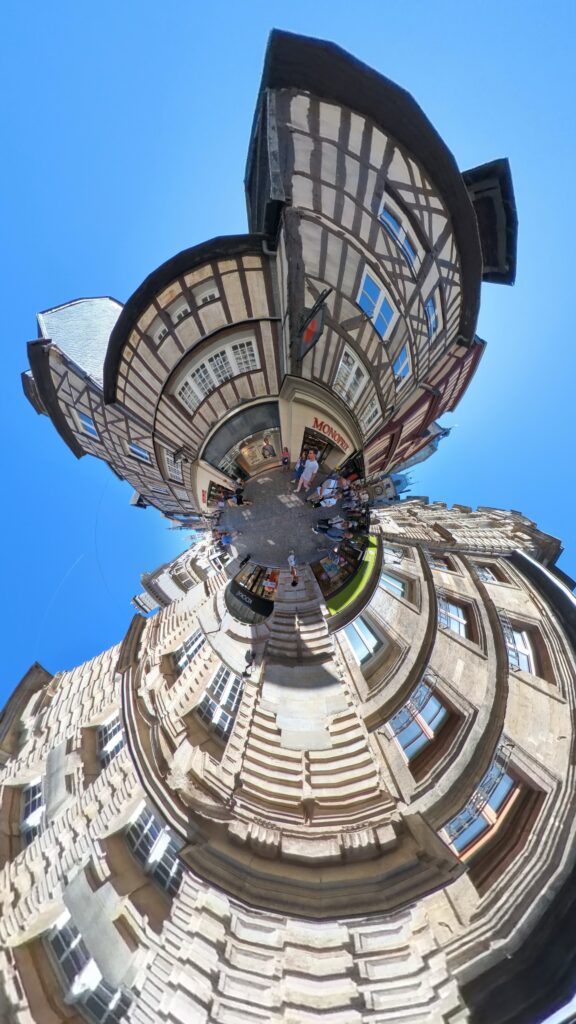
Walking towards the Rouen Cathedral from the Old Market
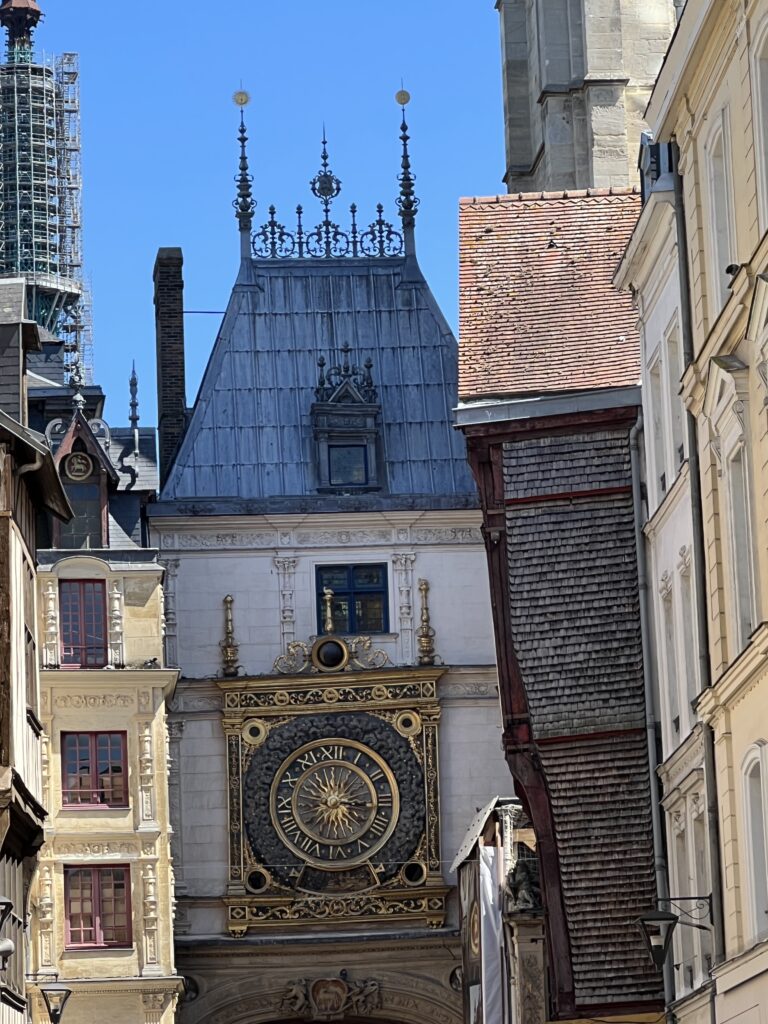
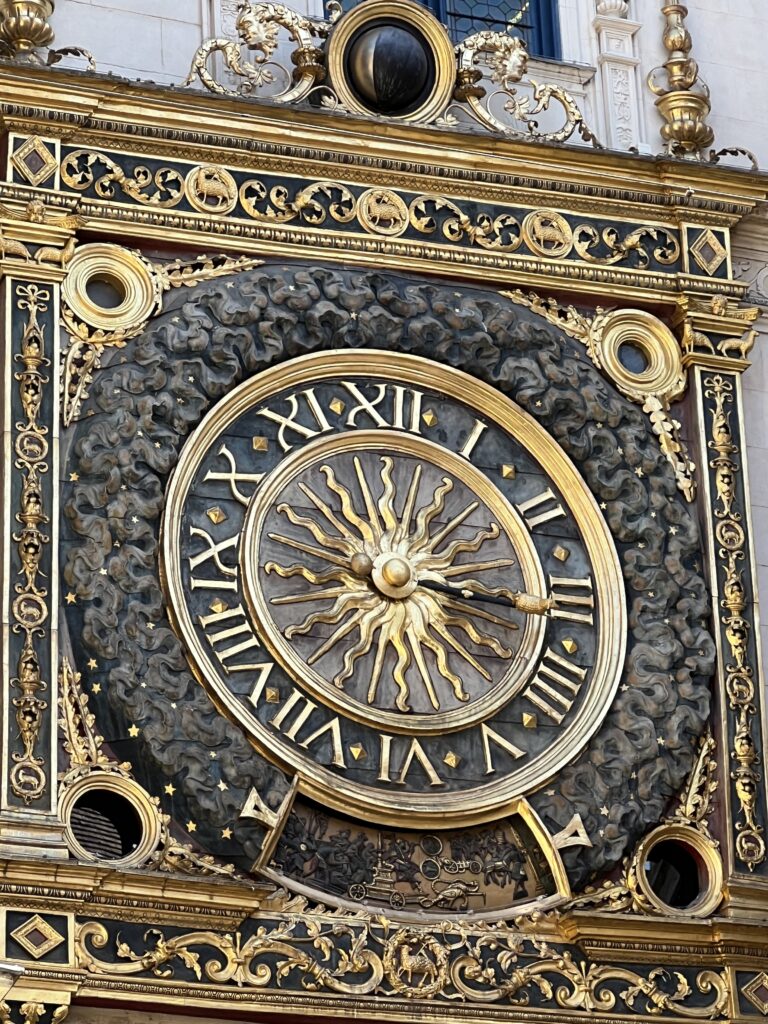
The Gros-Horloge (English: Great Clock) is an astronomical clock from the 14th century in Rouen, Normandy.
The clock is installed in a Renaissance arch crossing the Rue du Gros-Horloge. The mechanism is one of the oldest in France, the movement having been made in 1389. Construction of the clock was started by Jourdain del Leche who lacked the necessary expertise to finish the task, so the work was completed by Jean de Felain, who became the first to hold the position of governor of the clock.
The clock was originally constructed without a dial, with one revolution of the hour-hand representing twenty-four hours. The movement is cast in wrought iron, and at approximately twice the size of the Wells Cathedral clock, it is perhaps the largest such mechanism still extant. A facade was added in 1529 when the clock was moved to its current position. The mechanism was electrified in the 1920s and it was restored in 1997. As of 17 September 2025, the clock movement itself is fully functional. There is an electrical solenoid that rings one of the two bells in the tower on the 1/4 hr.
The Renaissance facade represents a golden sun with 24 rays on a starry blue background. The dial measures 2.5 meters (25 dm; 250 cm) in diameter. The phases of the moon are shown in the oculus of the upper part of the dial. It completes a full rotation in 29 days. The week days are shown in an opening at the base of the dial with allegorical subjects for each day of the week.
The Gros Horloge has featured in paintings by J. M. W. Turner and the French impressionist Léon-Jules Lemaître.
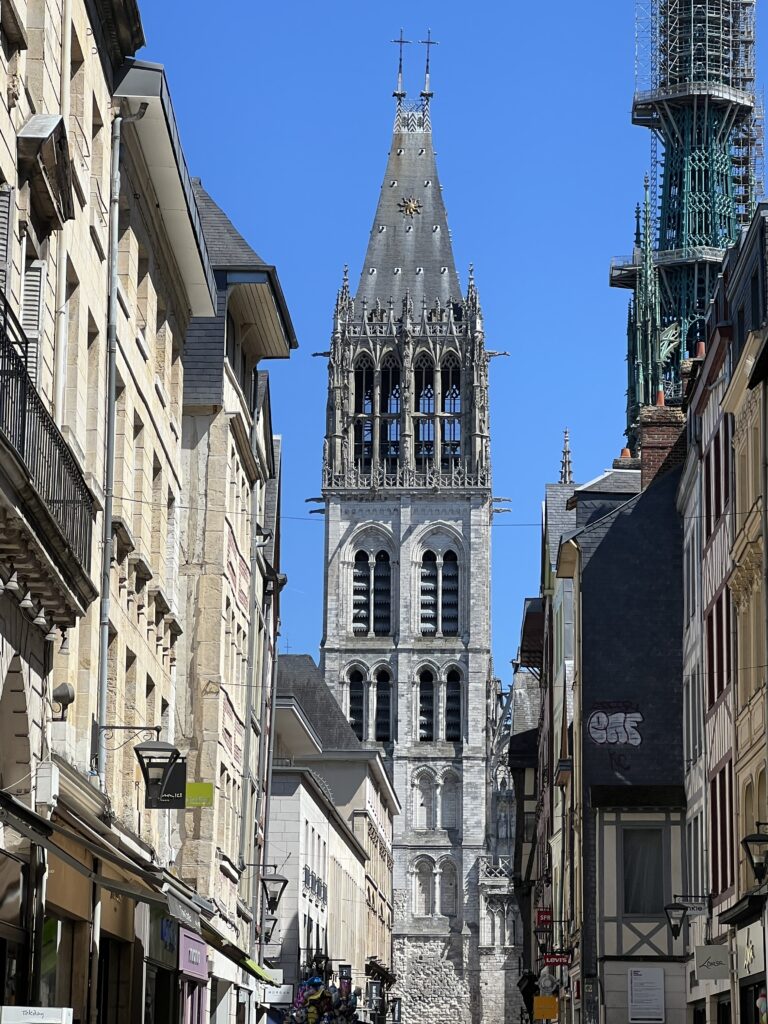
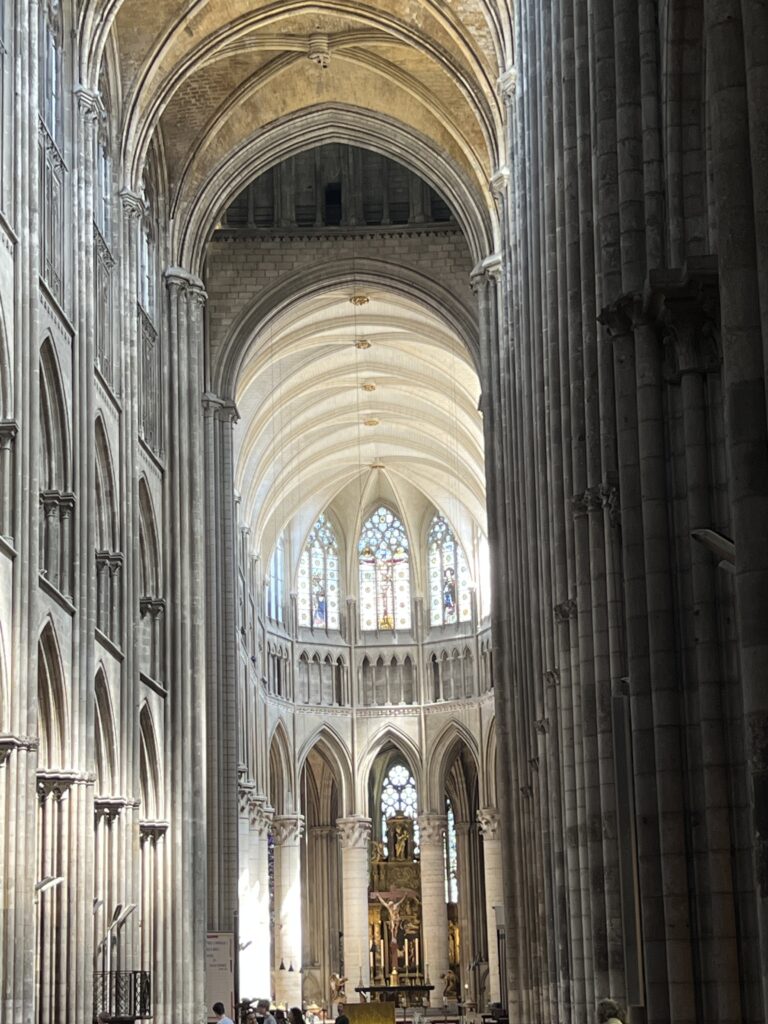
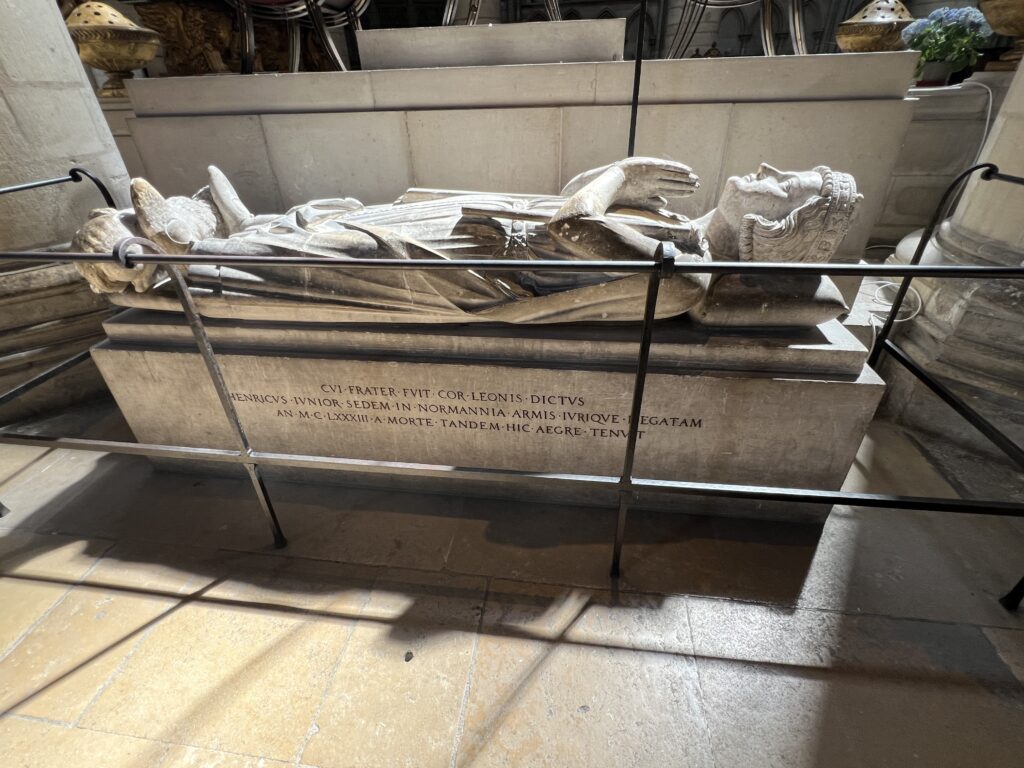
Rouen Cathedral (French: Cathédrale primatiale Notre-Dame de l’Assomption de Rouen) is a Catholic church in Rouen, Normandy, France. It is the see of the Archbishop of Rouen, Primate of Normandy. It is famous for its three towers, each in a different style. The cathedral, built and rebuilt over a period of more than eight hundred years, has features from Early Gothic to late Flamboyant and Renaissance architecture.It also has a place in art history as the subject of a series of impressionist paintings by Claude Monet, and in architecture history, as from 1876 to 1880 it was the tallest building in the world.
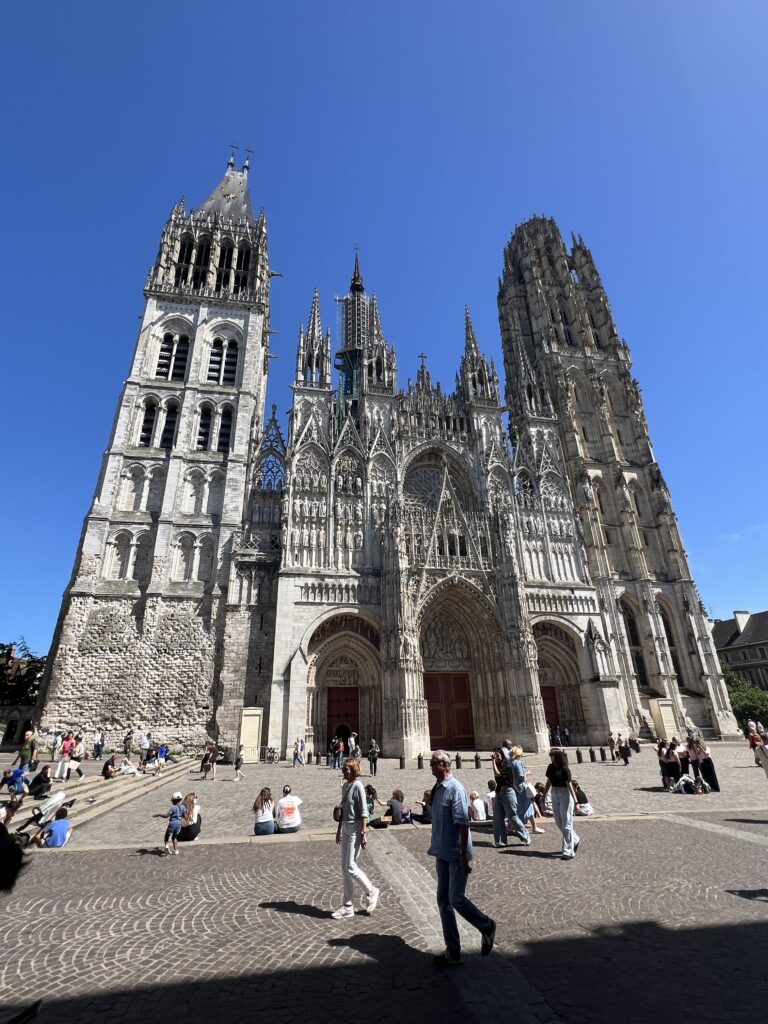
The west front of the Cathedral, with its three portals, is the traditional entrance to the Cathedral. The portals are aligned with the three aisles of the nave. The west front was first built in the 12th century, entirely redone in the 13th century, and then totally redone again at the end of the 14th century, each time become more lavishly decorated.
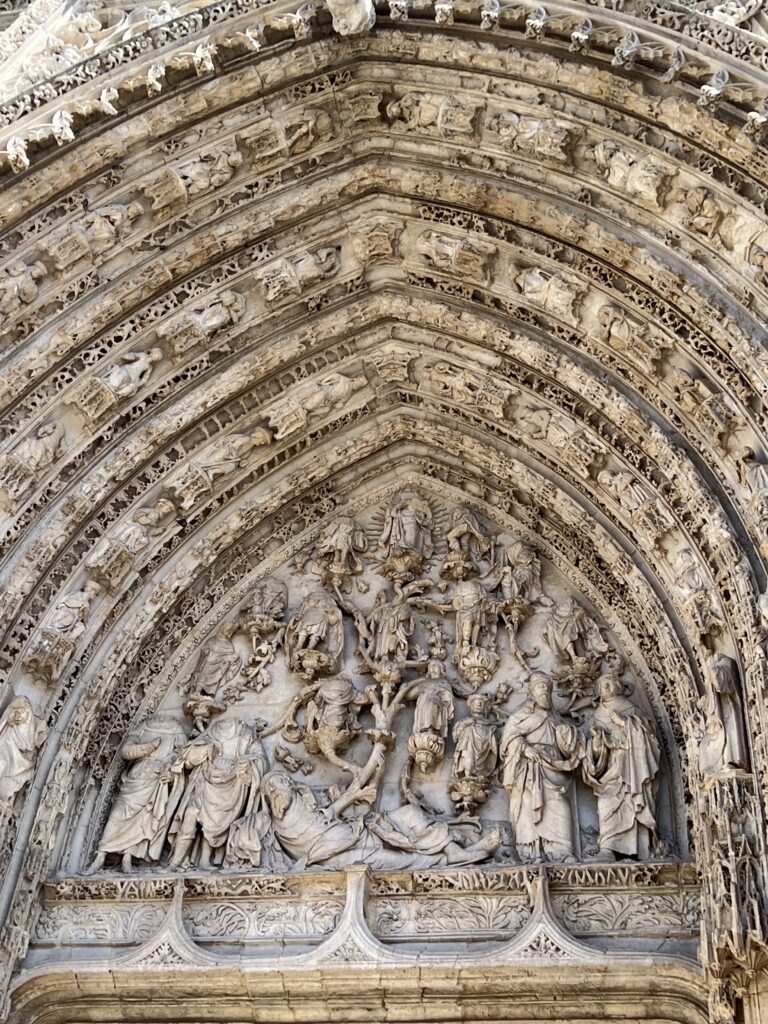
The main, or central portal, was originally dedicated to St. Romain in the 12th century, but was rededicated to the Virgin Mary when the facade was remade on a grander scale at the beginning of the 14th century. The central sculptural element of the tympanum, or arch over the portal, is a Tree of Jesse, a traditional depiction of the family tree of Christ. At the top is the Virgin Mary, with a halo of sun and stars. The arches above the tympanum of the portal are filled with sculpture of prophets, sibyls, or fortune-tellers, and patriarchs.
The portals on either side of the central portal followed the same format, with sculpture in the tympanum vividly illustrating Biblical stories. The central portal, facing the building, is dedicated to John the Evangelist, and the sculpture in the tympanum above illustrates the baptism of Christ, the passage of Saint John; the dance of Salome; the feast of Herod; and the beheading of John the Baptist. The portal to the right is devoted to Saint Stephen, and its sculpture illustrates the gathering of souls, Christ in majesty, and the stoning of Stephen. The portal to the Traces of pigment and gilding on the sculpture indicate that all the sculpture was originally brightly colored.
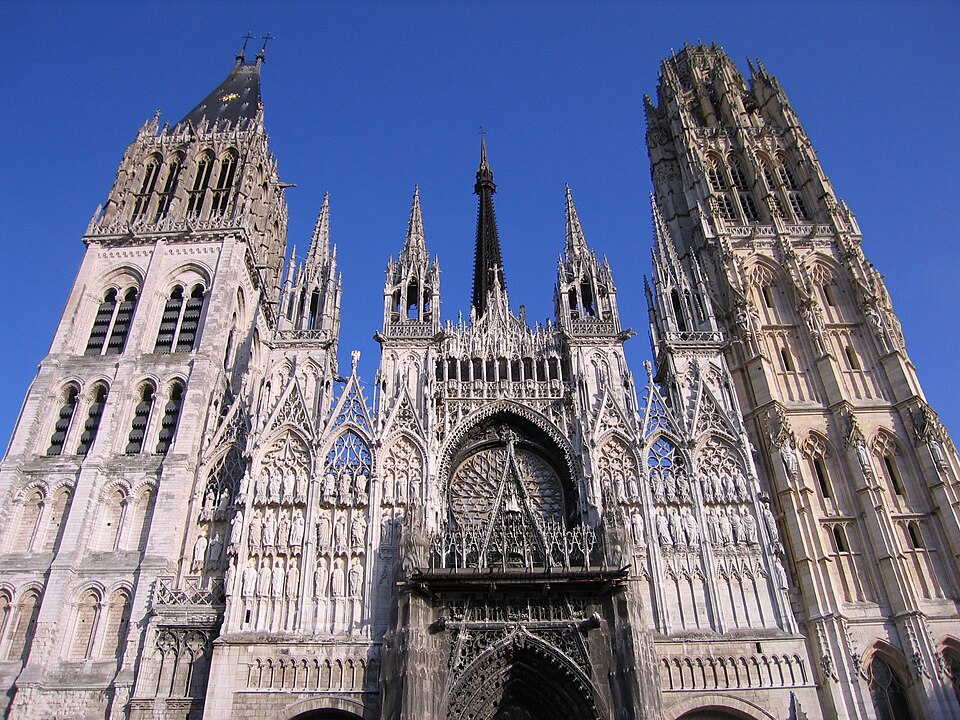
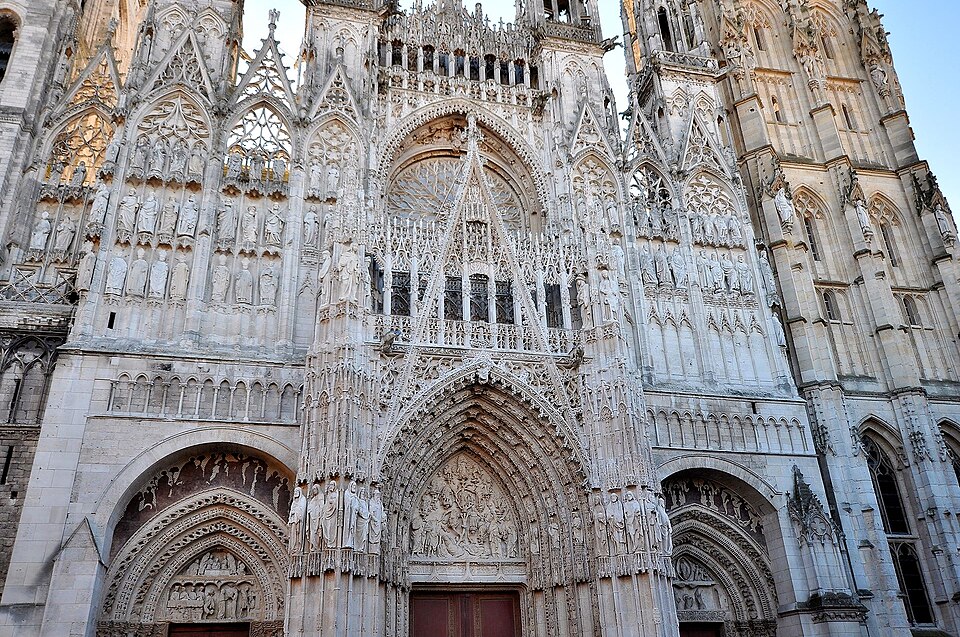
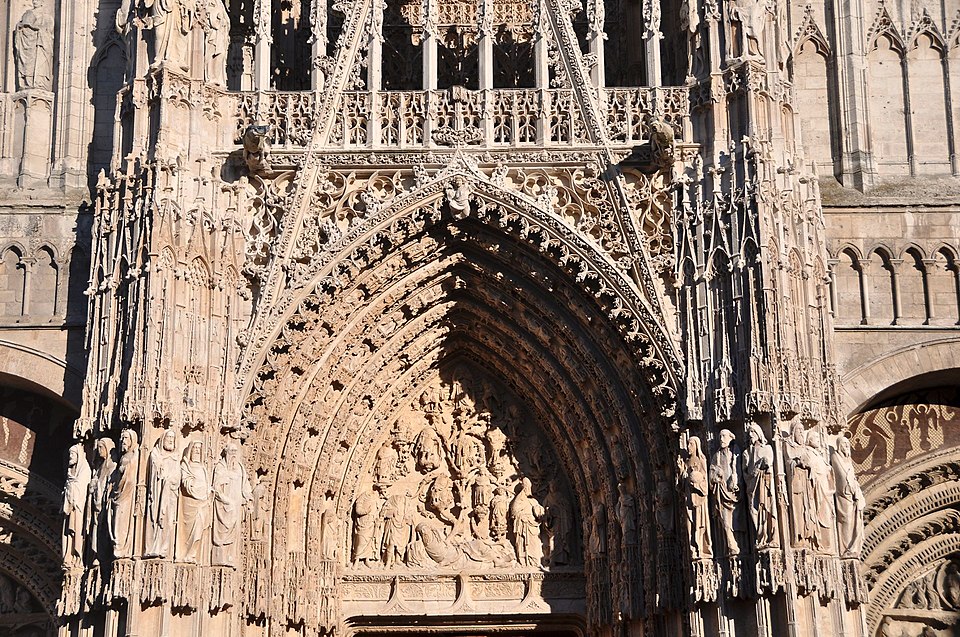
Details of the sculpture in the Voussures over the Portal of Notre-Dame
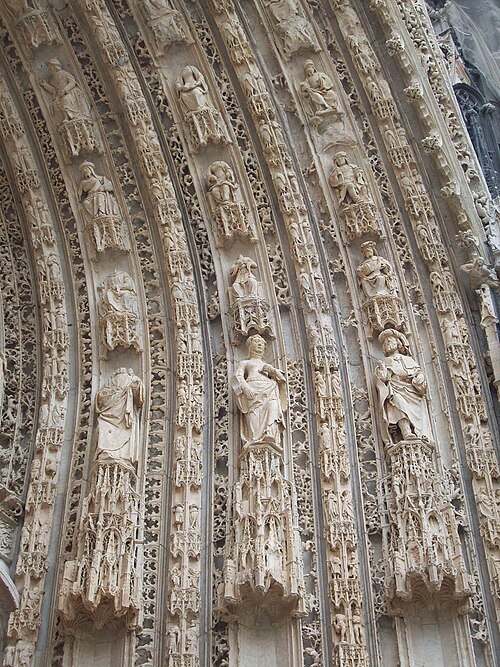
Detail of the portal of St. Stephen
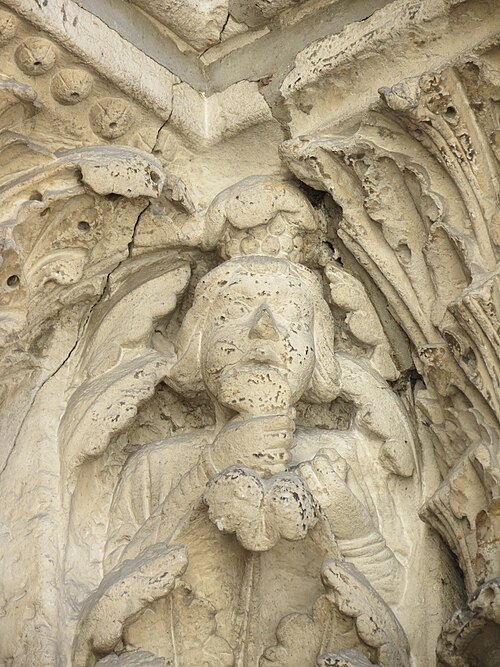
Detail of the Portal of Saint John
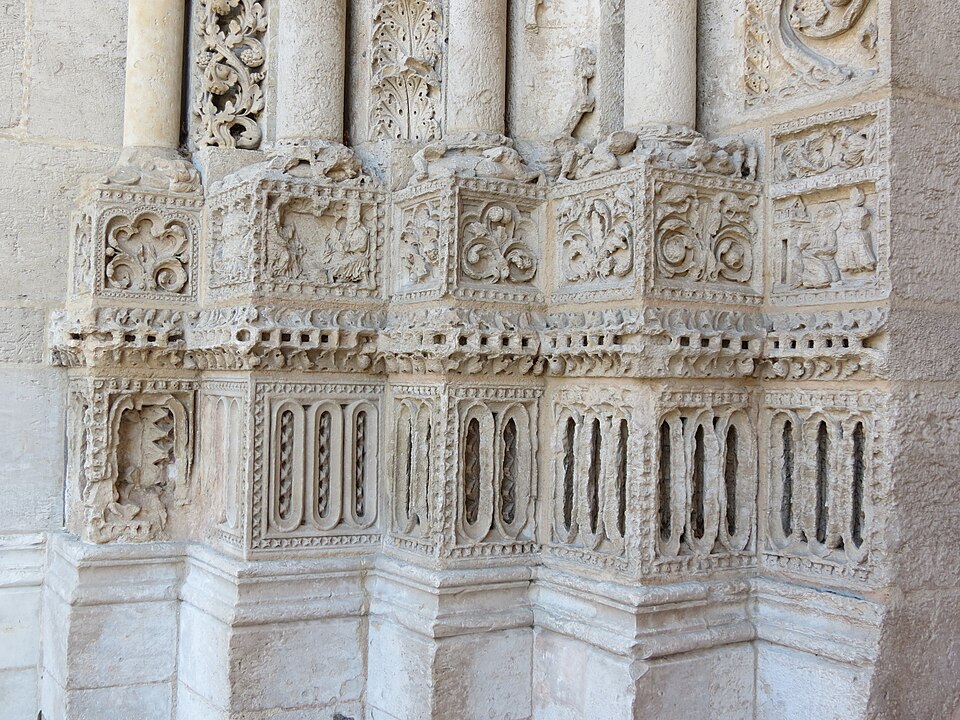
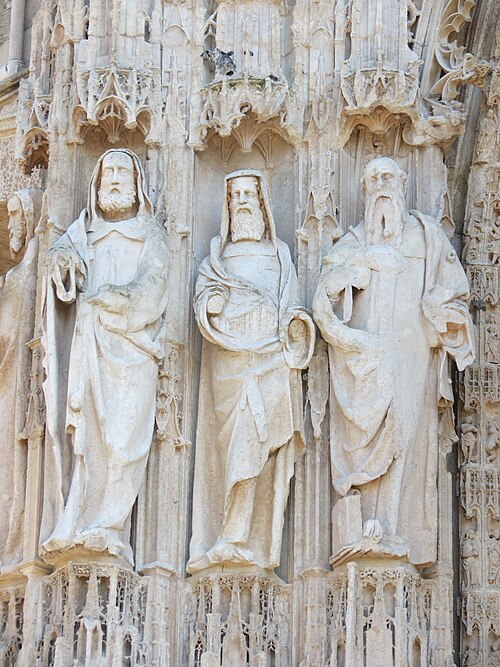
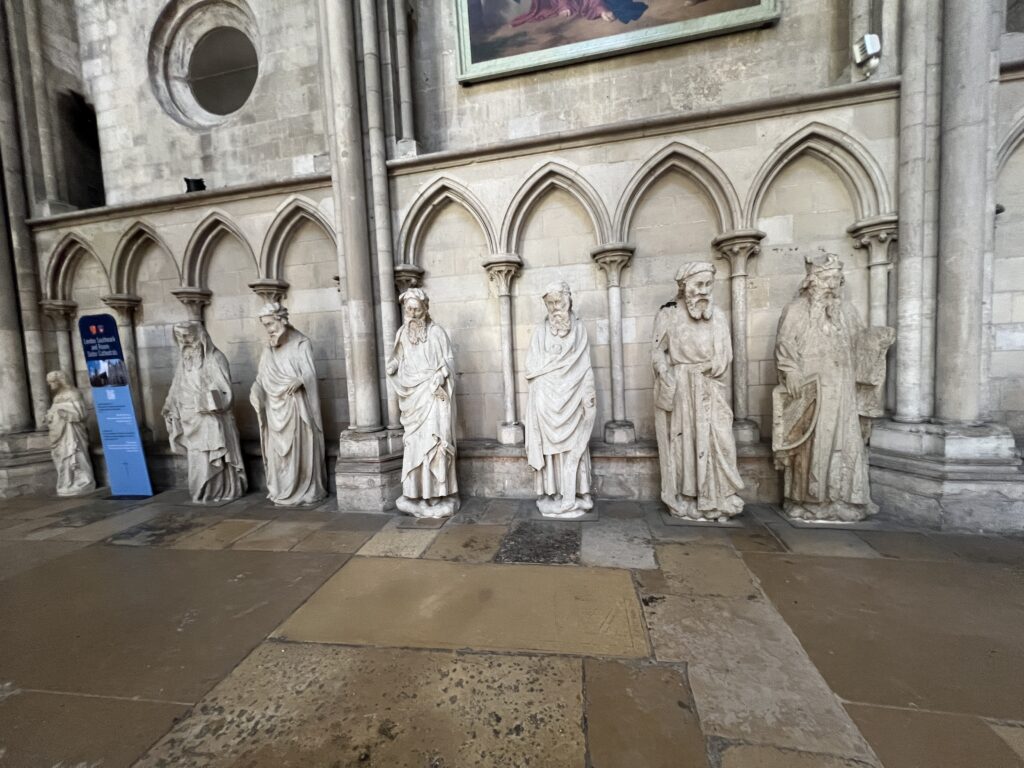
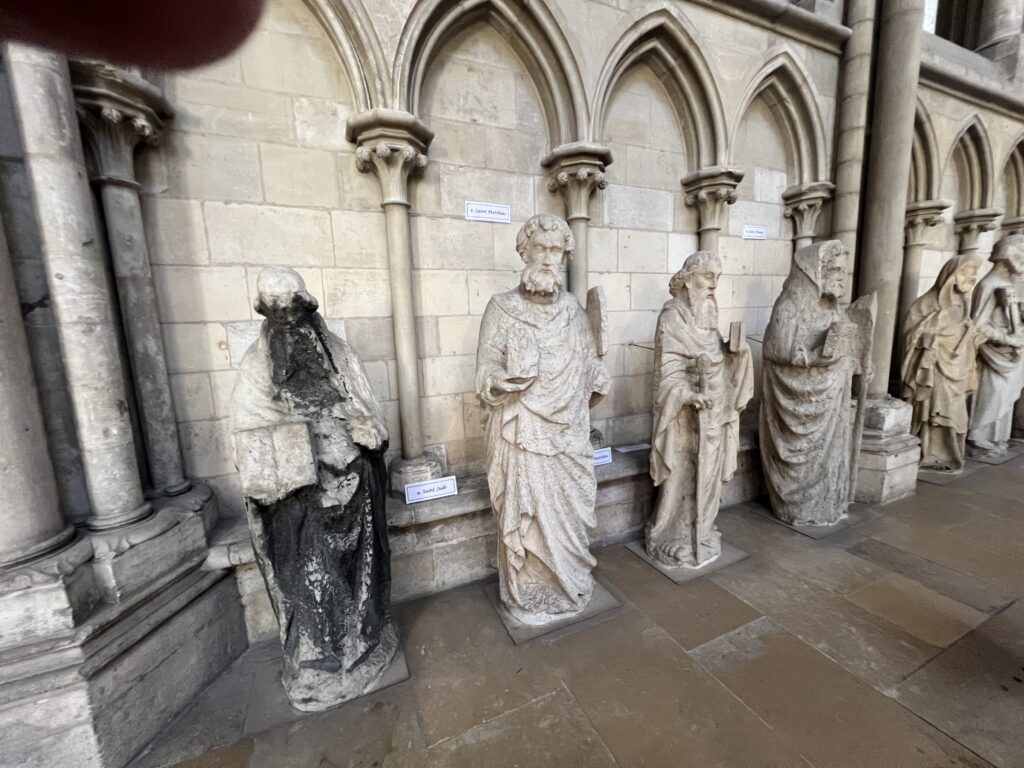
Sculpture of Apostles on the North Buttress
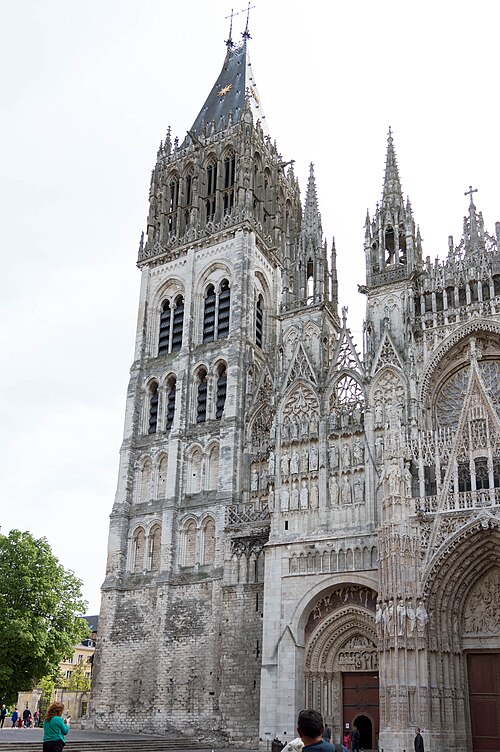
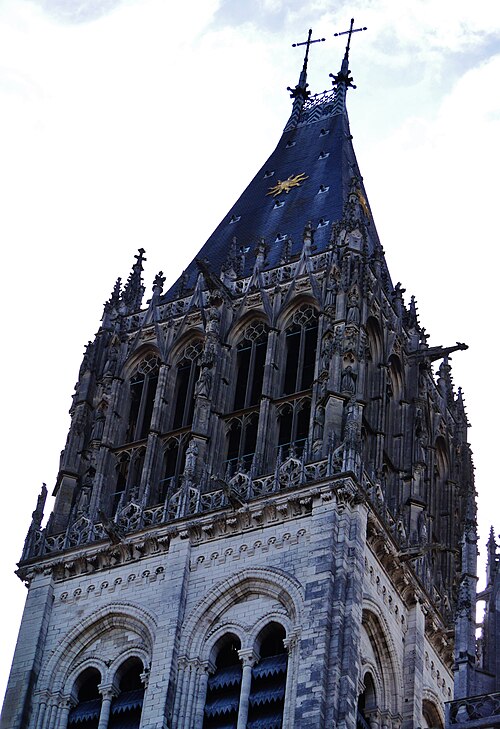
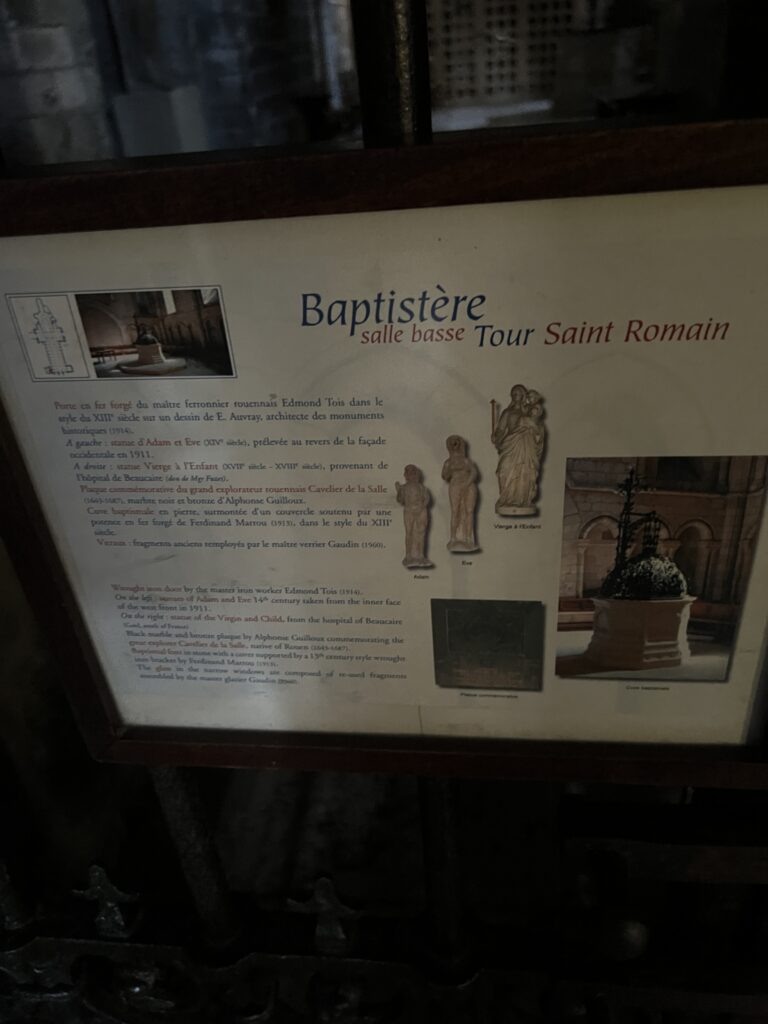
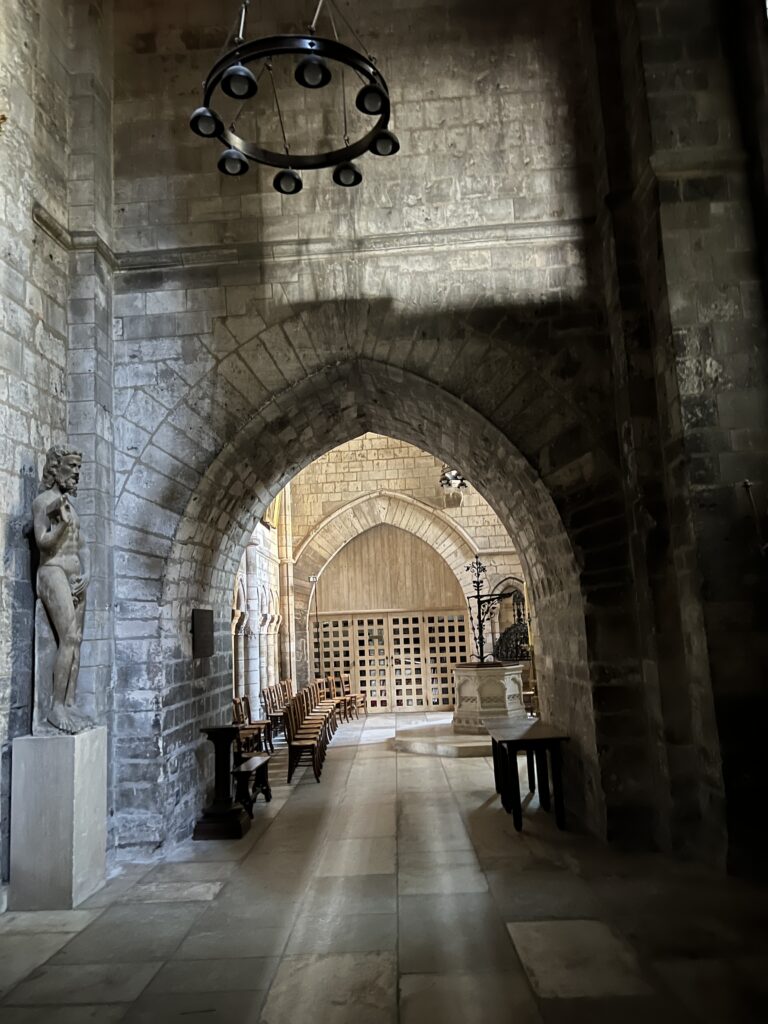
The Saint-Romain tower, on the left facing the west front, was begun in 1145 as part of the original Gothic cathedral. The top of the tower, more decorative, was added in the 15th century. Like the Butter tower on the right side, it is separated from and slightly behind the main block of the west front. The ground level has no windows, and contains the Baptistry. Above is a tall vaulted space with four levels of bays, topped by a very ornate belfry. This contains the bourdon or largest Cathedral bell, named Joan of Arc, which weighs 9.5 tons. It also houses the sixty-four smaller bells of the carillon, which was restored in 2016. It is the second-largest carillon in France. The roof of the tower is decorated with sculptures of four small suns, made of gilded lead.
Saint-Romain tower
Top of the Saint-Romain tower
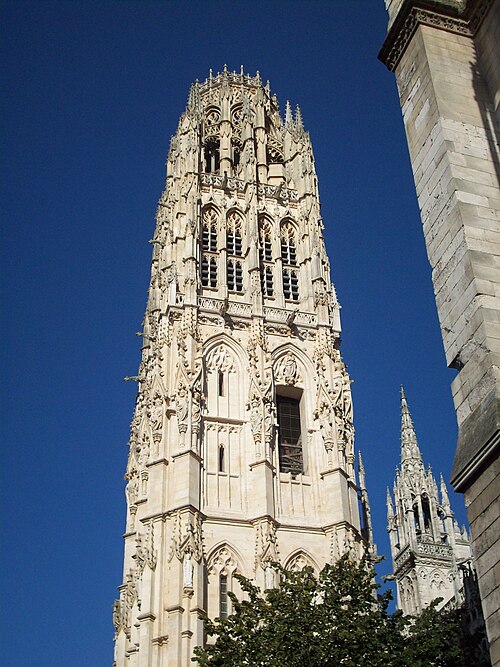
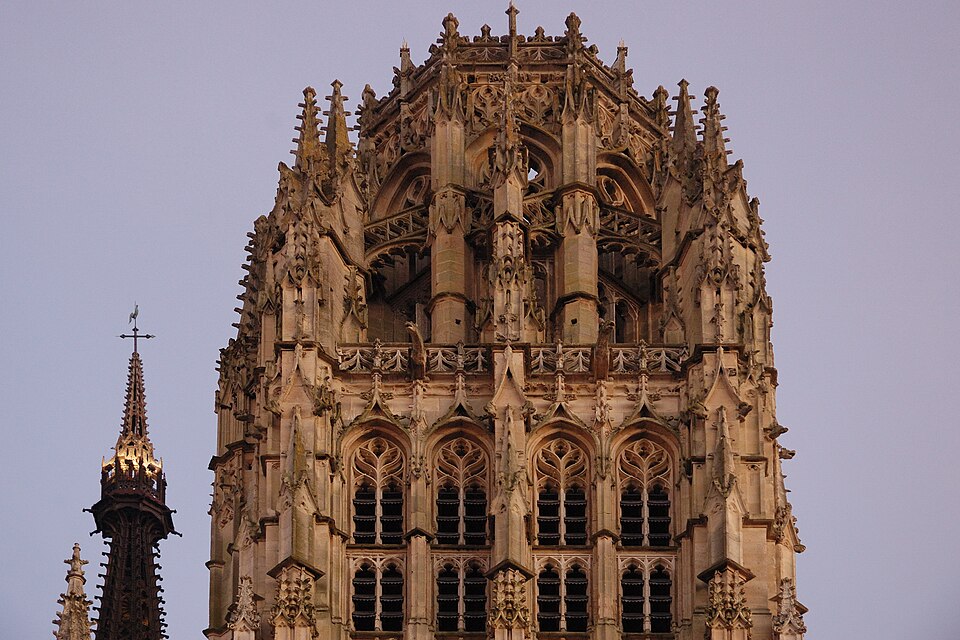
The Butter Tower was constructed between 1488 and 1506, in a late Gothic Flamboyant style. It received its popular name because donors to the tower were given dispensation to consume butter and milk during Lent. The dense decoration of the tower emphasises its height; tall pointed niches for sculpture, buttresses decorated with tracery, pinnacles, gables and arches. At the top, the square plan of the tower becomes an octagon, with an ornate stone crown.
A bell for the Butter Tower, named Georges d’Amboise in honor of the Cardinal, was completed in 1501. It cracked in 1786 and was melted down during the French Revolution.
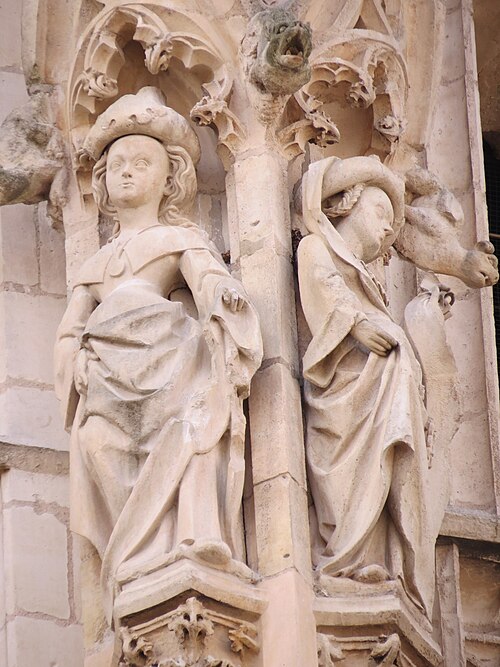
Sculpture on the Butter Tower
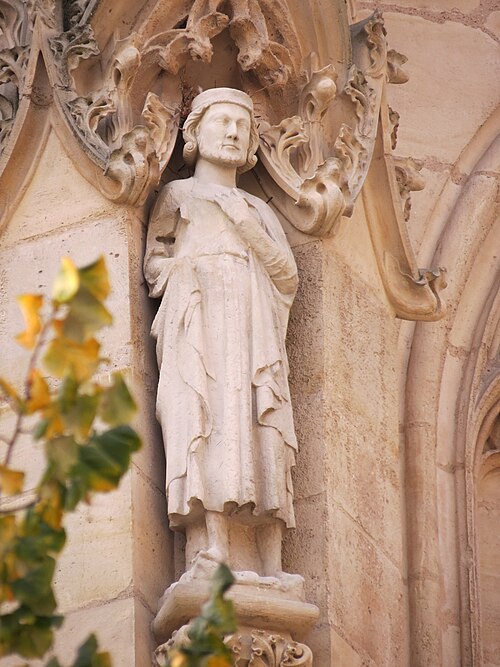
The Butter Tower
Top of the Butter Tower
Sculpture and gargoyles on the Butter Tower
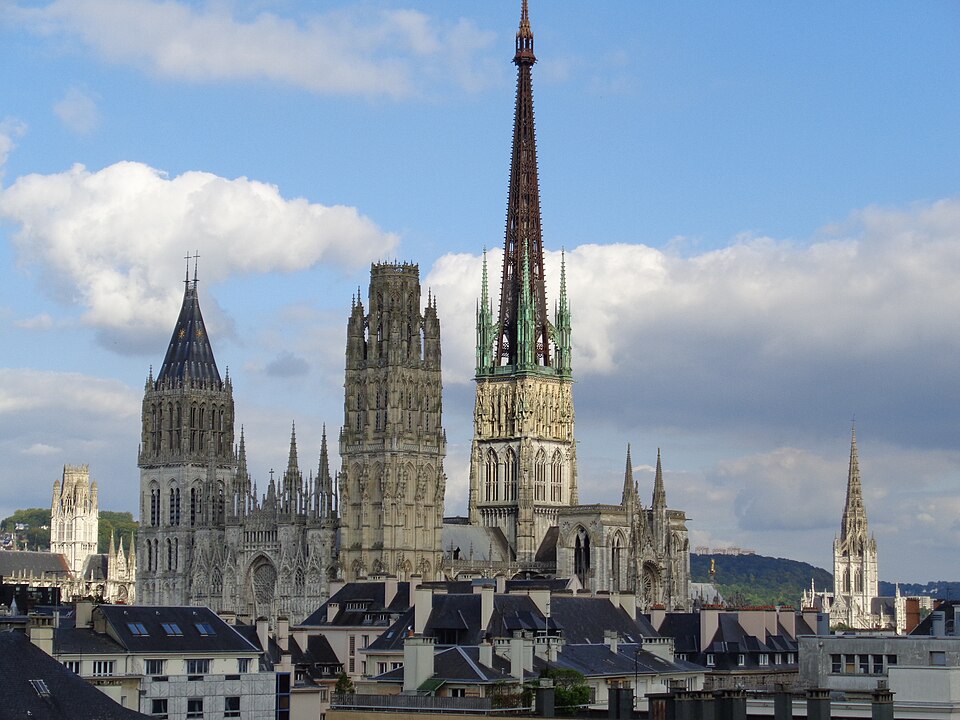
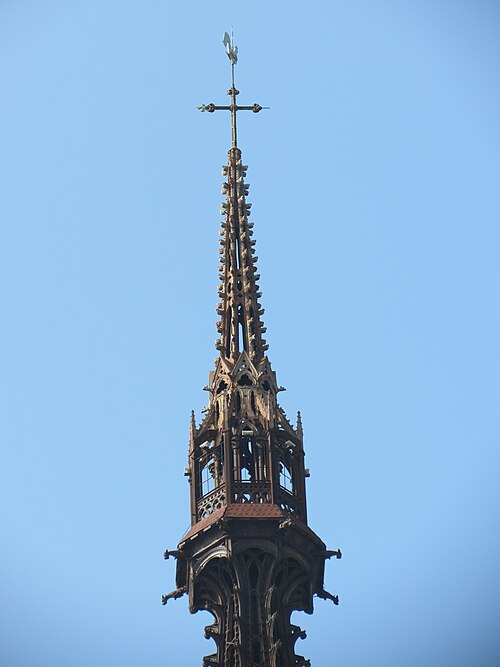
A central lantern tower over the transept is a tradition of Gothic architecture in Normandy. The lantern tower with its flèche, or spire is placed over the transept, almost in the centre of the cathedral, and is 151 meters high, the tallest of the three towers. The first two levels of the lantern tower were built in the 13th century. The original Gothic spire was destroyed by fire in 1514, and rebuilt in 1544 in wood and lead by the master builder Robert Becquet. The next builder, Rouland Le Roux, consolidated the first two levels of the lantern tower and added flamboyant decoration and sculpture.
Another fire in 1822 destroyed the lead and wood spire, which was then replaced, after much controversy, by the architect Jean-Antoine Alavoine with one of iron and copper, finished in 1882. He surrounded the new spire with four smaller spirelets, made of copper. One of these fell during a hurricane in 1999, going through the roof and damaging the choir stalls below.
On 11 July 2024, the main spire caught fire, though it was quickly brought under control.
The spire and clochetons, seen from the Rouen Opera
Top of the Flèche
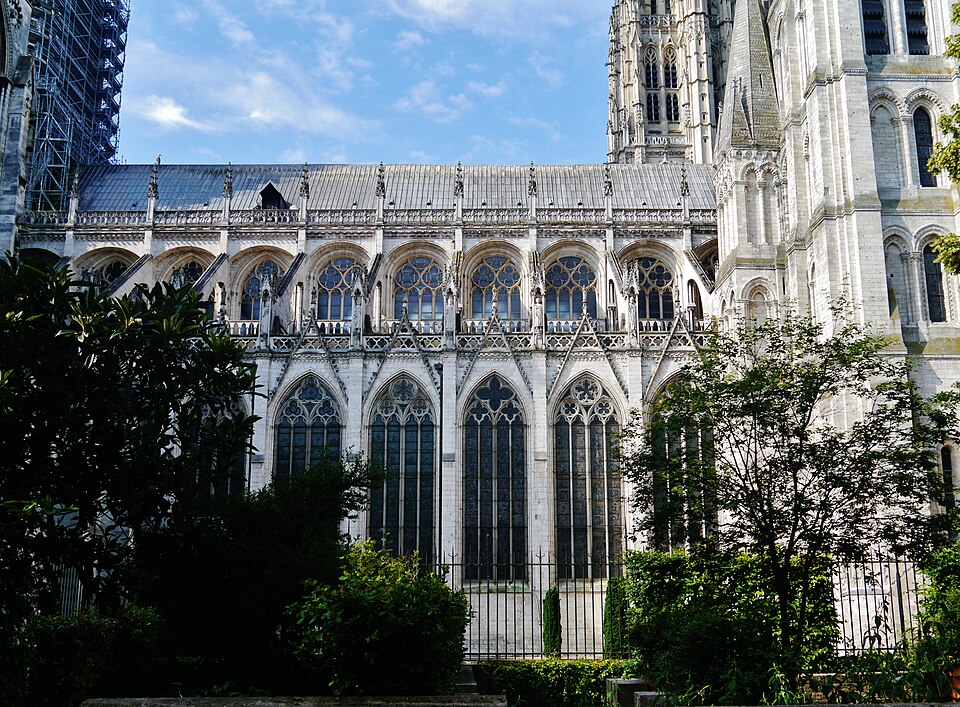
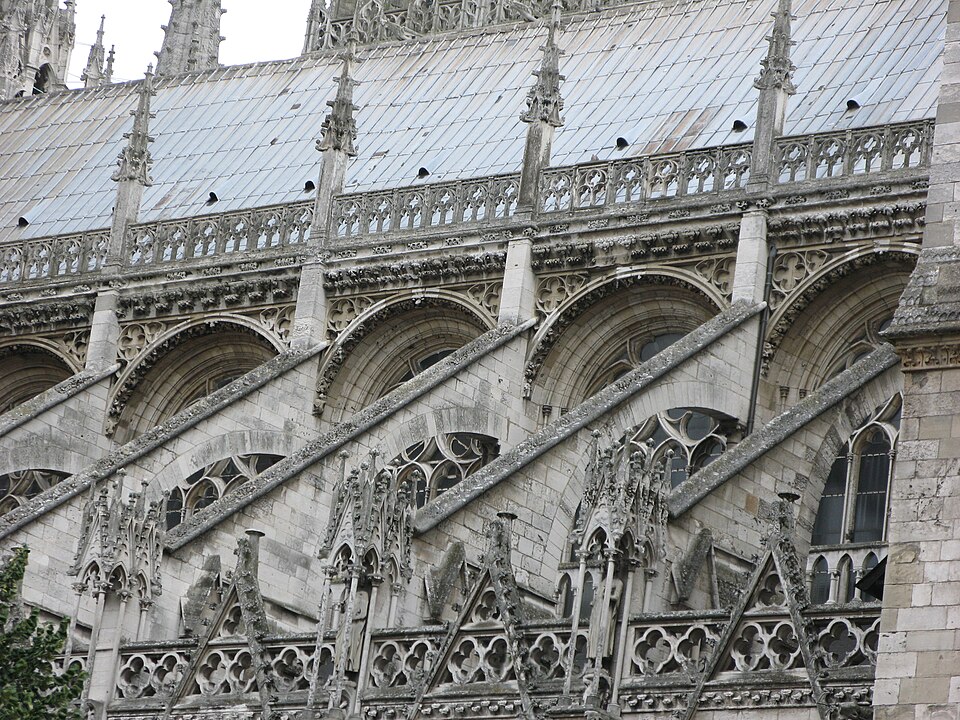
Flying buttresses along the north and south sides of the cathedral reach up over the roof of the side aisles to support the upper walls of the nave. The space between the buttresses on the lower level is filled with lateral chapels. Because of the support of the buttresses, the upper walls of the nave are able to be entirely filled with windows. The edges of the roofs of the aisles and nave are both decorated with balustrades and pinnacles.
Flying buttresses on the north side reach over the roof of the aisle to support the upper walls of the nave
The buttresses and decoration of the roofline of the nave
Christianity was established in Rouen in about 260 by Saint Mellonius, who became the first bishop. The first church is believed to have been under or close to the present cathedral. In 395, a large basilica with three naves was built at the same site. In 755, the archbishop Rémy, the son of the Frankish statesman and military leader Charles Martel, established the first Chapter of the cathedral and constructed several courtyards and buildings around the church, including a palace for the archbishop.
The cathedral was enlarged by St. Ouen in 650, and visited by Charlemagne in 769. However, beginning in 841, a series of Viking raids seriously damaged the cathedral complex.
The Viking leader Rollo became first Duke of the Duchy of Normandy and was baptized in the Carolingian cathedral in 915 and buried there in 933. His grandson, Richard I of Normandy, further enlarged it in 950.
In the 1020s, the archbishop Robert began to rebuild the church in the Romanesque style, beginning with a new choir, crypt and ambulatory, and then a new transept. The Romanesque cathedral was consecrated by the archbishop Maurille on October 1, 1063, in the presence of William, Duke of Normandy, soon to become William the Conqueror after his conquest of England in 1066
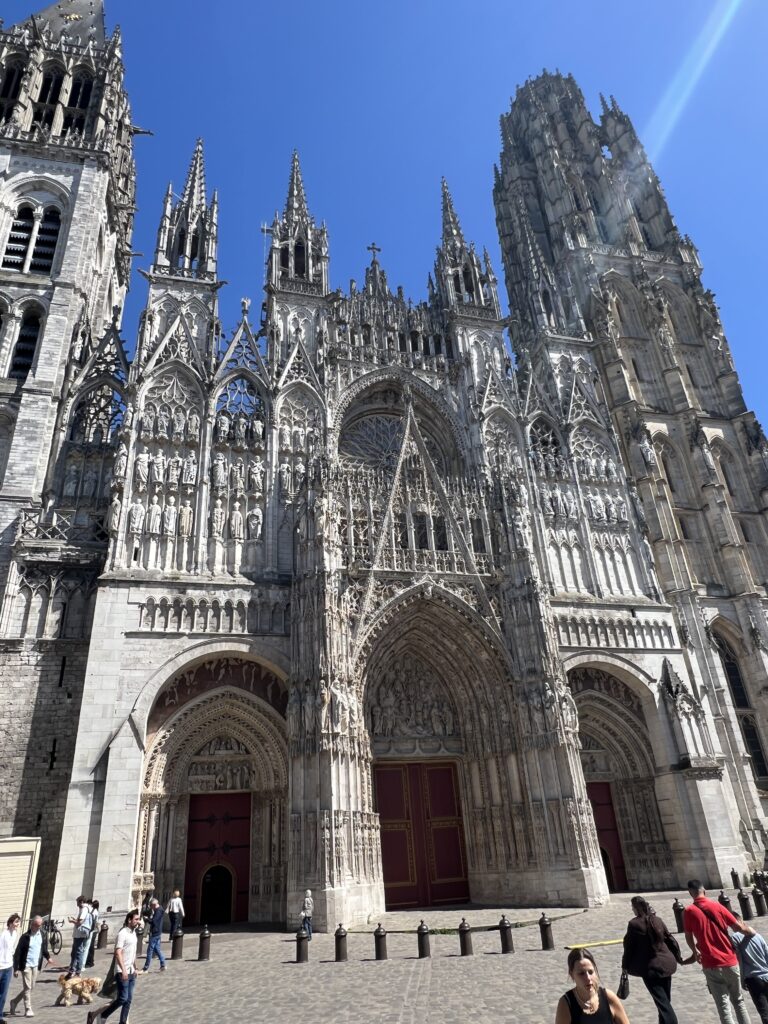
The project for a cathedral in the new Gothic style was first launched by the Archbishop of Rouen, Hugues of Amiens, who had attended the consecration in 1144 of the Basilica of Saint-Denis, the first Gothic structure, with its emphasis upon filling the interior with light. In 1145, he began constructing a tower, now called the Tower Saint-Roman, in the new Gothic style.
A complete reconstruction of the cathedral was begun by his successor, Gautier the Magnificent. In 1185 he demolished the Romanesque nave and began building the western end of the sanctuary. He had completed the west front and first traverses when the work was interrupted by a major fire on Easter eve in 1200, which destroyed a large part of the town and seriously damaged the unfinished church and its furnishings. Gautier quickly repaired the damage and resumed the work, which was directed by his master mason, Jean d’Andeli. The nave was sufficiently complete by 1204 for King Philip II of France to be received there to celebrate the annexation of Normandy to the Kingdom of France. By 1207 the main altar was in place in the choir.
The first architectural addition to the new church was a series of small chapels between the buttresses on the north and south sides of the nave, requested by the city’s prominent religious brotherhoods and corporations. In 1280 the surrounding spaces and buildings were modified to permit the construction of portals on the north and south transepts. The next addition was a response to the growing role of the Virgin Mary in church doctrine; the small axial chapel at the east end of the apse was replaced by a much larger chapel dedicated to her, begun in 1302. The west front was also given new decoration between 1370 and 1450.
Beginning in 1468 a highly ornamental new top, made of iron and covered with stone tiles, in the late Gothic Flamboyant style was added to the tower of Saint-Romaine.
Cardinal-Archbishop Georges d’Amboise (1494-1510) had a major influence on the church architecture. He incorporated into the Gothic design new Renaissance features, as he had done in his own residence, the Château de Gaillon, The first major project of the period was a new tower to match the old Saint-Romaine tower, built almost three centuries earlier. Work on the tower had begun in 1488, under master builder Guillaume Pontifs, but under Cardinal d’Amboise in 1496 the project was taken over 1496 by Jacques Le Roux, who had a more ambitious plan with Renaissance touches. The Pope authorised Cardinal d’Amboise to grant dispensations to consume milk and butter during Lent, in exchange for contributions to the tower. The new tower soon took on the nickname of the Butter Tower, though the money collected paid only a portion of the cost.
As the new tower was being built, the west front of the Cathedral showed weaknesses and began to tilt. Cardinal d’Amboise ordered its complete reconstruction. This was carried out by master builder Rouilland Le Roux, nephew of Jacques Le Roux, in a lavishly ornate Flamboyant style. It was covered with layers of lacelike stone tracery, and hundreds of sculpted figures were added to the arch and niches of the portals. To stabilise the new facade, he added two massive buttresses, also richly decorated with sculpture. In addition to his changes to the Cathedral, the Cardinal and his architect reconstructed and decorated the Palace of the Archbishop close by, adding a new reception hall, galleries, gardens and fountains.
In 1514 the flèche, or spire of the cathedral, a lead-covered wooden spire over the lantern tower, fell. It was replaced within a few months in exactly the same form and with the same materials.
Over the front door of the cathedral
In the late 16th century the cathedral was badly damaged during the French Wars of Religion: in 1562 the Calvinists attacked the furniture, tombs, stained-glass windows and statuary. The cathedral was again struck by lightning in 1625 and 1642, then damaged by a hurricane in 1683.
In 1796, in the course of the French Revolution, the new revolutionary government nationalised the cathedral and transformed it for a time into a Temple of Reason. Some of the furniture and sculpture was sold, and the chapel railings were melted down to make cannon.
In 1822 lightning started a fire that destroyed the wood and lead Renaissance spire of the central tower. The architect Jean-Antoine Alavoine proposed to replace it with a new spire made of cast iron. The idea of an iron spire was highly controversial; the novelist Gustave Flaubert denounced it as “the dream of a metal-worker in a delirium.” The new spire, 151 meters (495 feet) tall, was not finally completed until 1882. For a short time, from 1876 to 1880, the spire made Rouen Cathedral the world’s tallest building, until the completion of Cologne Cathedral.
In 1905, under the new law separating church and state, the Cathedral became the property of the French government, which then granted to the Catholic Church its exclusive use.
At the beginning of World War II in 1939, remembering the damage caused to French cathedrals in World War I, the Cathedral authorities protected the sculpture of the cathedral with sandbags and removed the old stained glass and transported it to sites far from the city. Nonetheless, in the weeks before D-Day in Normandy, the cathedral was hit twice by Allied bombs. In April 1944, seven bombs dropped by the British Royal Air Force hit the building, narrowly missing a key pillar of the lantern tower, and damaging much of the south aisle and destroying two windows. In June 1944, a few days before D-Day, bombs dropped by the U.S. Army Air Force set fire to the Saint-Romain tower. The bells melted, leaving molten remains on the floor.
Following World War II, a major restoration effort began to repair war damage by the Service of Historic Monuments, concluding in 1956. Then a new campaign began to consolidate the structure and to restore the statuary of the west front, including putting back four statues that had been moved elsewhere. In 2016, the project was finished and the scaffolding which had covered much of the cathedral for a half-century was finally removed.
Prior to the re-opening of the Cathedral in 1956, the choir, damaged by the bombing during the war, was given a substantial renewal. This included a new high altar topped by an 18th-century Rococo statue of Christ made of gilded made by Clodion, which had previously been on the altar screen, as well as new choir screens, a new episcopal throne, and a new communion table and pulpit made of cast iron and gilded copper.
Beginning in 1985, excavations were carried out beneath the church and its surroundings, which uncovered vestiges of the earlier Paleochristian buildings and foundations of the Carolingian cathedral.
In 1999, during Cyclone Lothar, a copper-clad wooden turret, which weighed 26 tons, broke free from the tower and fell partly into the church, damaging the choir.
On 11 July 2024, the central spire of the cathedral caught fire during renovation works. The fire was brought under control the same day by a team of some 70 firefighters and 40 fire engines.
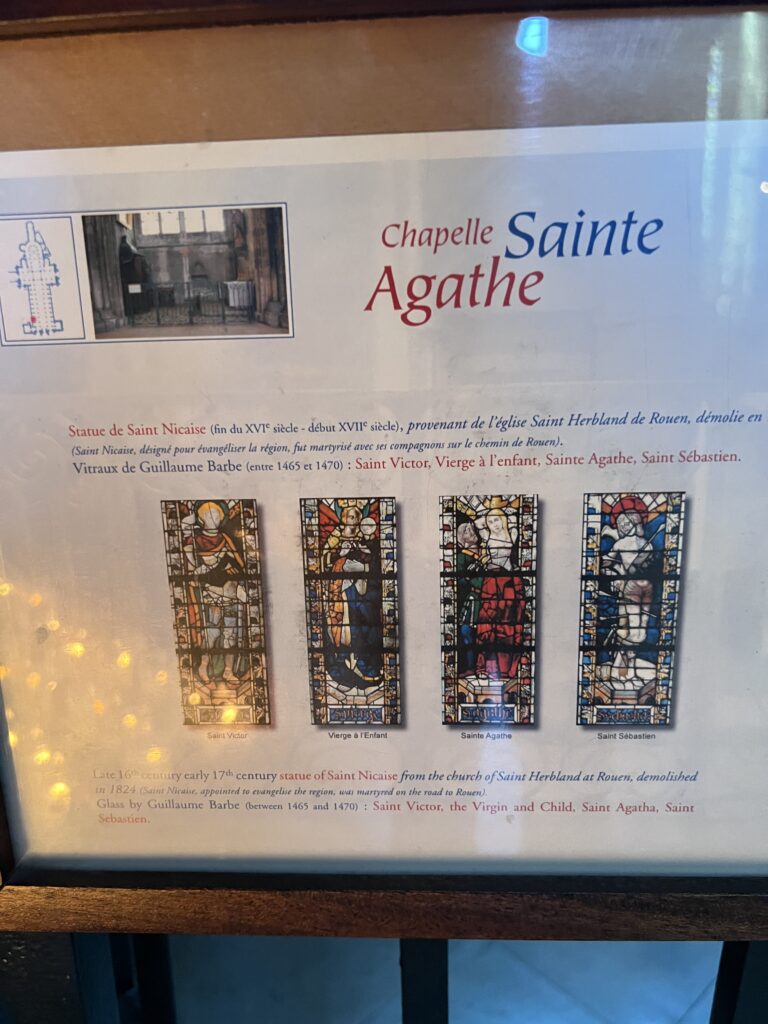
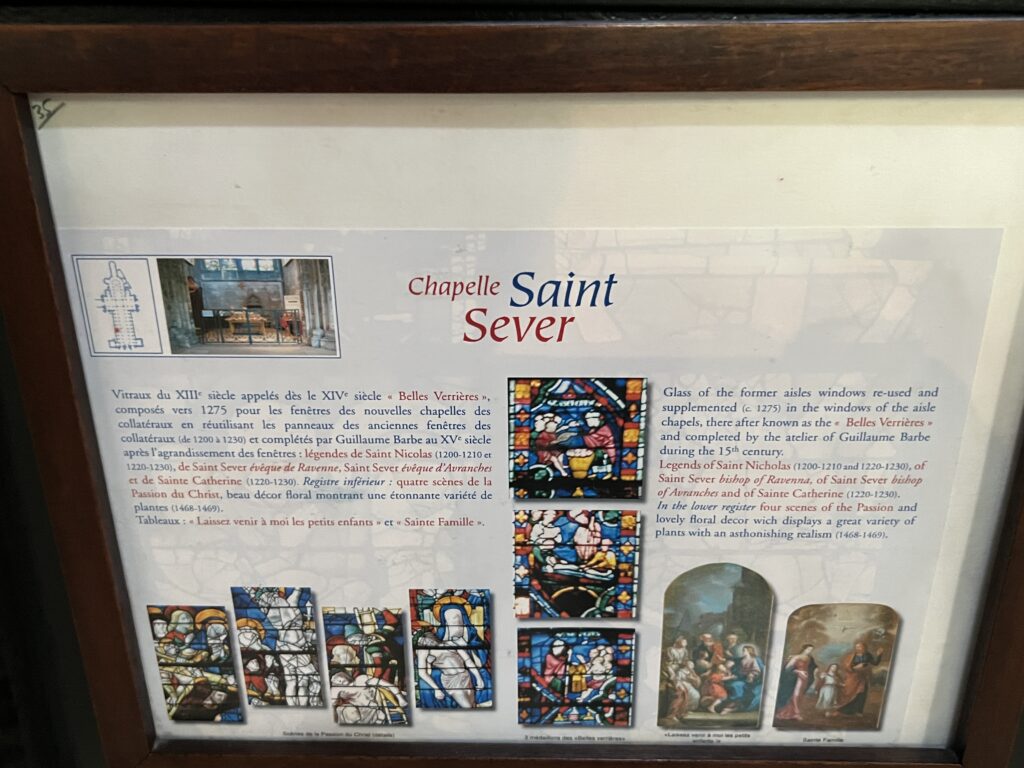
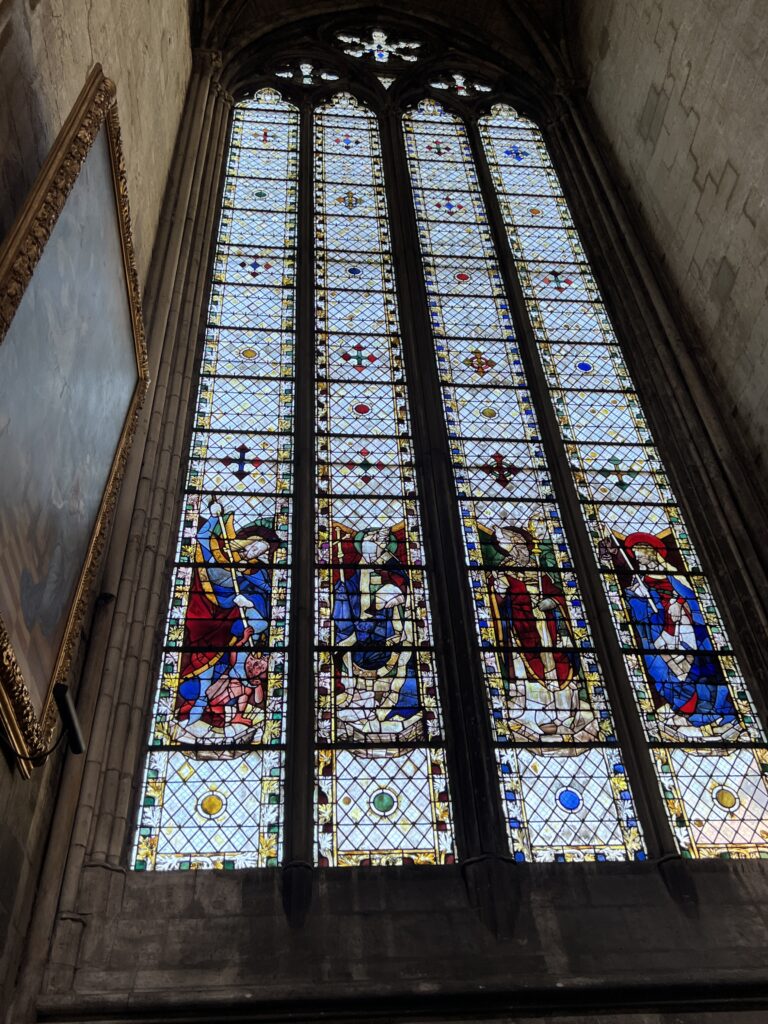
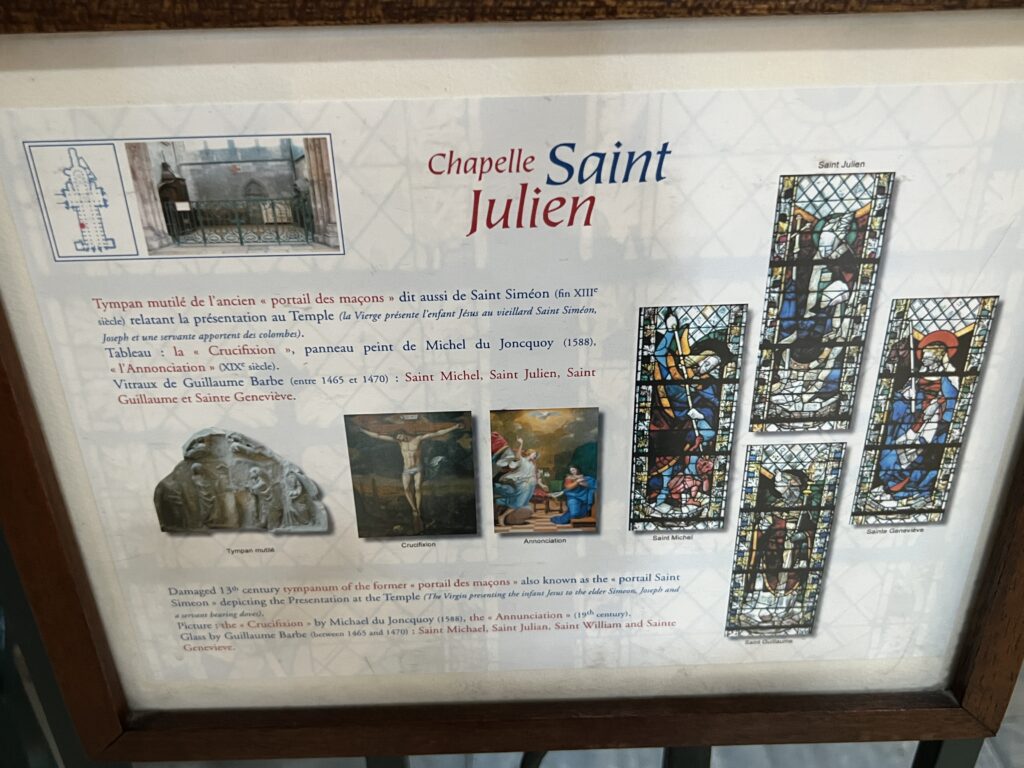
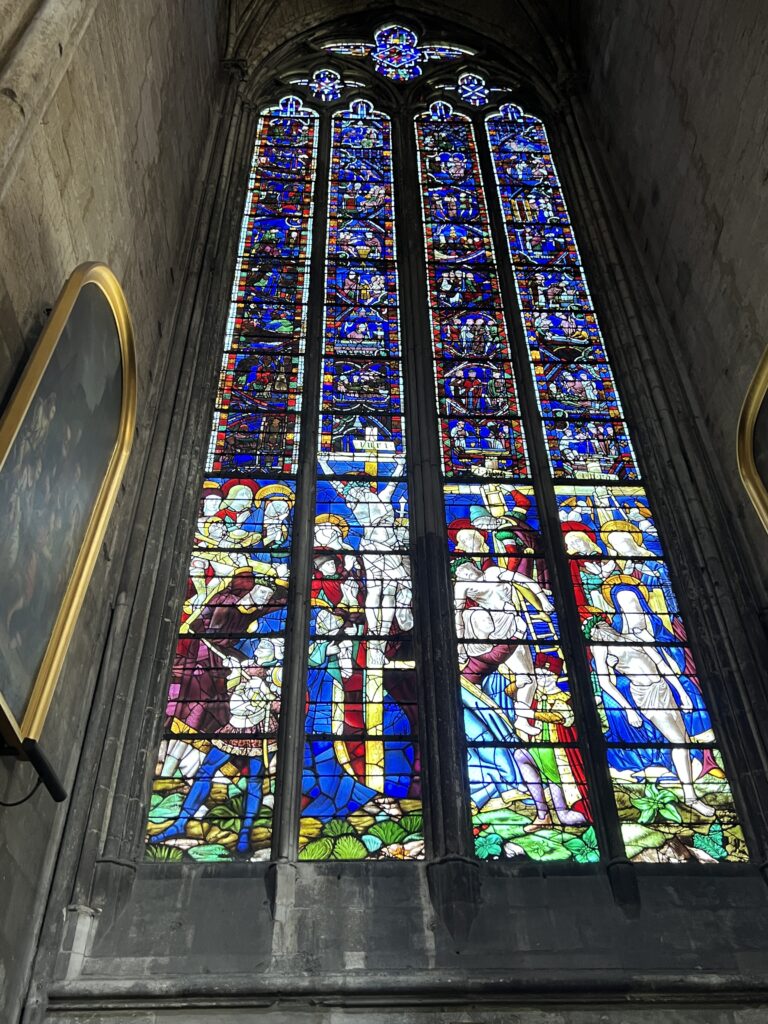
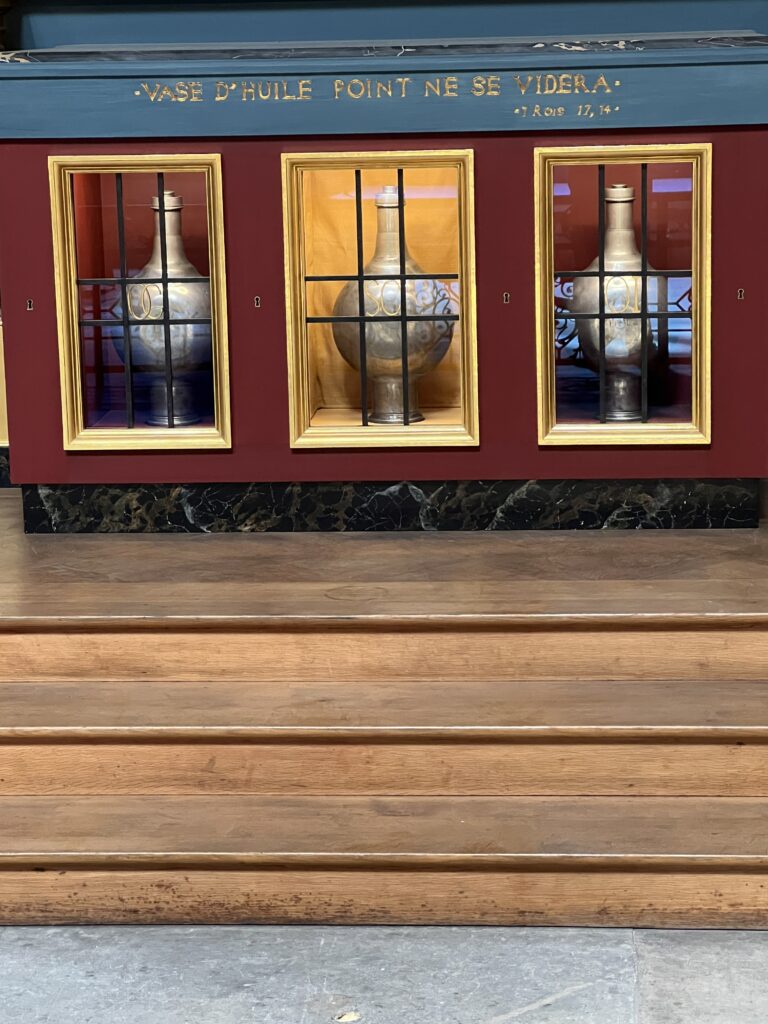
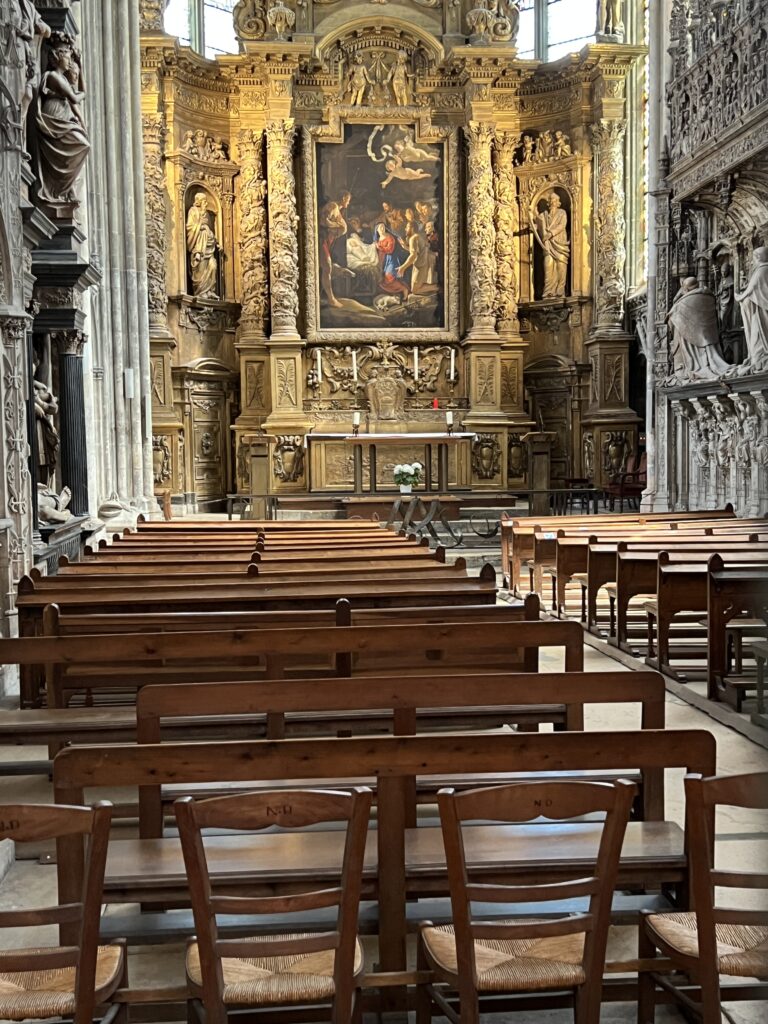
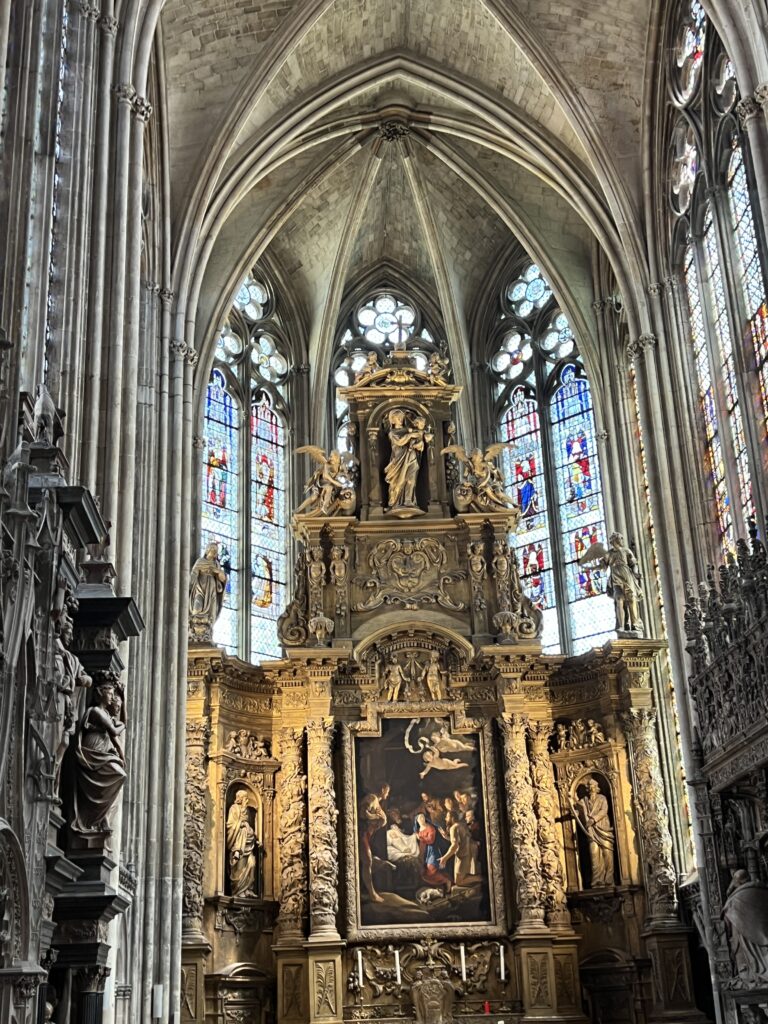
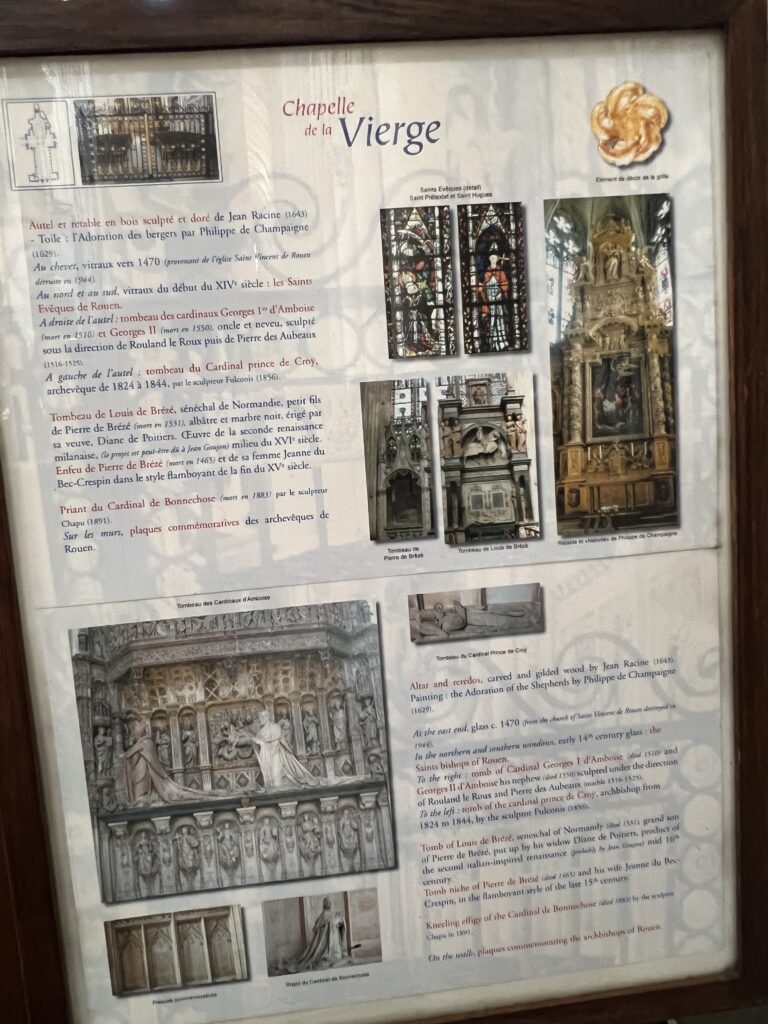
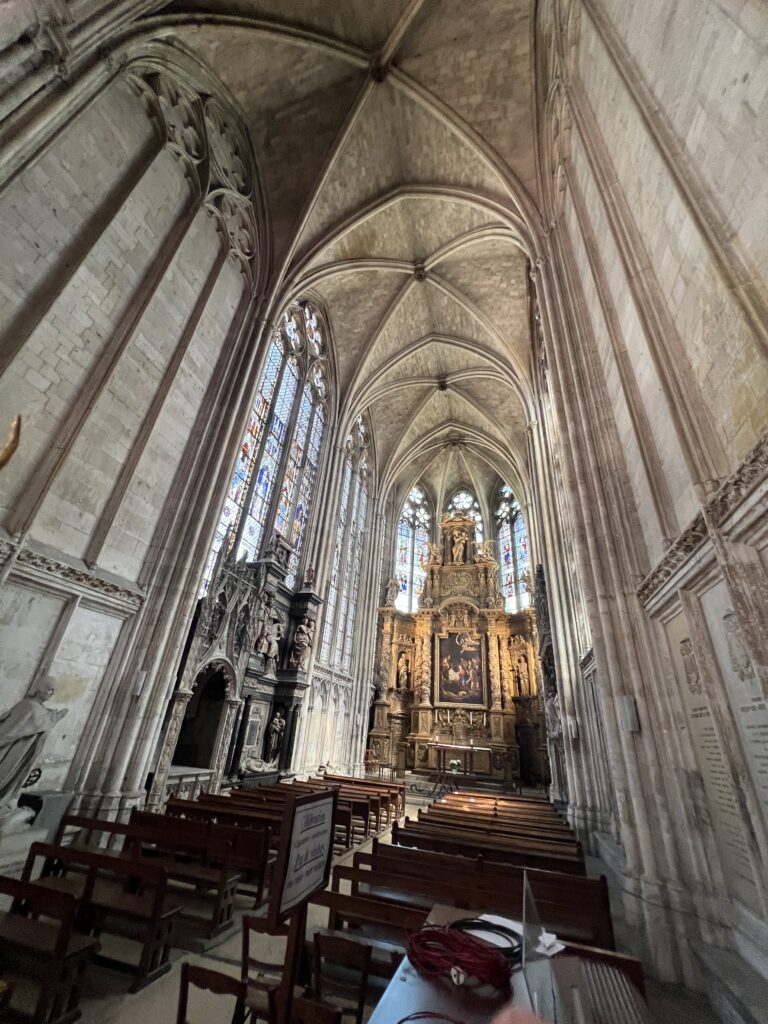
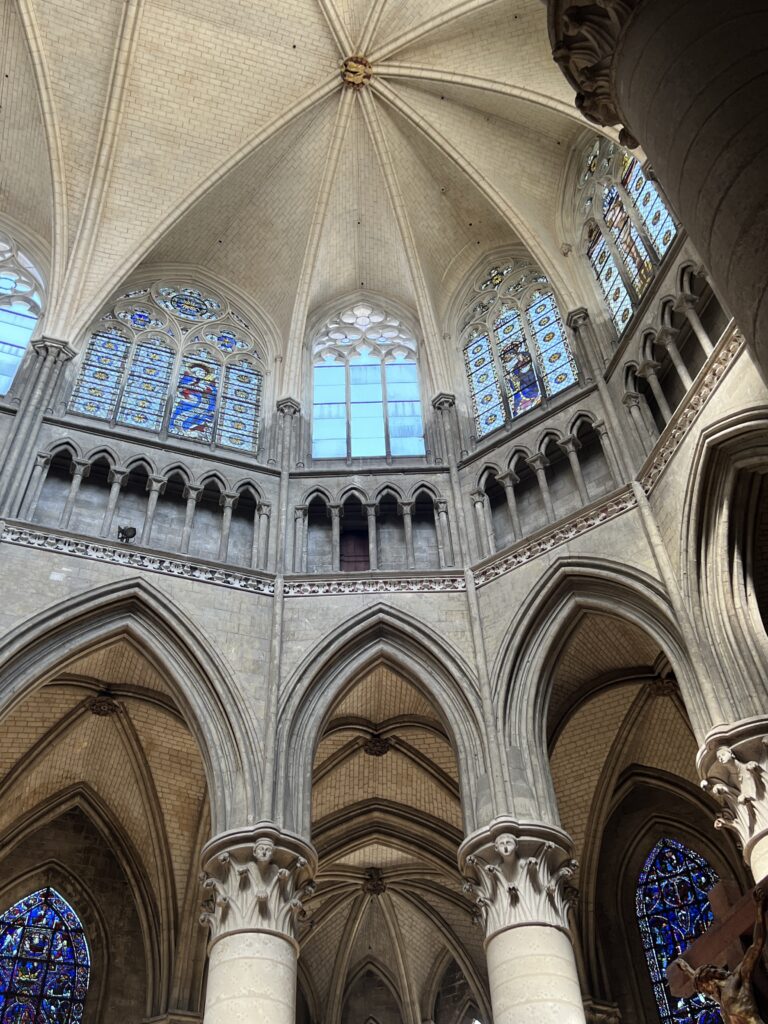
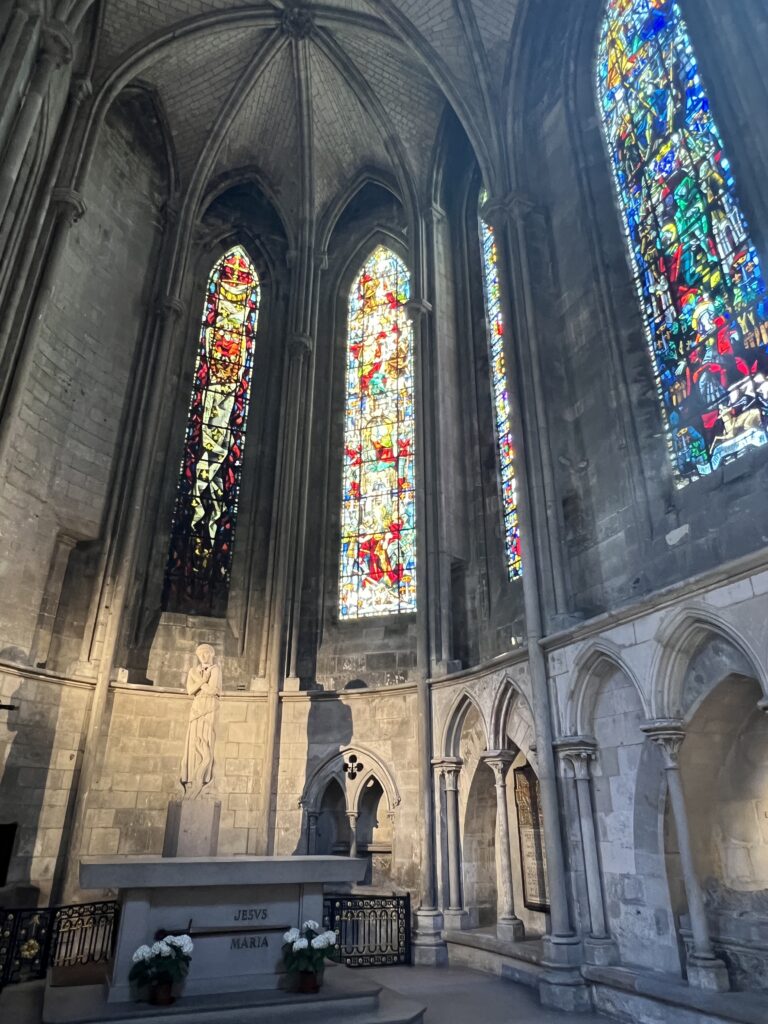
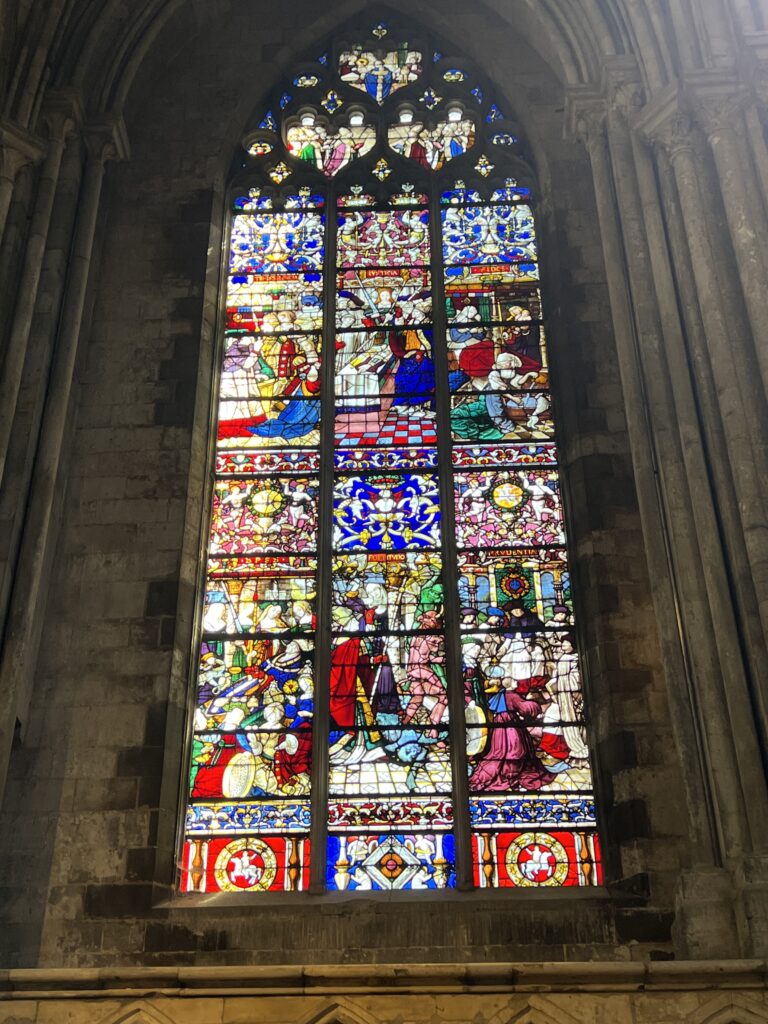
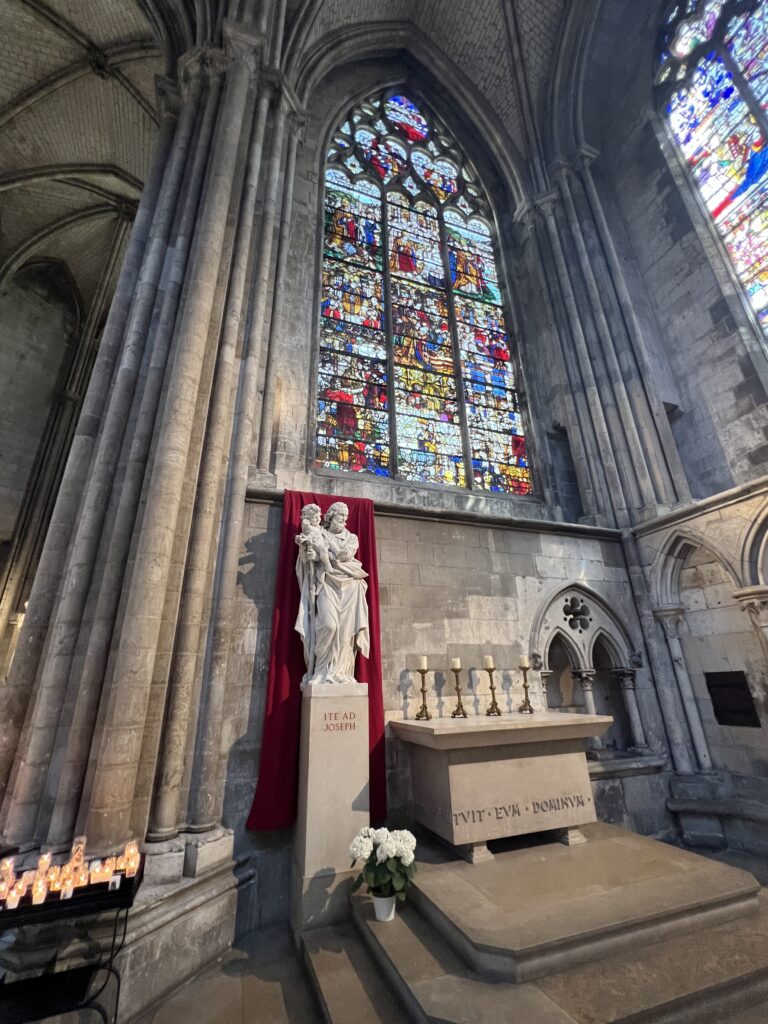
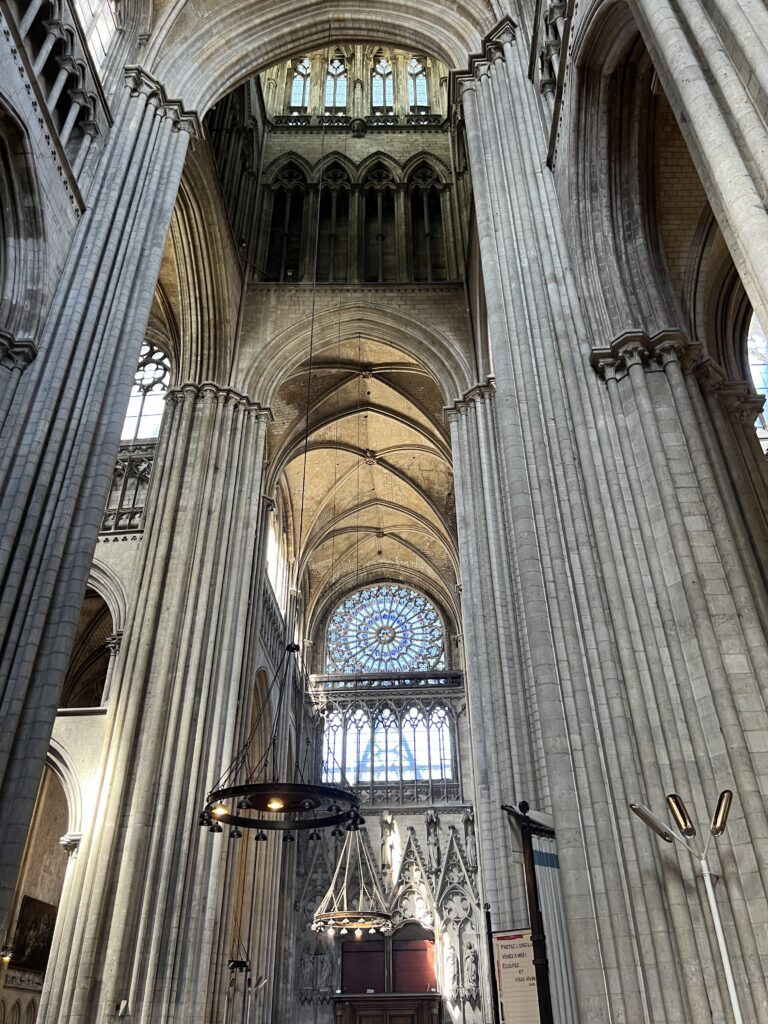
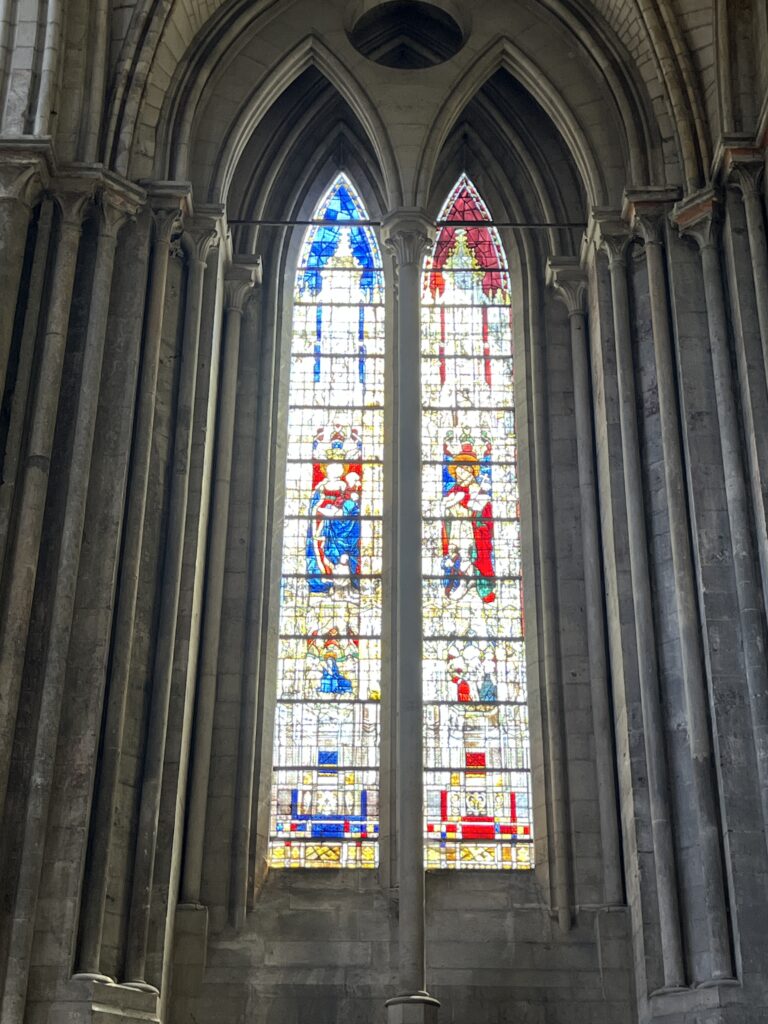
Description and then photo of the cathedral colored glass
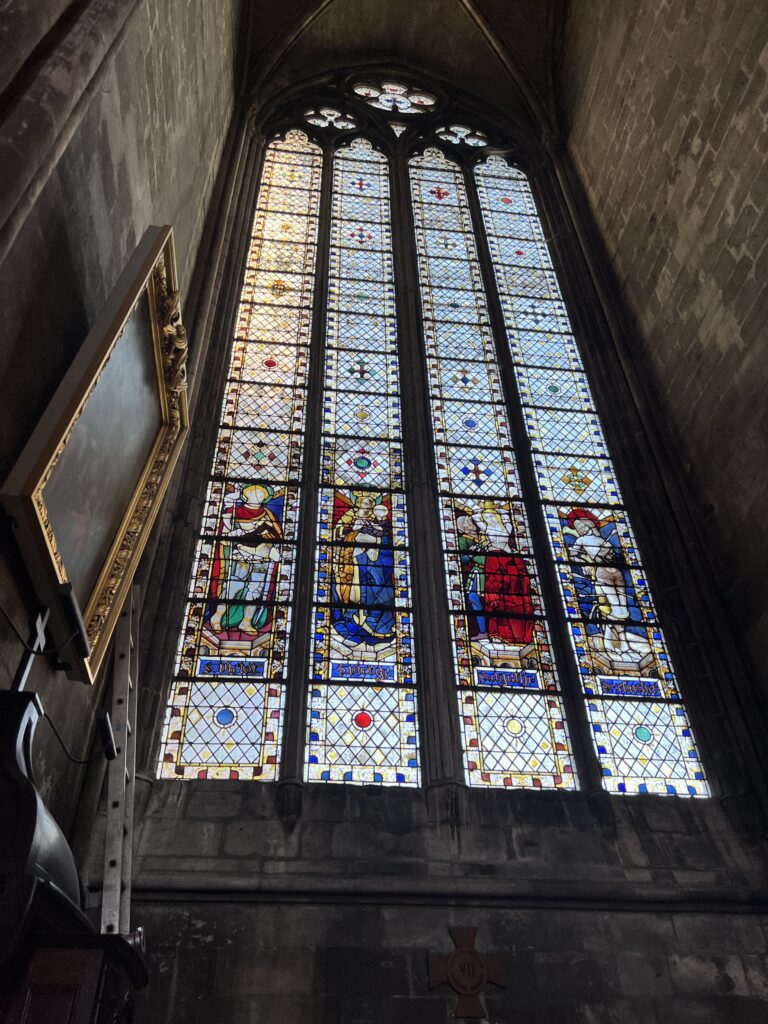
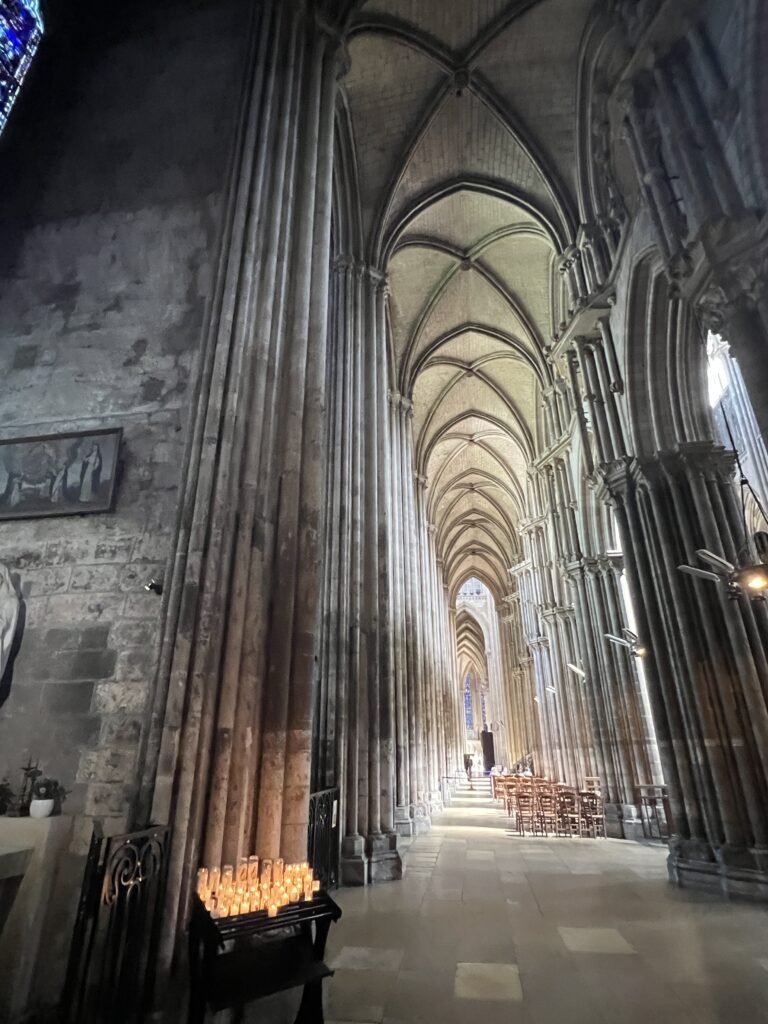
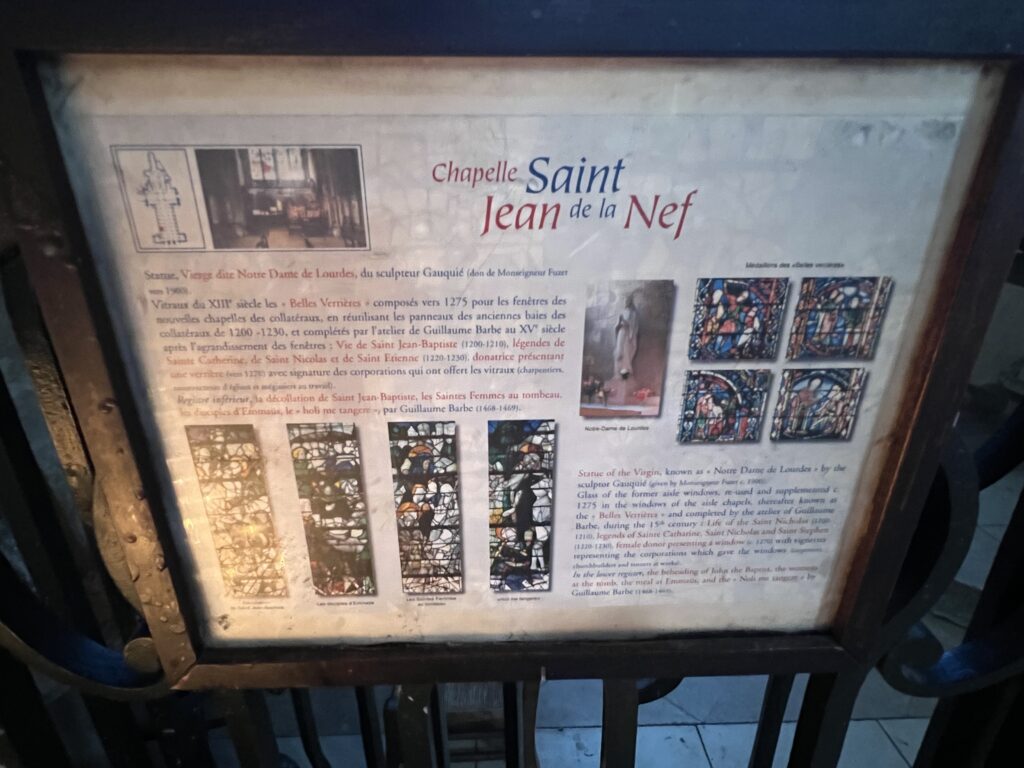
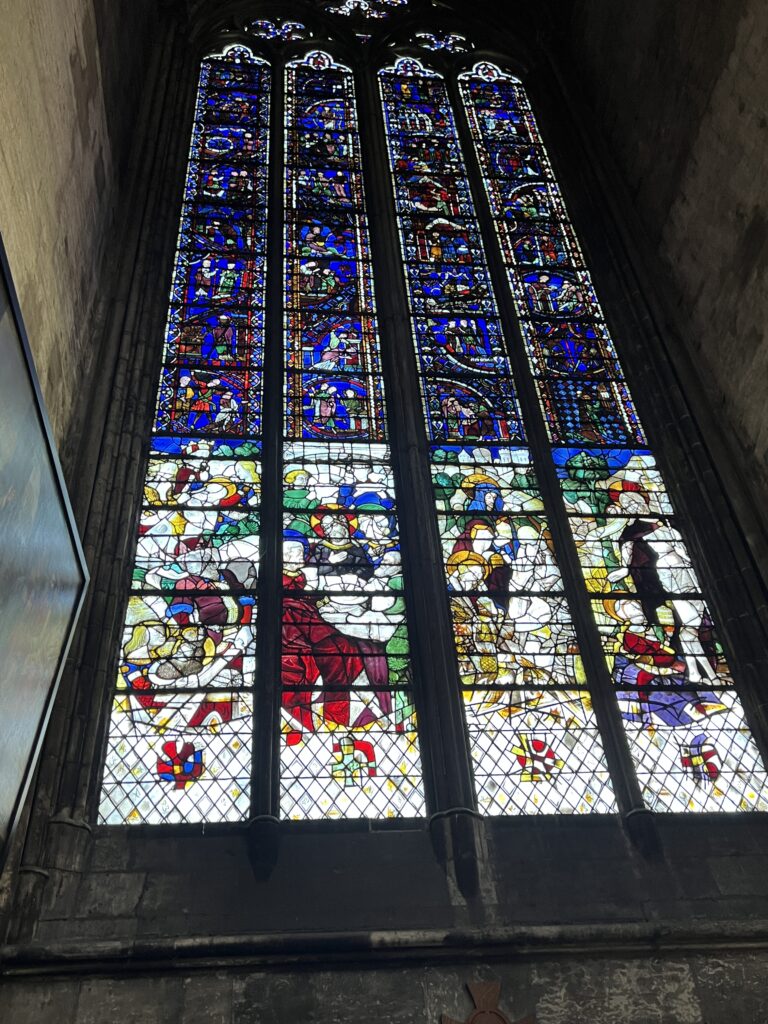
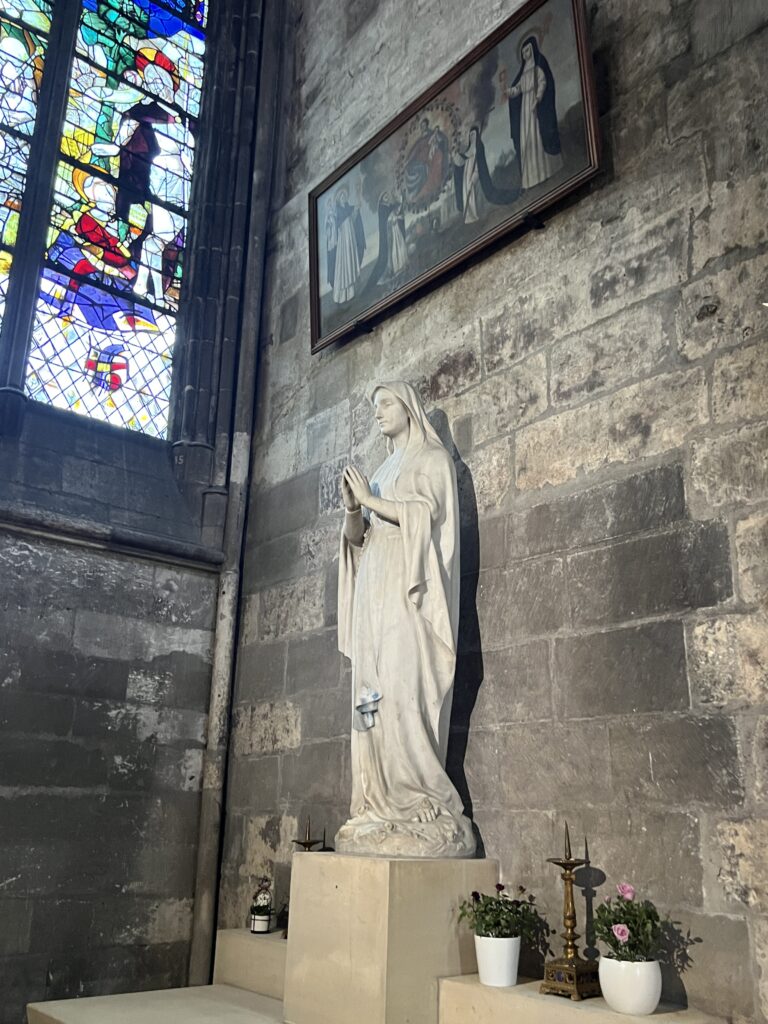
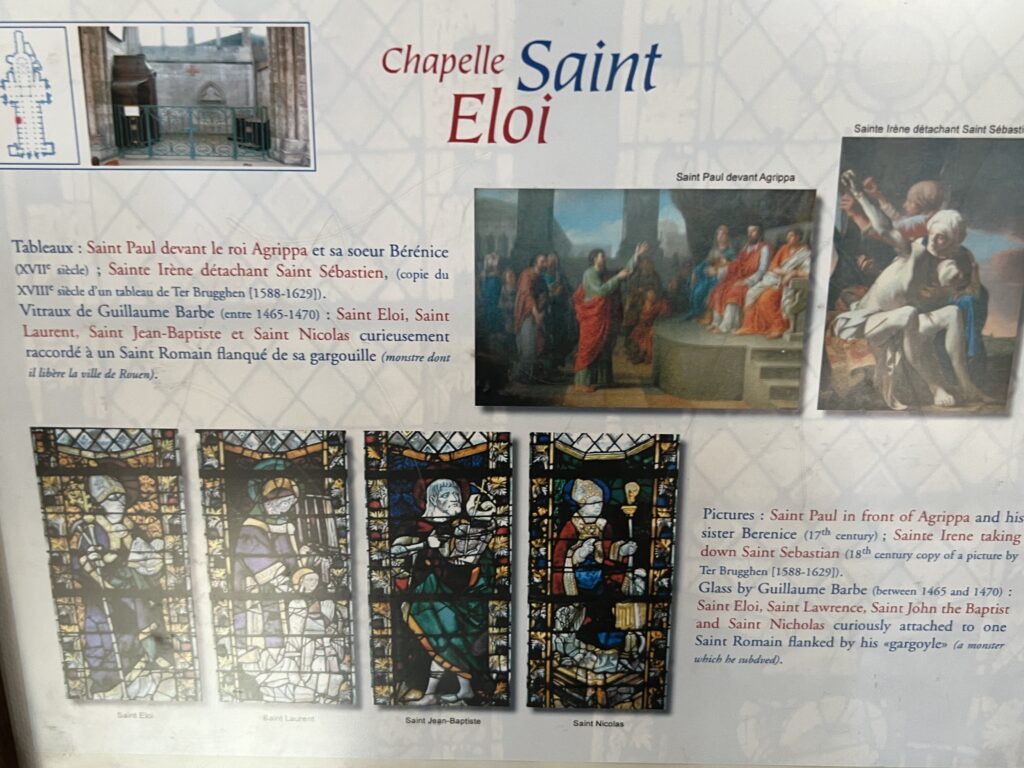
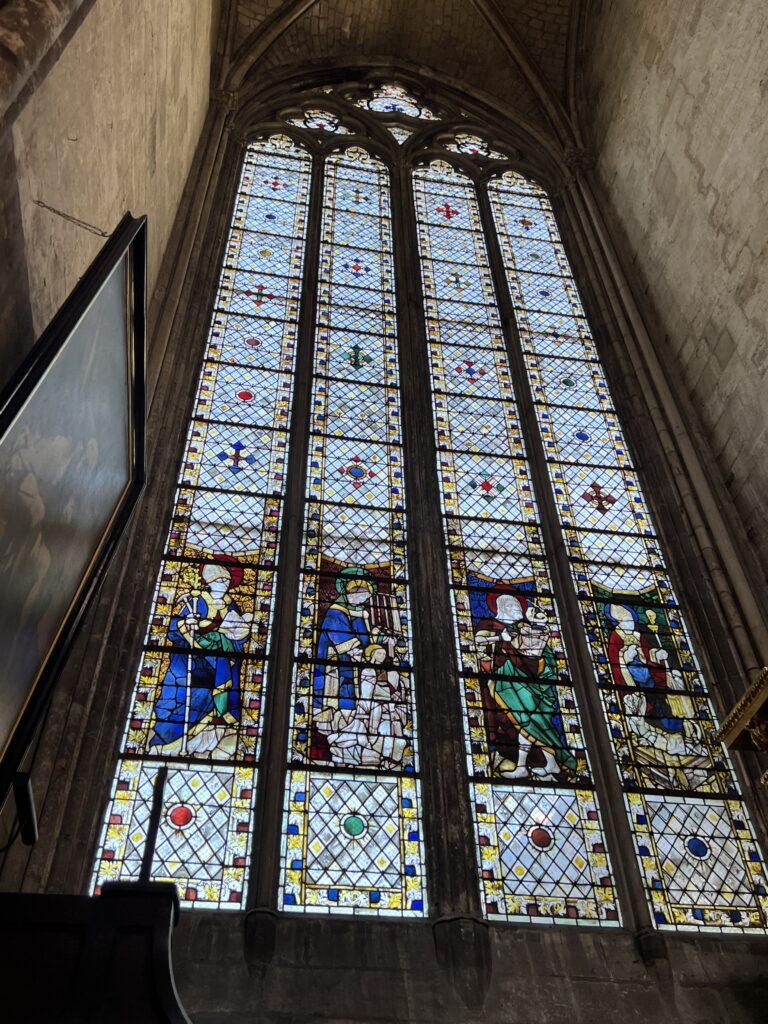
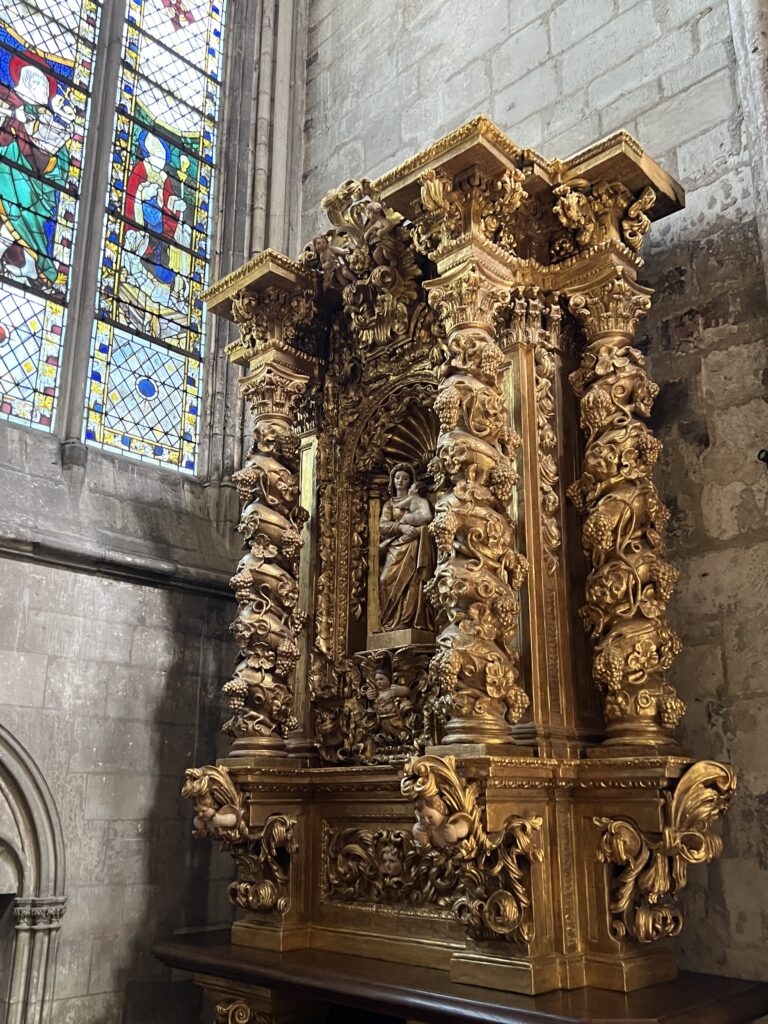
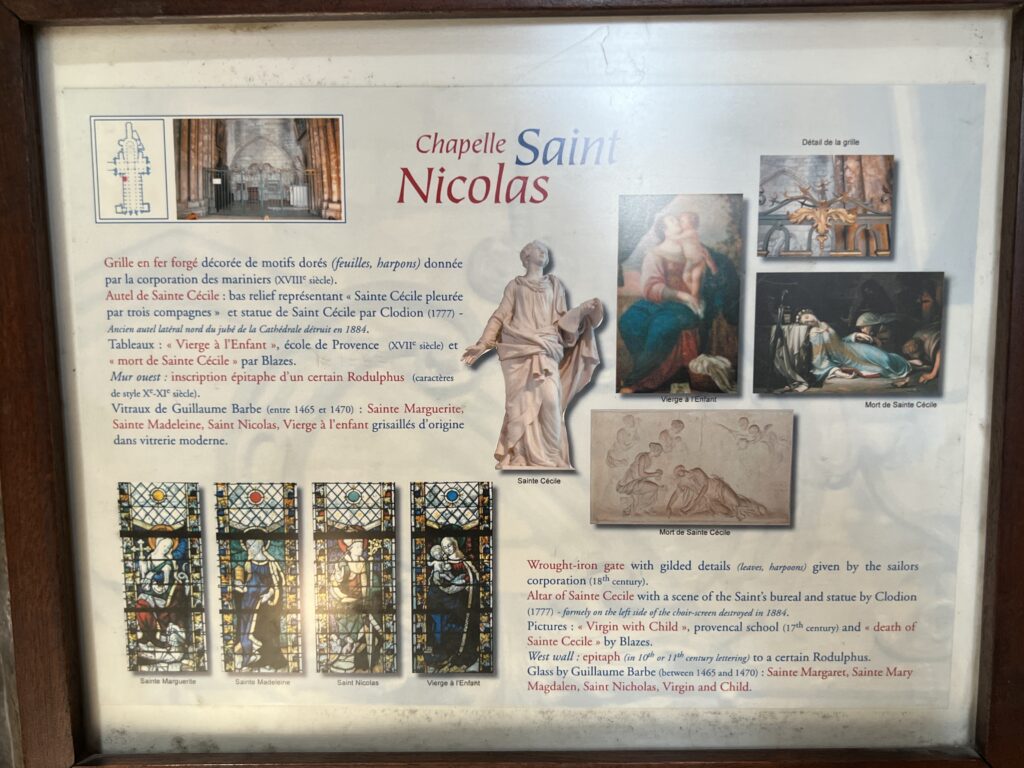
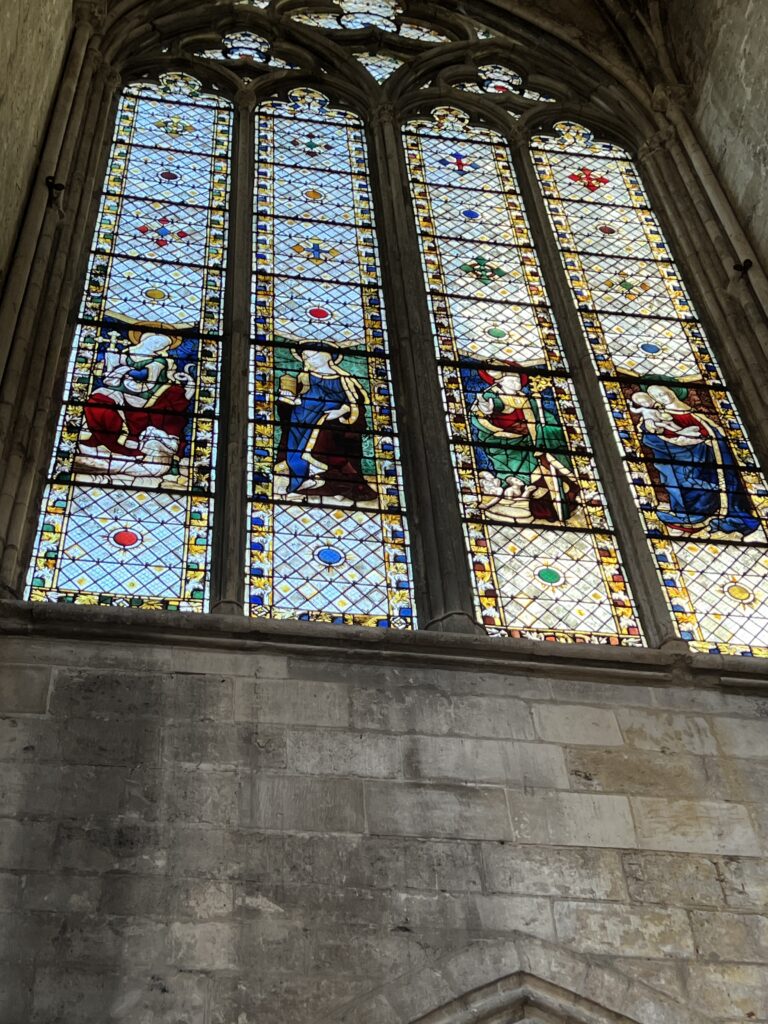
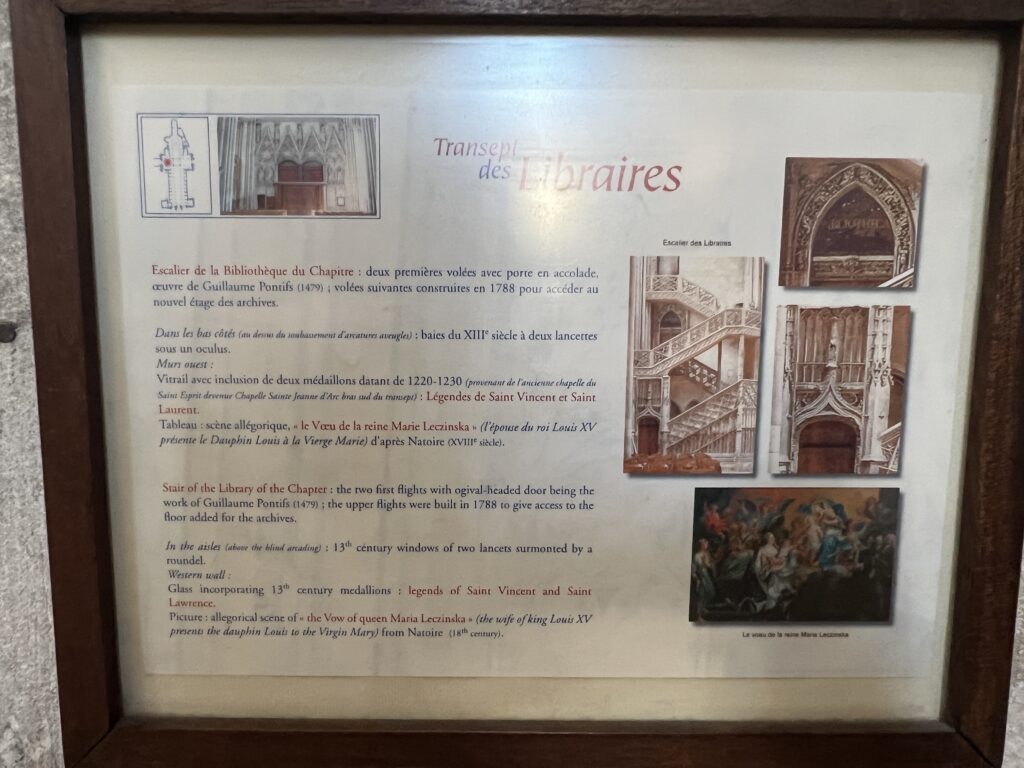
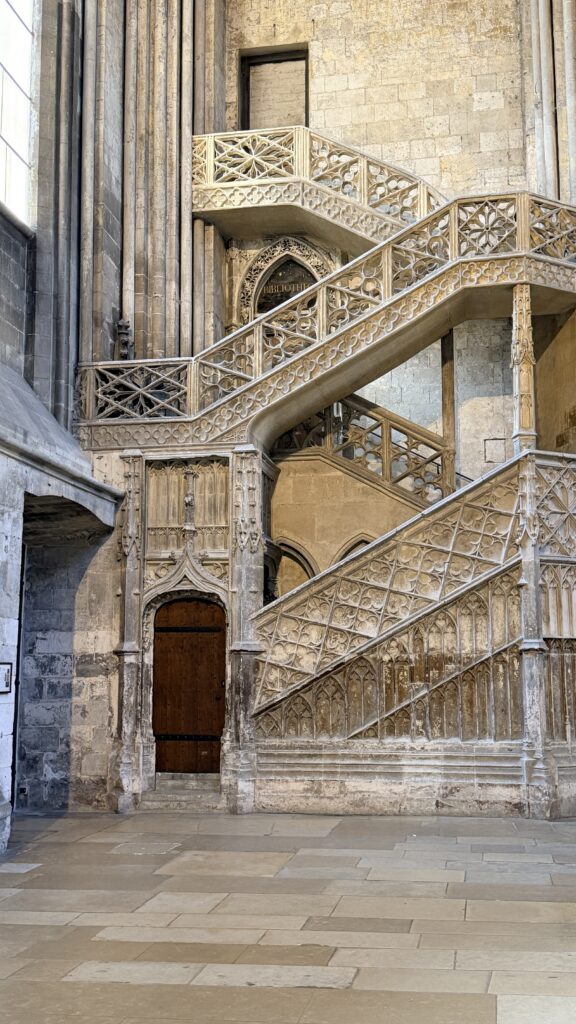
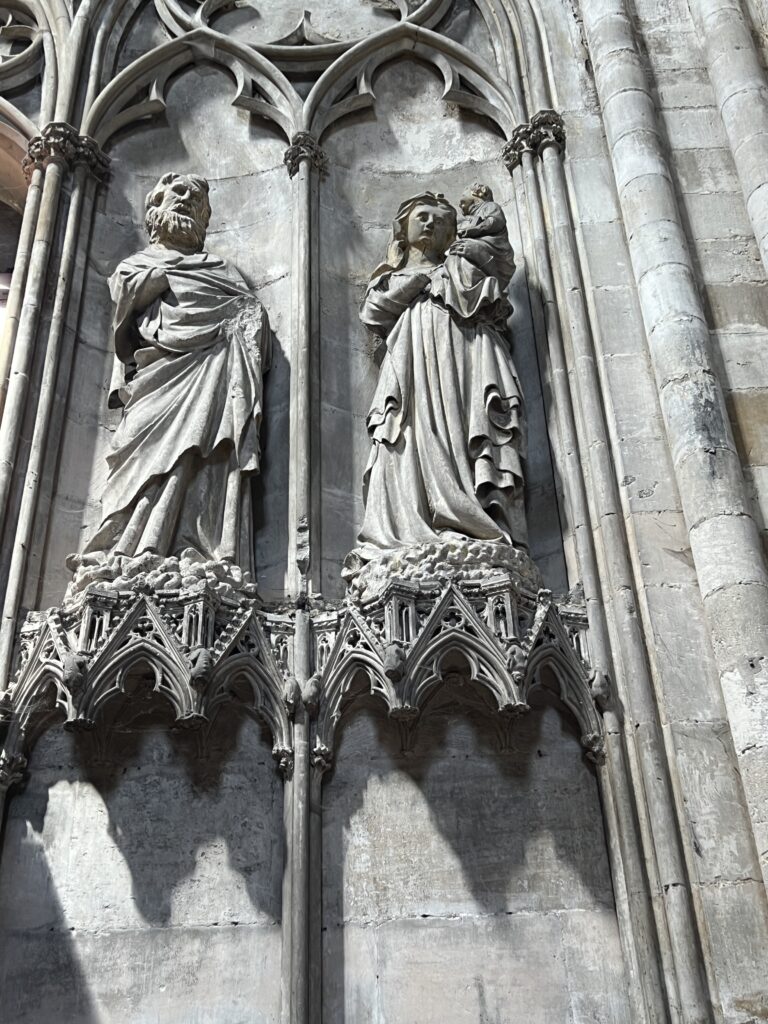
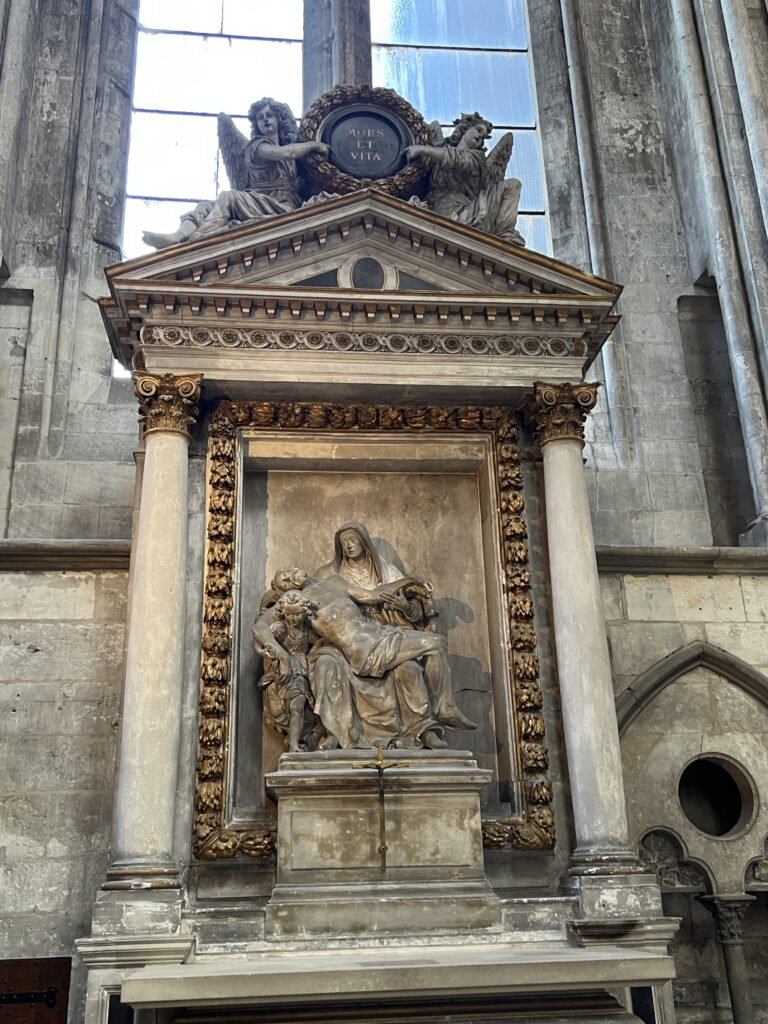
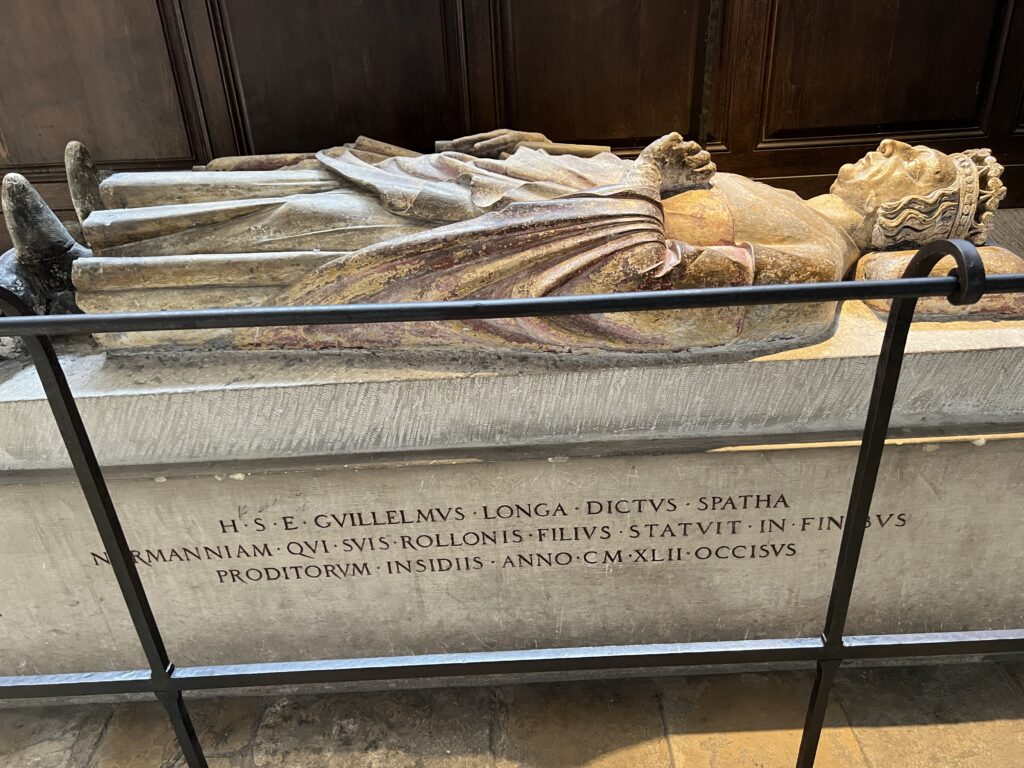
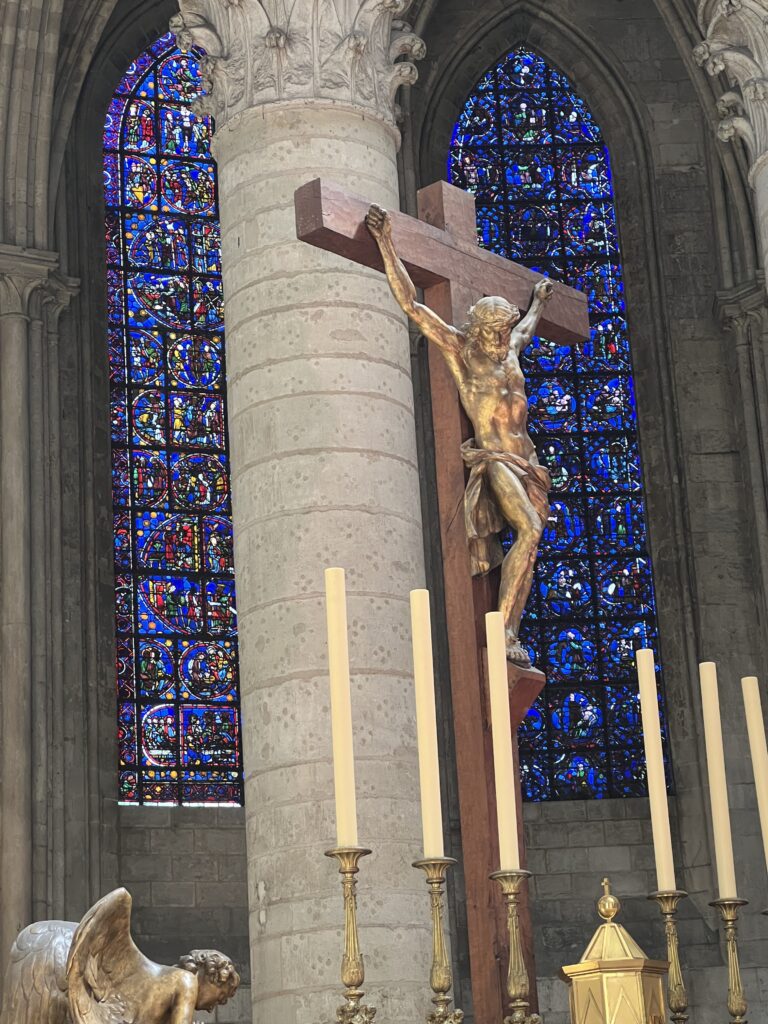
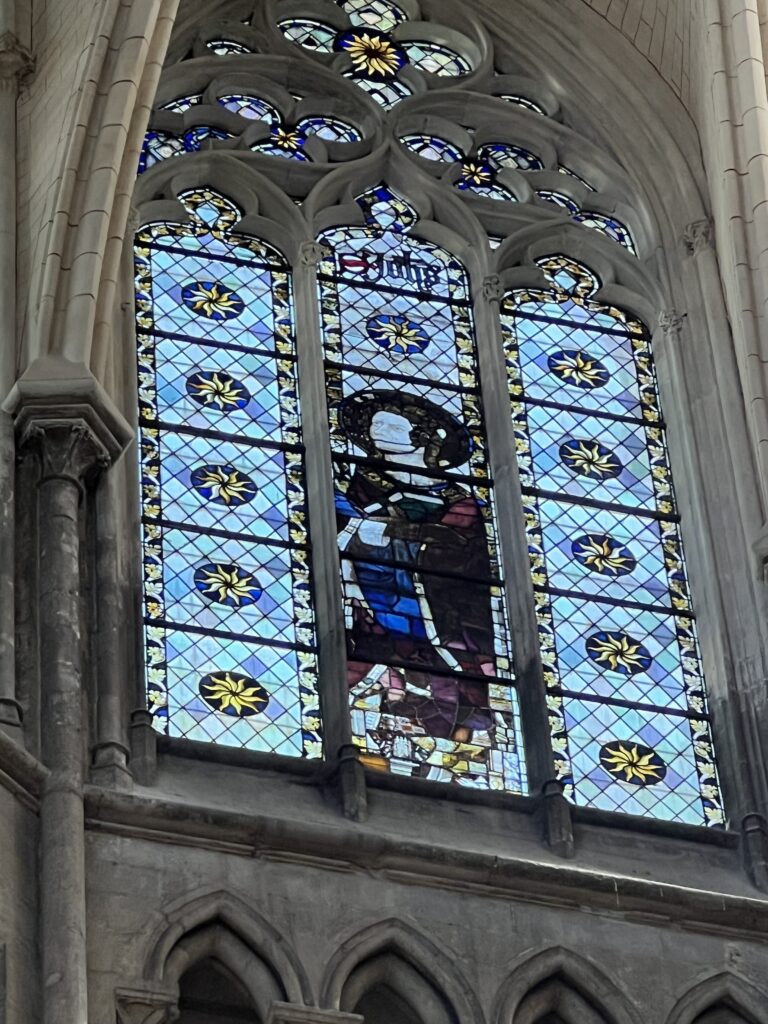
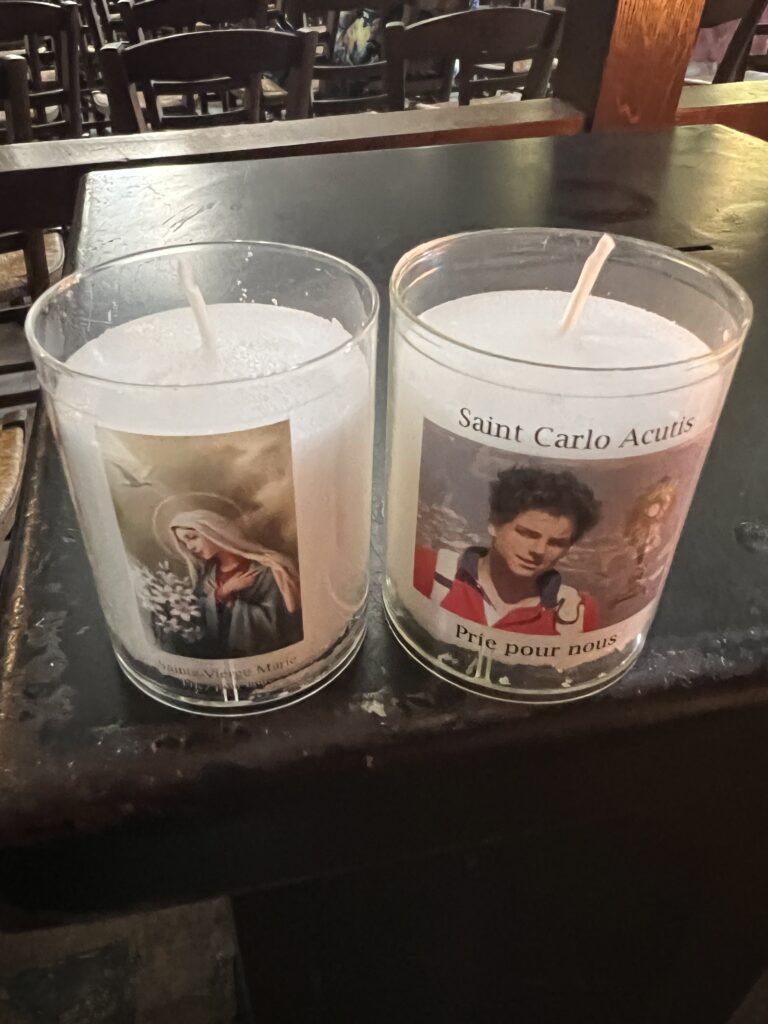
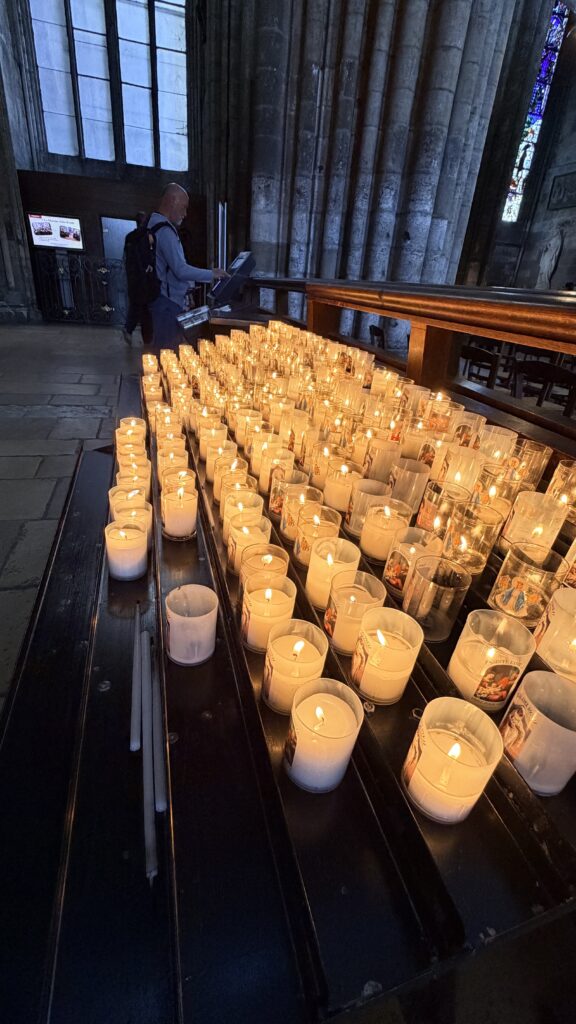
Candles lit for Marie and David
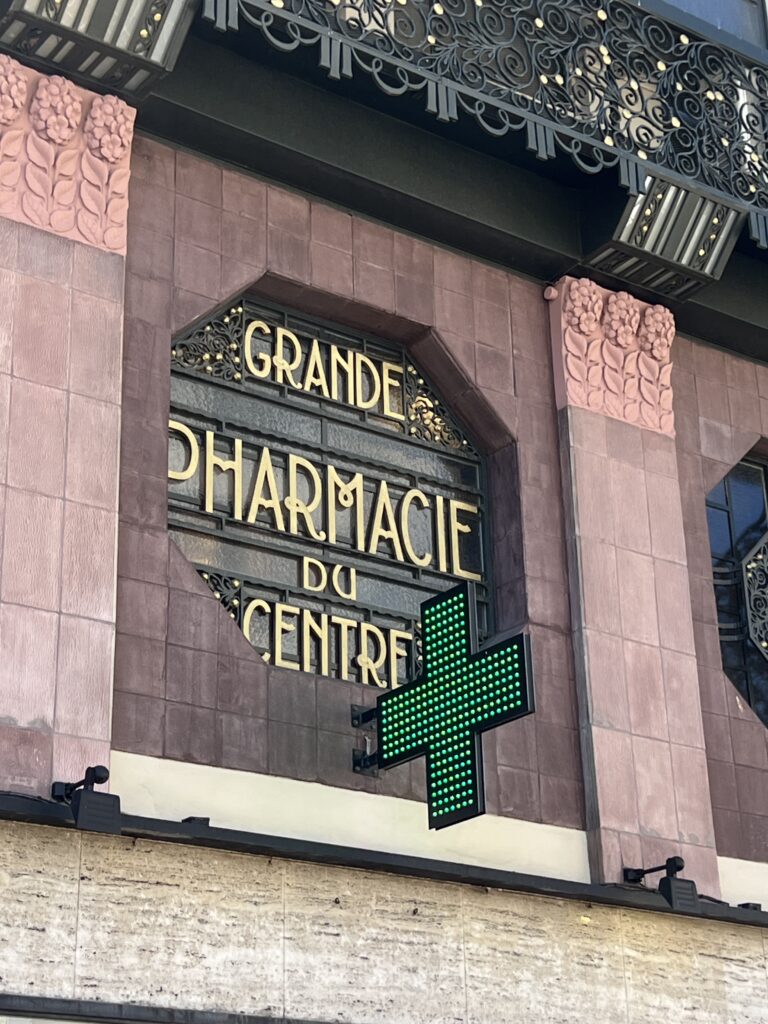
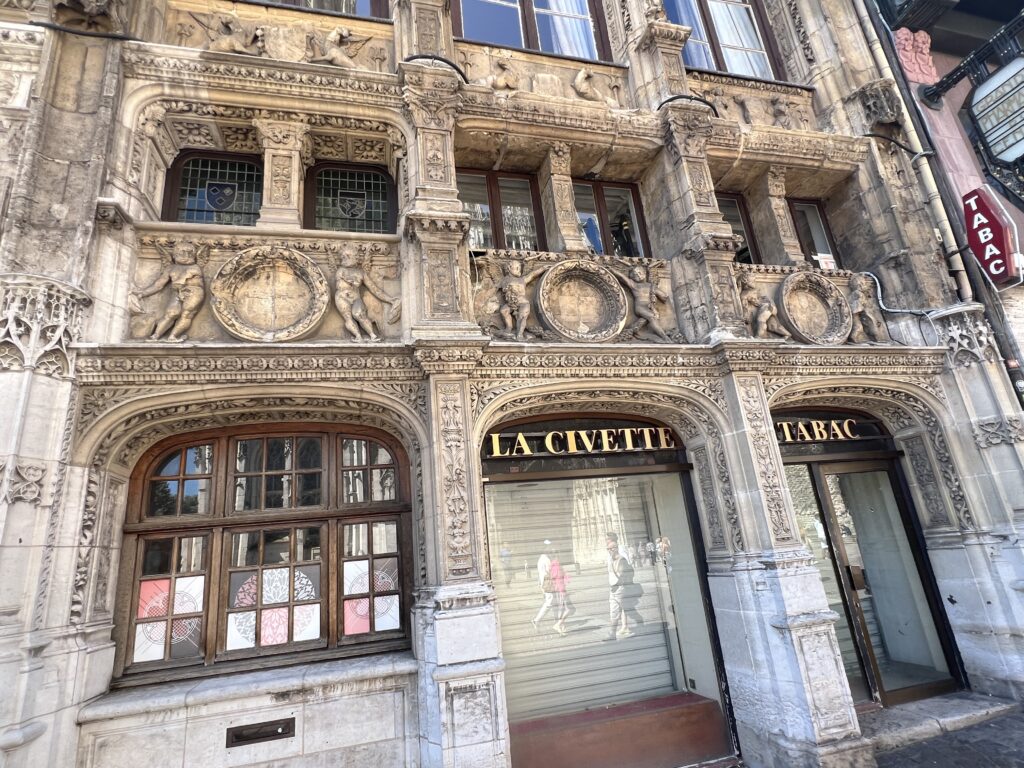
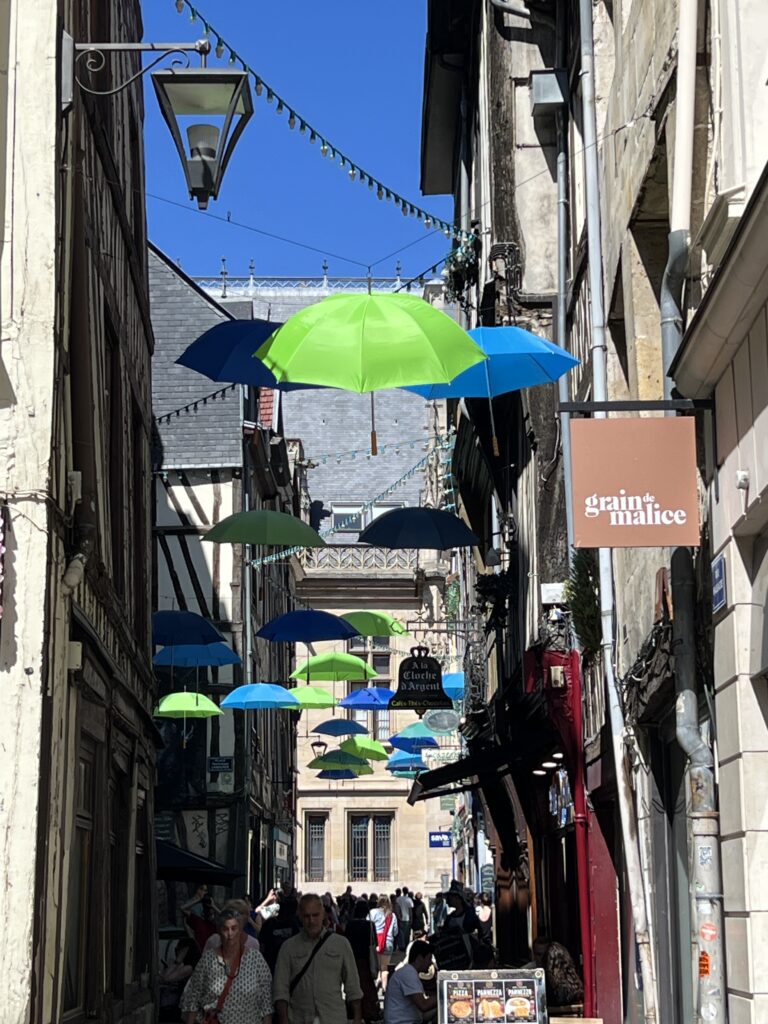
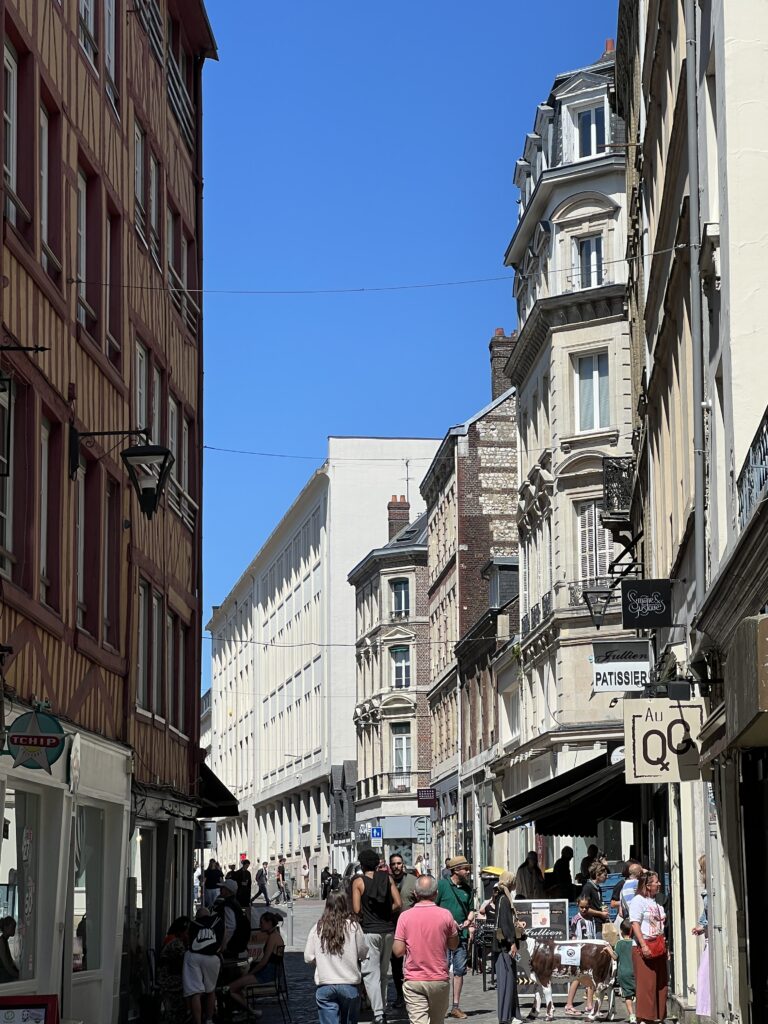
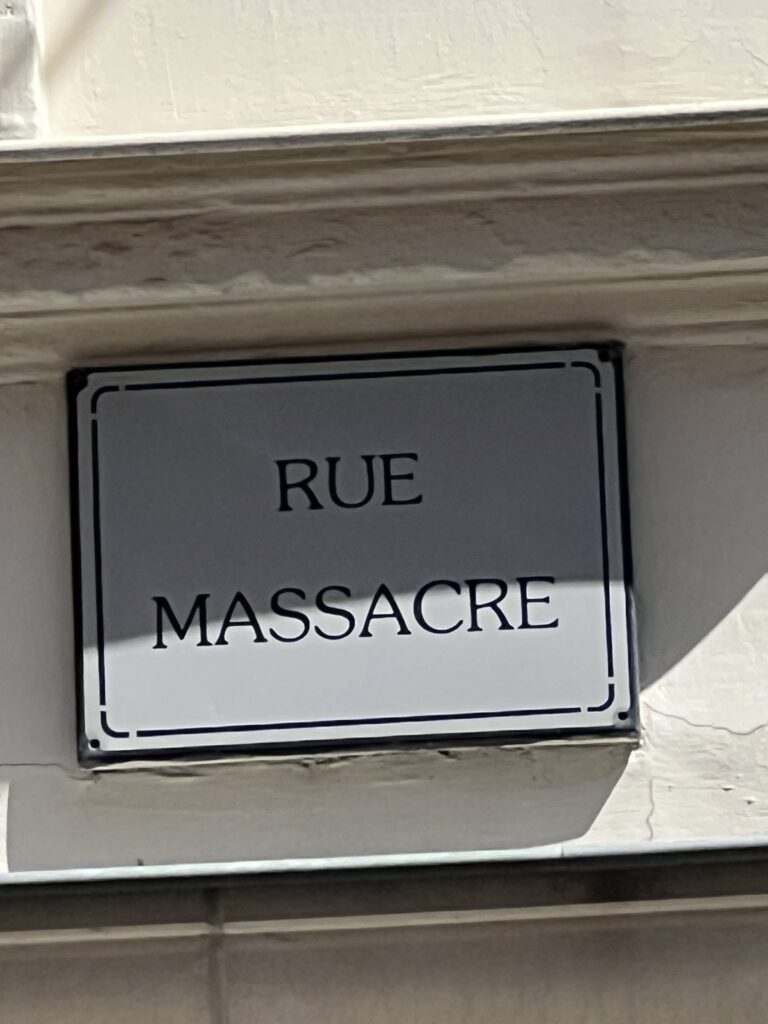
Despite its intimidating name, Rue Massacre in central Rouen, France, is a charming and historic thoroughfare known for its colorful half-timbered buildings and suspended decorations. The name actually dates back to the Middle Ages, when the area was known as Rue des Boucheries Massacres.
The street name does not refer to a violent historical slaughter of people, but rather to the city’s butchers. The Medieval Butcher Shop: In the 15th and 16th centuries, there were no dedicated, outdoor public slaughterhouses. Butchers operated directly on this street, where they slaughtered (“massacred”) animals for meat. Historical Documentation: This origin is officially documented by the prominent local architect and chronicler Jacques Le Lieur in his famous Livre des Fontaines in 1525.
Today, the road is a popular, lively pedestrian shopping street located just a few steps from Rouen’s famous Gros-Horloge (Great Clock).
- It features preserved architecture, boutique shops, and bakeries.
- Depending on the season, the street is frequently decorated with art installations overhead, such as suspended colorful umbrellas or holiday lights.
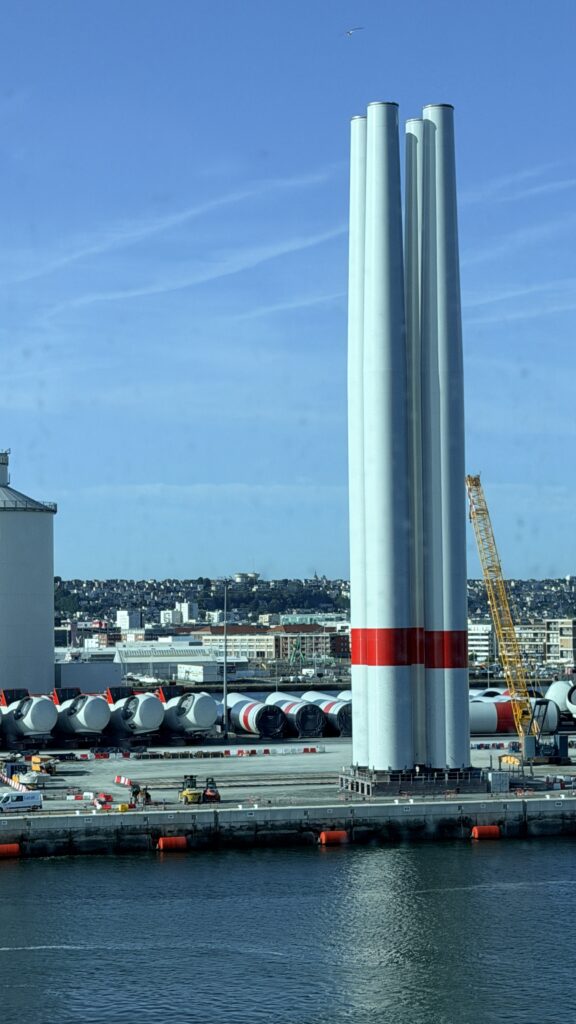
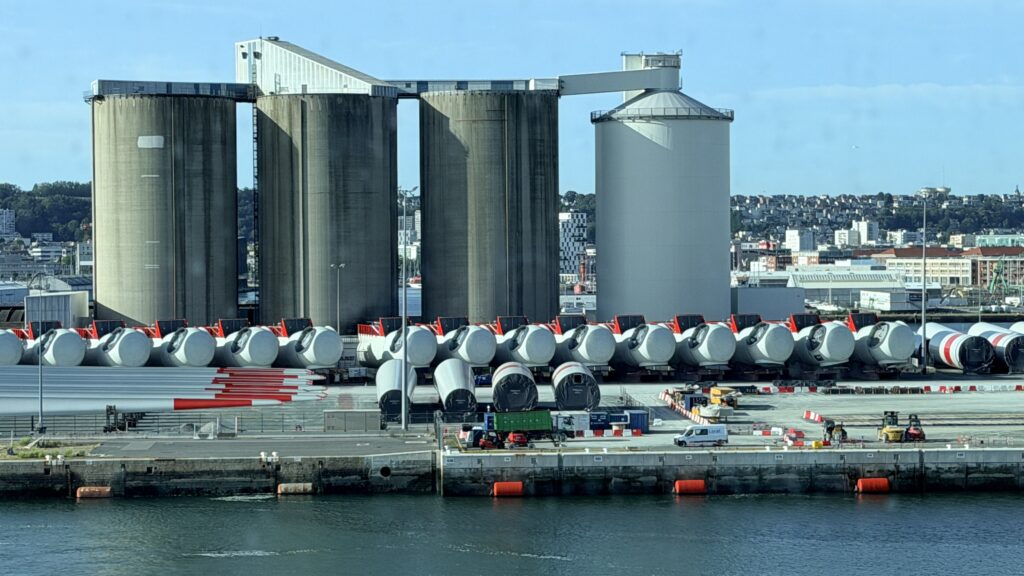
As we were leaving the port of Rouen we saw these huge pieces and did not know what they were.
As part of an annual contract Sarens has with its client Agence Maritime Cherbourg (AMC), the team assisted in the unloading of wind turbine sections at the Port of Rouen in Normandy, France.
The port of Rouen is one of the three ports of Seine Maritime which receives wind turbine parts before they are transported to various parks.
Sarens has an annual contract with AMC to perform the unloading of the wind turbine sections as and when they arrive at the port or need to be transported. According to Samuel Perrier from the Sales Department, “The specific challenge during these unloading operations is the short duration in which the operation needs to be planned and equipment has to be arranged owing to the river and sea constraints.”
Tomorrow we are in the port of Southampton after really enjoying the day in Rouen


4 thoughts on “Day 98 June 13 – Le Havre, France”
Great information and pictures!
Thank you!!! Trip is winding down, it has passed quickly
I am amazed at the construction of such a beautiful church so many years ago. How could such a decorated church be constructed without of the tools we have today. Every worker must have had the skill to produce these beautiful reliefs.
It is very impressive. The photos and videos do not show the churches beauty